
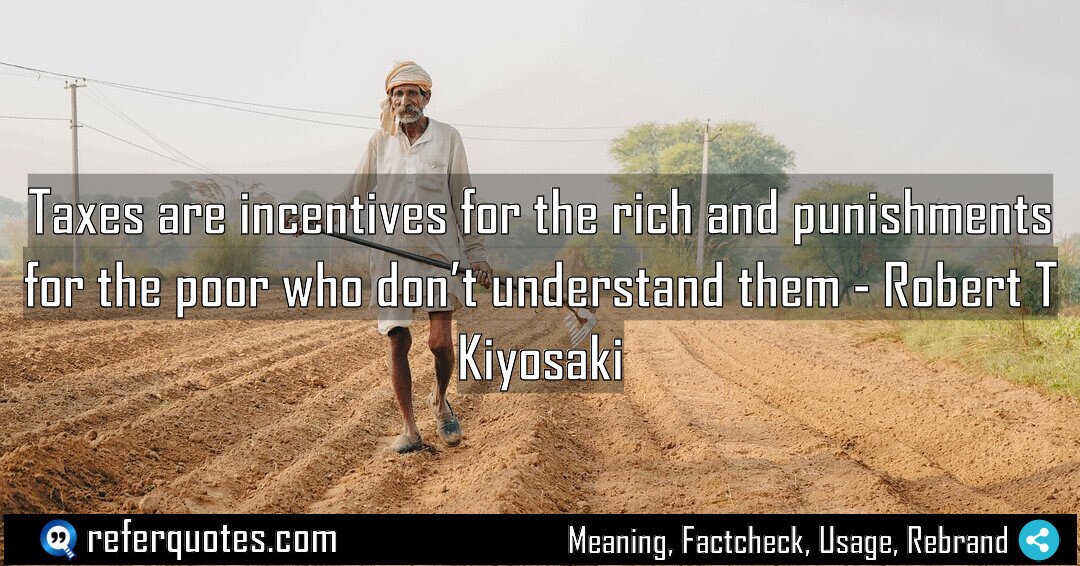
Find Origin, audience, FAQ, author, book and summary of the quote – Taxes are incentives for the rich and punishments for the poor who don’t understand them.
There is a certain discomfort in this statement. It pushes against the comfort of believing the system is uniform for all. Still, hidden inside is an opportunity to reflect and learn.
Share Image Quote:Table of Contents
Meaning
The tax system does not function the same way for everyone. For some it becomes a structure that rewards investment and asset ownership. For others it feels like a constant deduction from earned income. The difference is often knowledge.
Explanation
Those who build assets tend to study the rules that govern money. They treat the tax code as something to understand and work within. They look for lawful deductions. They structure income differently. They plan ahead instead of reacting at the end of the year.
Many hardworking people simply receive a salary and see taxes as something taken before they even touch their earnings. There is little sense of control. The system feels heavy not because it’s complicated, but because it isn’t fully understood.
The deeper message here is not about blame. It is about awareness. Financial literacy changes the experience. When you understand the rules you begin to see options, and you see options you regain a sense of power.
Summary
| Category | Wealth (120) |
|---|---|
| Topics | money (27) |
| Style | analytical (18) |
| Mood | realistic (60) |
Origin & Factcheck
This quote comes straight from Kiyosaki’s 2017 book, Why the Rich Are Getting Richer. It’s a core tenet of his philosophy. You sometimes see this sentiment floating around unattributed online, but it’s definitively his.
| Author | Robert T Kiyosaki (53) |
|---|---|
About the Author
Robert T. Kiyosaki is an entrepreneur, investor, and author of the international bestselling personal finance books that has influenced millions, challenging views on money, and financial independence.
| Official Website | Facebook | X| Instagram | YouTube
Quotation Source:
| Taxes are incentives for the rich and punishments for the poor who don’t understand them |
| Publication Year/Date: 2017, ISBN/Unique Identifier: 9781612680811, Last edition: 1st Edition, Number of pages: 256 |
| Chapter 8, Understanding Taxes, page 140 |
Context
This quote reflects the broader philosophy of Robert Kiyosaki and his book Rich Dad Poor Dad. He often speaks about the limits of traditional education in teaching financial skills. His focus has always been on encouraging people to move from earning only wages to building income through assets and ownership.
Usage Examples
- With a young professional: You see your tax refund as extra money. Let us explore why it exists in the first place and how better planning might reduce the amount withheld during the year.
- In a financial literacy workshop: Instead of viewing taxes as a burden we can begin to see them as a set of rules. Once we understand the rules we can respond wisely within them.
- Debating tax policy: The problem might not be the tax rate itself. It may also be the gap in financial education that shapes how different groups experience the same system.
To whom it appeals?
| Audience | entrepreneurs (204), investors (99), policy analysts (12), students (437) |
|---|---|
This quote can be used in following contexts: finance blogs,business education,economic discussions,financial literacy courses,money management programs
FAQ
Question: Is Kiyosaki saying rich people don’t pay taxes?
Answer: No. The point is that many asset owners use legal provisions within the tax code to reduce their effective rate, while salaried workers often have fewer structural options.
Question: So is this quote advocating for tax evasion?
Answer: No. The distinction is clear between illegal evasion and legal planning. The focus is on learning the lawful strategies available.
Question: What’s the first step to changing from the “punished” to the “incentivized” group?
Answer: Start by learning how different types of income are taxed. Explore ways to build assets that generate cash flow. Small steps in knowledge can slowly change the way the system feels. The shift begins with understanding.