
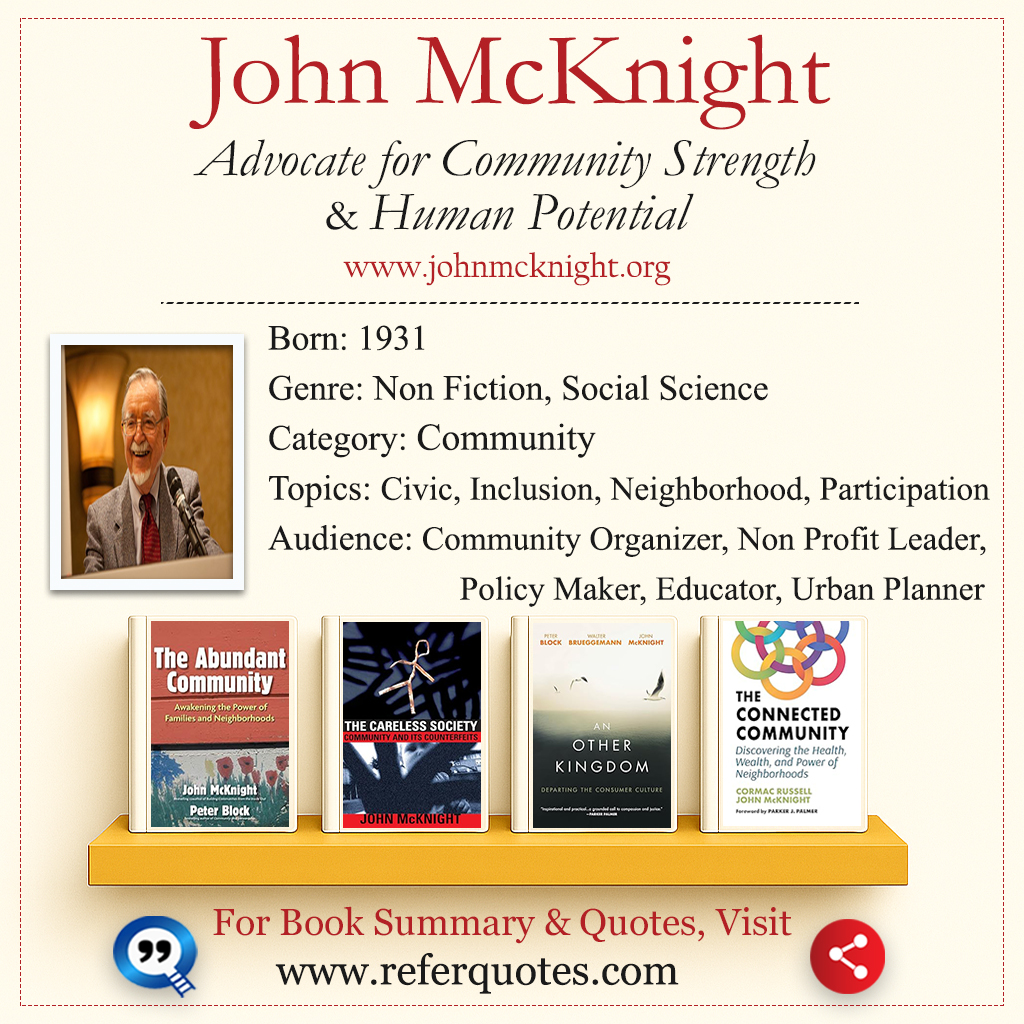
Biography
John McKnight, Professor Emeritus at Northwestern University had spent decades of his life helping people rediscover the power of relationships. Being, co-founder of the ABCD Institute, his core idea revolves around communities that grows by identifying and connecting their assets. You’ll find the John McKnight book list here which are anchored by Building Communities from the Inside Out, The Careless Society, The Abundant Community, and The Connected Community.
Author Summary
| Country | United States (3) |
|---|---|
| Language | English (546) |
| Genre | nonfiction (88), social science (1) |
| Category | Community (7) |
| Topics | civic (1), inclusion (2), neighborhood (2), participation (2), social capital (1) |
| Audiences | Community (10), educators (31), nonprofit leader (1), policy maker (1), urban planner (1) |
Popularity Score
John McKnight Book list
Click book name to see chapterwise and video book summary
John McKnight is a community organizer, educator, and co-founder of the Asset-Based Community Development (ABCD) movement. As Professor Emeritus at Northwestern University and a longtime leader of the ABCD Institute, he has shaped how neighborhoods discover and mobilize local strengths. His collaborations produced field-defining books such as Building Communities from the Inside Out, The Careless Society, The Abundant Community, and The Connected Community. For readers seeking the John McKnight book list, his work centers on practical, people-powered strategies for civic life and resilient local associations.
Interview Questions
How did Asset-Based Community Development (ABCD) begin, and what problem was it trying to solve?
McKnight explains that ABCD emerged from field research showing that communities thrive when they start with their strengths—people’s skills, local associations, and neighborhood institutions—rather than deficits. The approach reframed practice away from needs assessments toward capacity inventories and relationship-building.
Why does he emphasize associations over institutions?
He notes that associations—small, voluntary groups—produce trust, reciprocity, and belonging in ways large systems often cannot. Institutions can support, but they should not replace, the problem-solving and meaning-making that associations generate among neighbors.
What’s a practical first step for communities adopting ABCD?
Start by mapping local assets: catalog neighbor skills, identify active associations, and connect small groups around shared interests. Early, visible wins—like block projects or mutual aid circles—build momentum and demonstrate community capacity.
How does his work connect to public health and safety?
He argues that health and safety grow from social connectedness: friendship networks, youth opportunities, and places for neighbors to gather. Investing in local relationships often yields better outcomes than expanding service delivery alone.
The Abundant Community Quotes
No quotes found for this book.