
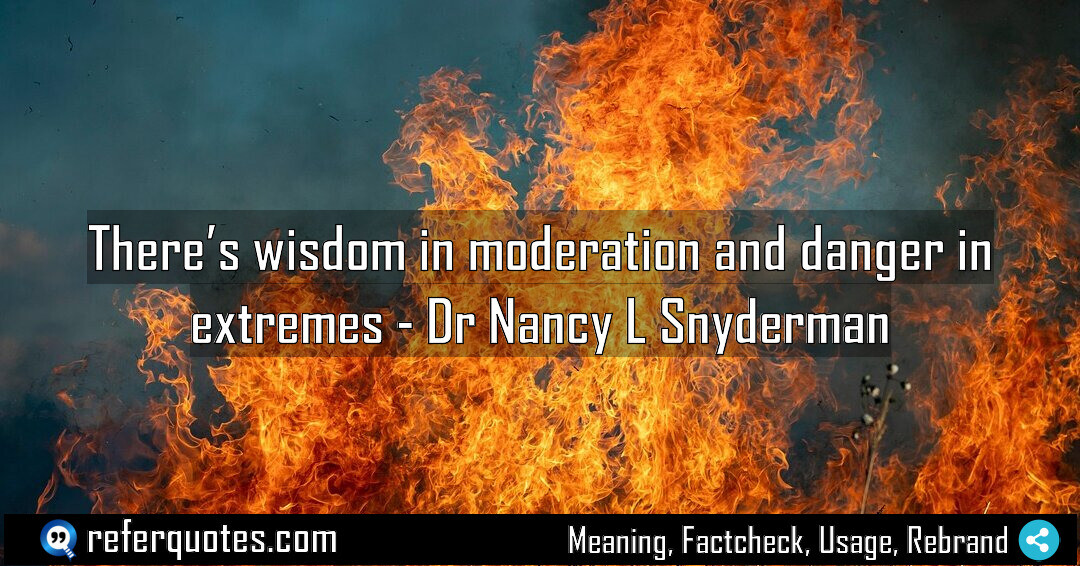
Find meaning, explanation, image, and usage of quote -There’s wisdom in moderation and danger in extremes.
It’s a principle that applies everywhere, from your health to your business strategy.
Share Image Quote:Table of Contents
Meaning
This quote is about balance. It’s the simple, powerful idea that the middle path is often the most sustainable and effective one, while going too far in any one direction almost always leads to problems.
Explanation
This isn’t just a nice saying; it’s a fundamental operating principle. The wisdom in moderation part is about the compound interest of good decisions. It’s the daily, consistent, sustainable effort that builds real, lasting success. It’s not sexy, but it works.
Now, the danger in extremes, that’s where the real damage happens. I’ve watched so many people, in business, in fitness, in life, burn out because they went all-in on an extreme approach. They chase a perfect diet, a 90-hour work week, a radical new strategy. It creates massive fragility. One small setback and the whole thing collapses. Extremes are brittle. Moderation is antifragile.
Summary
| Category | Health (56) |
|---|---|
| Topics | balance (14), moderation (2) |
| Style | proverbial (3) |
| Mood | steady (3) |
Origin & Factcheck
| Author | Dr Nancy L Snyderman (13) |
|---|---|
| Book | Medical Myths That Can Kill You: And the 101 Truths That Will Save, Extend, and Improve Your Life (13) |
About the Author
Dr. Nancy Lynn Snyderman is an physician and award-winning medical journalist with more than 40 years of experience in clinical medicine. Her journalism has earned multiple Emmy Awards.
Quotation Source:
| There’s wisdom in moderation and danger in extremes |
| Publication Year/Date: 2008, ISBN: 978-0345496312, Last Edition: 1st Edition, Number of Pages: 304 |
| Chapter: Balance in Health, Approximate page from 2008 edition |
Context
She’s using this in a medical context, and it’s brilliant. She’s talking about how patients often swing from ignoring a health problem completely to panicking and seeking out extreme, unproven cures. Her point is that the real path to health isn’t in those extremes; it’s in the moderate, consistent, evidence-based practices, the boring stuff that actually works long-term.
Usage Examples
You can apply this tomorrow. Here’s how:
- For a team struggling with burnout: “Look, pulling all-nighters is an extreme. So is completely disengaging. The wisdom is in moderate, focused work hours with clear boundaries. That’s how we win without burning out.”
- For a client obsessed with a fad diet: That keto/paleo/juice cleanse is an extreme. The danger is your metabolism and energy crashing. The wisdom is in a moderate, balanced diet you can actually maintain.
- For an entrepreneur: Putting all our ad spend on one untested channel is an extreme. The wisdom is in a moderate, diversified marketing mix where we can test and learn without betting the company.
To whom it appeals?
| Audience | nutritionists (8), patients (21), students (397), trainers (13) |
|---|---|
This quote can be used in following contexts: wellness programs,public health talks,diet counseling
FAQ
Question: Isn’t moderation just another word for being average or mediocre?
Answer: That’s the biggest misconception. No. Mediocrity is about low effort. Moderation is about optimal, sustainable effort. It’s the difference between jogging 3 times a week for years and running a marathon with no training, getting injured, and never running again .
Question: But don’t you need extreme action to achieve breakthrough results?
Answer: Sometimes, for a very short, defined sprint. But you can’t sprint a marathon. Breakthroughs are usually the result of moderate, consistent pressure applied intelligently over a long period, not a single, chaotic explosion of effort.
Question: How do you know when you’re in moderation versus just being lazy?
Answer: It comes down to intentionality and consistency. Laziness is avoidance. Moderation is a conscious strategy. You’re making a deliberate choice to do what is effective and repeatable, not what is easy.