
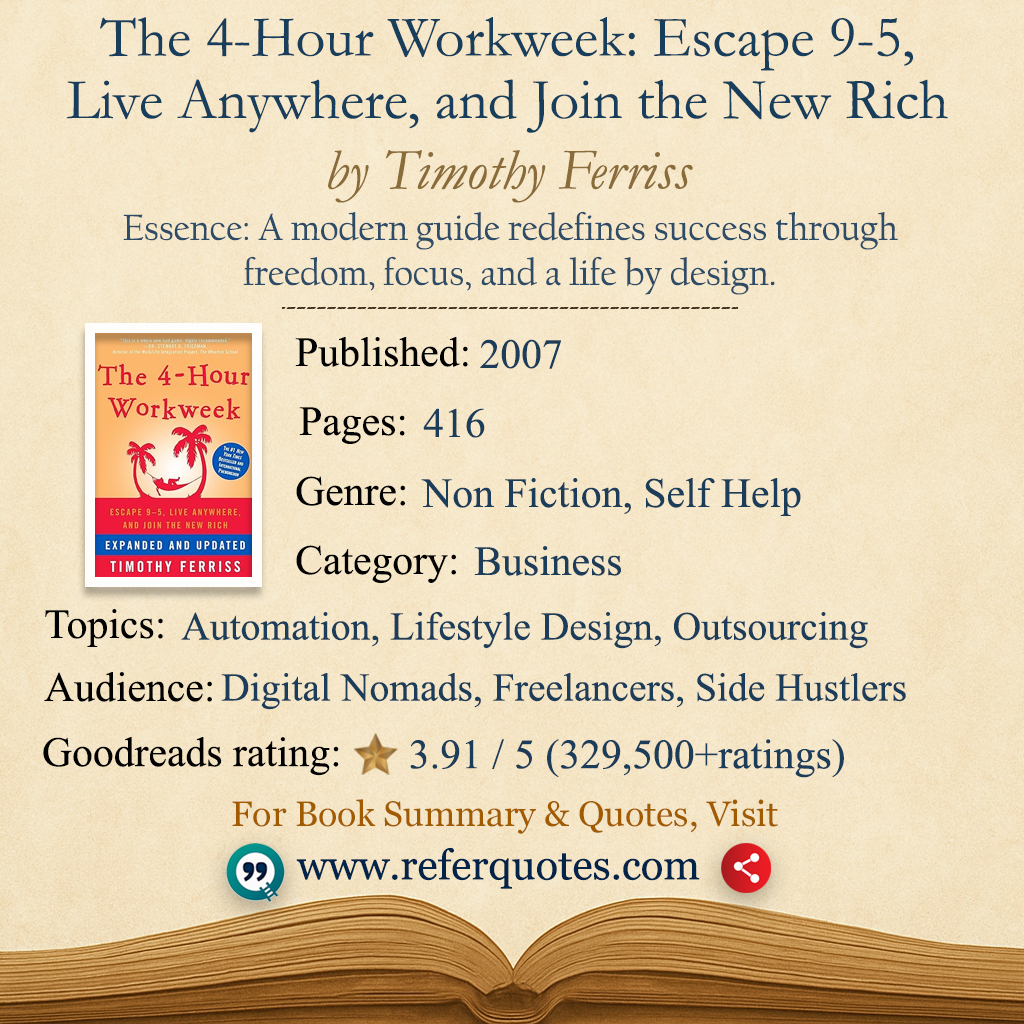
The 4-Hour Workweek: Escape 9-5, Live Anywhere, and Join the New Rich by Timothy Ferriss – this is the The 4-Hour Workweek book summary you’re searching for. It contains a practical blueprint (the D.E.A.L. method) for designing a flexible life: define what you want, eliminate time-wasters, automate income, and liberate yourself from the office. Ferriss, entrepreneur, investor, and author, packs in scripts, tools, and case studies to help you work less and live more. You’ll learn how to outsource, test “muses,” negotiate remote work, and take mini-retirements, with templates that cut guesswork.
Key takeaways:
- Design income around life, not life around income.
- Use 80/20, automation, and mini-retirements to reclaim time and freedom.
Book Summary
| Language | English (548) |
|---|---|
| Published On | 2007 (4) |
| Timeperiod | 21st Century (226) |
| Genre | nonfiction (88), self-help (89) |
| Category | Business (40) |
| Topics | automation (2), lifestyle design (2), outsourcing (1), remote work (1), time management (10) |
| Audiences | digital nomads (5), entrepreneurs (194), freelancers (6), knowledge workers (3), side hustlers (1) |
Table of Contents
- What’s Inside The 4-Hour Workweek: Escape 9-5, Live Anywhere, and Join the New Rich
- Book Summary
- Chapter Summary
- The 4-Hour Workweek: Escape 9-5, Live Anywhere, and Join the New Rich Insights
- Usage & Application
- Life Lessons
- FAQ
- Famous Quotes from The 4-Hour Workweek: Escape 9-5, Live Anywhere, and Join the New Rich
What’s Inside The 4-Hour Workweek: Escape 9-5, Live Anywhere, and Join the New Rich
Synopsis
Ferriss offers a step-by-step plan to escape the 9–5 by eliminating nonessential work, automating income with small “muse” businesses, and negotiating freedom to live anywhere through remote work and mini-retirements.
Book Summary
The 4-Hour Workweek book summary distills Tim Ferriss’s D.E.A.L. framework, Definition, Elimination, Automation, Liberation, into actionable steps for designing a life around freedom, not the office. The book talks about identifying high-leverage goals, cutting 80% of tasks, outsourcing and systemizing, and using remote work and mini-retirements to reclaim time. It’s important because it flips the script on deferred-life plans, showing you how to build income streams that serve your life now. The ideas resonate with universal trade-offs, time vs. money, risk vs. regret, and provide scripts, tools, and experiments to test safely.
Key takeaways:
- Use 80/20 and Parkinson’s Law to cut workload fast.
- Prototype a “muse” with tiny tests before investing big.
- Outsource routine tasks to free cognitive bandwidth.
- Negotiate remote work and create absence systems.
- Plan mini-retirements to practice the life you want.
Chapter Summary
- Preface: A warning and promise, why lifestyle design beats the deferred-life plan.
- 1. D is for Definition: The New Rich mindset and “dreamlining.”
- 2. Rules That Change the Rules: Case studies and comfort challenges.
- 3. Dodging Bullets: Fear-setting and risk calibration.
- 4. System Reset: Redefining wealth and time freedom.
- 5. E is for Elimination: 80/20 and Parkinson’s Law for ruthless focus.
- 6. The Low-Information Diet: Managing inputs to reclaim attention.
- 7. Interrupting Interruption: Batch, gatekeep, and set boundaries.
- 8. A is for Automation: Outsourcing life, assistants, SOPs, and tools.
- 9. Income Autopilot I: Finding a “muse” (simple, scalable product).
- 10. Income Autopilot II: Testing (ads, landing pages, conversion).
- 11. Income Autopilot III: MBA-Management by Absence.
- 12. L is for Liberation: Escape the office, prove remote productivity.
- 13. Disappearing Act: Scripts for negotiating flexibility.
- 14. Mini-Retirements: Geoarbitrage and designing meaningful time off.
- 15. Filling the Void: Avoiding aimlessness; building purpose and play.
The 4-Hour Workweek: Escape 9-5, Live Anywhere, and Join the New Rich Insights
| Book Title | The 4-Hour Workweek |
| Book Subtitle | Escape 9-5, Live Anywhere, and Join the New Rich |
| Author | Timothy Ferriss |
| Publisher | Crown Publishing Group (Random House) |
| Translation | Original language: English; no translation required |
| Details | Publication Year/Date: 2007; ISBN: 9780307353139; Last Edition: Expanded and Updated Edition (2009); Number of Pages: 416. |
| Goodreads Rating | 3.91 / 5 – 329,500 ratings – 10,000 reviews |
About the Author
Timothy Ferriss writes and builds systems that help people work less and achieve more. His books focus on body optimization, accelerated learning, and distilled tactics from top performers.
| Official Website | Facebook | X| Instagram | YouTube
Usage & Application
How to Use This Book
You’re busy, but output isn’t moving. Start with a 48-hour sprint: list your top 20 tasks, circle the 4 that drive 80% of results, and eliminate, automate, or outsource the rest.
Scenario 1: You manage a small ecom store, hire a vetted VA for customer email and returns (2 hours saved daily), set canned responses, and batch support at 4 p.m.
Scenario 2: You’re an analyst, write a 1-page remote pilot plan with KPIs (tickets closed + turnaround), test 2 days/week for 30 days, and report a 25% productivity gain to secure permanent flexibility.
Scenario 3: Test a “muse” using $150 in ads, track CAC and conversion, and iterate weekly. Cut noise, buy time with systems, and stair-step freedom, then double down on what compounds.
Video Book Summary
Life Lessons
- Time is the scarcest currency, optimize for autonomy, not busyness.
- Small, reversible tests beat big, irreversible bets.
- Say “no” more: constraint creates focus, and focus creates leverage.
- Design systems so value flows without your constant presence.
- Freedom requires intention, schedule it, or work will fill the void.