
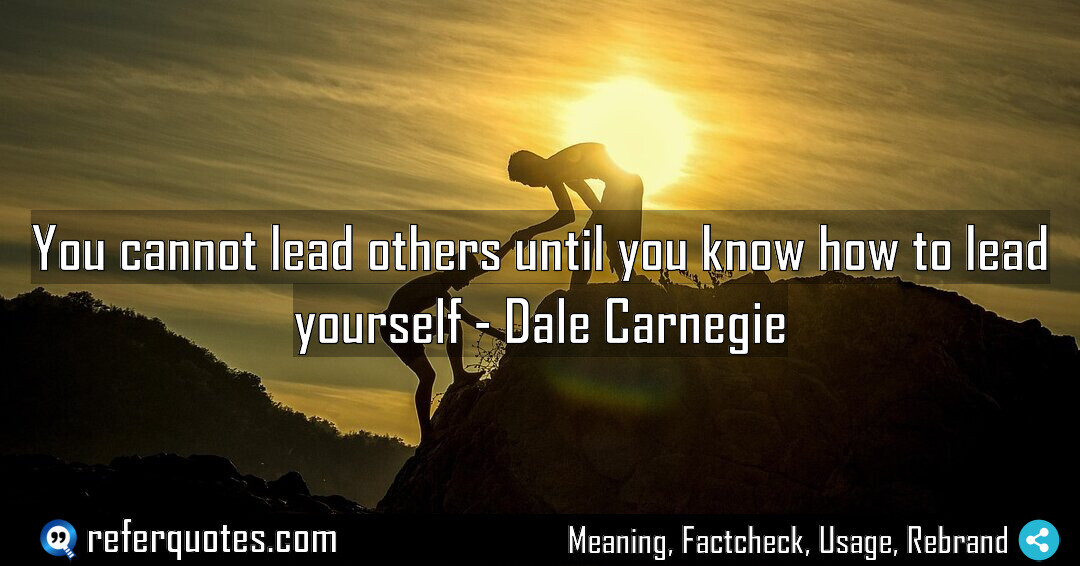
Find summary, explanation, image, and usage of quote-You cannot lead others until you know how to lead yourself.
It’s a simple truth, but one that flips the entire leadership script on its head. It’s not about your title, it’s about your internal state.
Share Image Quote:Table of Contents
Meaning
This quote means that effective leadership is an inside job. Your ability to guide a team is directly proportional to your ability to guide yourself.
Explanation
I’ve seen so many managers try to lead by just giving orders. It never, ever works long-term. Why? Because people don’t follow a title, they follow a person. They follow someone whose behavior they respect.
Leading yourself, that’s the real work. It means managing your emotions when a project goes sideways. It means having the discipline to do the hard thing first. It means taking ownership of your mistakes instead of deflecting. When you do that, you build a kind of quiet credibility that no MBA can teach. Your team sees you walking the walk, and that, that is what inspires them to do the same. Your self-leadership becomes the blueprint for the entire team’s culture.
Summary
| Category | Personal Development (79) |
|---|---|
| Topics | growth (36), leadership (45) |
| Style | clear (40), memorable (56) |
| Mood | calm (58), reflective (52) |
Origin & Factcheck
| Author | Dale Carnegie (174) |
|---|---|
| Book | The Leader In You (84) |
About the Author
Dale Carnegie, an American writer received worldwide recognition for his influential books on relationship, leadership, and public speaking. Among his timeless classics, the Dale Carnegie book list includes How to Win Friends and Influence People is the most influential which inspires millions even today.
Official Website
Quotation Source:
| You cannot lead others until you know how to lead yourself |
| Publication Year/Date: 1993 (first edition) ISBN/Unique Identifier: 9781501181962 (Gallery Books 2017 reprint); also 9780671798093 (early Pocket Books hardcover) Last edition. Number of pages: Common reprints ~256 pages (varies by printing). |
| Chapter: Self-Mastery, Approximate page from 1993 edition |
Context
In the book, this idea is the foundation. Before it dives into communication or team-building, it establishes that everything starts with self-awareness and personal integrity. It defined leadership not as a position you’re given, but as a person you choose to become, day by day.
Usage Examples
For the new manager feeling imposter syndrome: Instead of trying to act like a boss, focus on acting with integrity. Admit when you’re unsure. Be the most prepared person in the room. That’s self-leadership, and your team will notice.
For the seasoned executive: Your biggest lever isn’t another corporate initiative, it’s your own example. Are you demonstrating the resilience, curiosity, and work ethic you want to see scaled across the company?
For the individual contributor with no direct reports, You lead projects, you lead client relationships, you lead by influencing your peers. Mastering your own focus, motivation, and communication is your most powerful career tool.
To whom it appeals?
| Audience | coaches (129), leaders (295), managers (142), students (437), teachers (193) |
|---|---|
This quote can be used in following contexts: leadership training,career coaching,mentorship programs,motivational events,self-development workshops
FAQ
Question: Does this mean I have to be perfect before I can lead?
Answer: No. That’s a common misunderstanding. It’s not about perfection, it’s about awareness and effort. It’s about being conscious of your flaws and actively working on them. Showing that you’re a work in progress is more relatable and inspiring than pretending you have it all figured out.
Question: What are the first steps to leading myself?
Answer: Start brutally small. Master your calendar, show up on time, end meetings when you said you would. Get a handle on your emotional reactions, take a breath before responding to a frustrating email. It’s these tiny, consistent acts of self-command that build the foundation.
Question: Can you really not lead others at all without self-leadership?
Answer: You can command. You can manage. But to truly lead, to inspire people to bring their best selves to a shared goal, requires that internal foundation. Without it, you’re just pushing people, not guiding them. And people hate being pushed.