
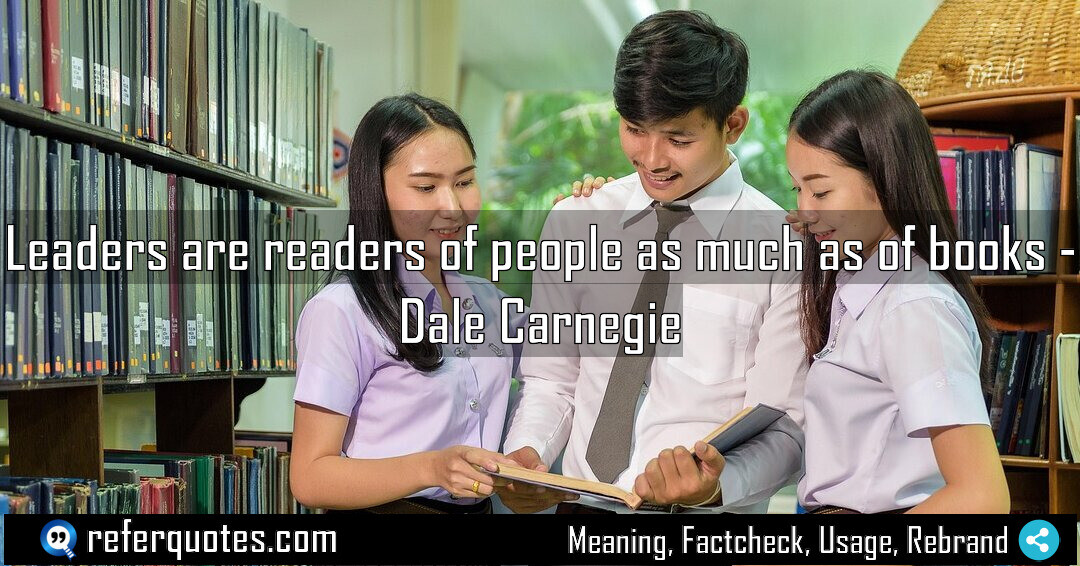
Find summary, FAQ, image, and usage of quote-Leaders are readers of people as much as of books
It’s not just about strategy, it’s about truly understanding the human beings on your team. Get this right, and everything else becomes easier.
Share Image Quote:Table of Contents
Meaning
The writer’s message here is that leadership is a dual discipline. It’s not enough to be book-smart, you have to be people-smart. You need to be able to read the room, the individual, the unspoken dynamics, just as you would read a text.
Explanation
This quote changes that on its head. It tells you that your most important skill isn’t just digesting market reports or financial statements, it’s decoding human behavior. It’s about noticing the slight shift in someone’s tone that says they’re overwhelmed, or the spark in their eyes when they’re passionate about an idea. That’s the real work. That’s where trust is built and where you unlock a team’s true potential. It’s the difference between being a boss and being a leader.
Summary
| Category | Skill (85) |
|---|---|
| Topics | awareness (8), connection (35), understanding (8) |
| Style | memorable (53), simple (29) |
| Mood | provocative (22), realistic (54) |
Origin & Factcheck
| Author | Dale Carnegie (162) |
|---|---|
| Book | The Leader In You (84) |
About the Author
Dale Carnegie, an American writer received worldwide recognition for his influential books on relationship, leadership, and public speaking. Among his timeless classics, the Dale Carnegie book list includes How to Win Friends and Influence People is the most influential which inspires millions even today.
Official Website
Quotation Source:
| Leaders are readers of people as much as of books |
| Publication Year/Date: 1993 (first edition) ISBN/Unique Identifier: 9781501181962 (Gallery Books 2017 reprint); also 9780671798093 (early Pocket Books hardcover) Last edition. Number of pages: Common reprints ~256 pages (varies by printing). |
| Chapter: Understanding People, Approximate page from 1993 edition |
Context
In the book, this idea sits at the heart of modernizing Carnegie’s timeless principles for a corporate audience. The context is all about shifting from a command-and-control leadership model to one that’s empathetic and collaborative. It positions emotional intelligence not as a soft skill, but as the essential, hard currency of effective leadership.
Usage Examples
- For a manager in a one-on-one: Instead of just running through a task list, you read your employee. Are they avoiding eye contact? Sounding less enthusiastic than usual? That’s your cue to dig deeper with, “You seem a bit quiet today, is everything okay with the project load?” That’s reading the person.
- In a team meeting: You pitch an idea and instead of just listening for verbal agreement, you’re scanning the room. You see crossed arms, a few people exchanging glances. That’s data. You can then say, “I’m throwing out an idea, but I want to hear your thoughts. What are we missing?” You’re reading the group dynamic and course-correcting in real-time.
- For anyone mentoring someone: You tell them, “Your technical skills are fantastic, but let’s work on your people-reading skills. Start by just observing body language in your next meeting.” You’re giving them a practical, actionable way to develop this crucial leadership muscle.
To whom it appeals?
| Audience | coaches (119), leaders (268), managers (140), students (397), teachers (180) |
|---|---|
This quote can be used in following contexts: communication workshops,leadership development,education programs,team management,emotional intelligence training
FAQ
Question: Can you really learn to read people, or is it just an innate talent?
Answer: You can learn it. It starts with simple observation and curiosity. Most of us are just on autopilot. Start by consciously looking for non-verbal cues, posture, facial expressions, energy levels. It’s a skill that improves with practice, like any other.
Question: Doesn’t this lead to overthinking and misinterpreting people?
Answer: It can, if you’re not careful. The key isn’t to assume you know what a sigh means. It’s to use your observation as a starting point for a conversation. “I noticed you sighed when I mentioned the deadline, what’s on your mind?” Reading people gives you the questions to ask, not necessarily the answers.
Question: Is this more important than being an expert in your field?
Answer: For a leader, I’d argue yes. Your technical expertise gets you in the door, but your ability to understand and motivate people is what builds a high-performing team that can execute on that expertise. You can hire technical skills, leadership is about harnessing them.