
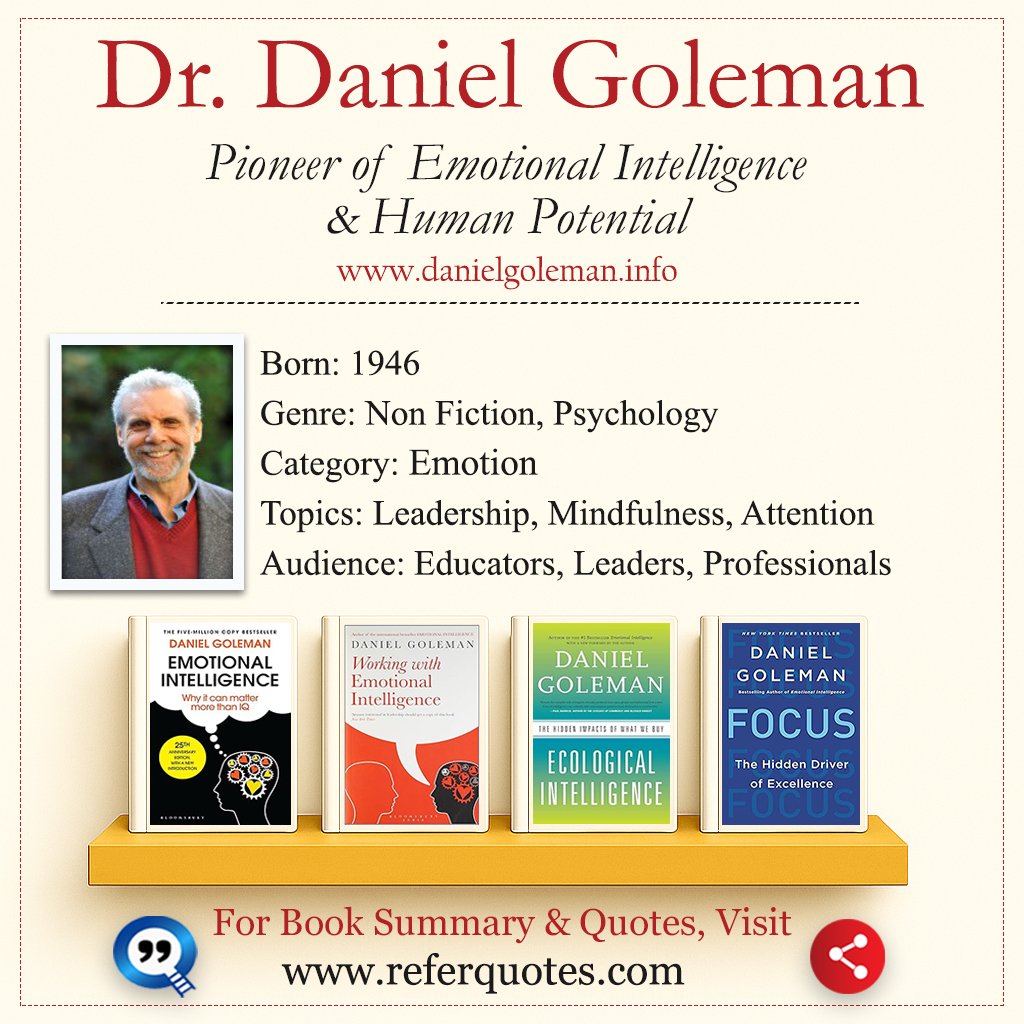
Biography
Daniel Goleman is a psychologist and bestselling author whose journalism at The New York Times brought brain and behavior science to a wide audience. He earned a BA from Amherst and a PhD in psychology from Harvard, and studied in India on a Harvard fellowship. Goleman’s research and writing helped mainstream emotional intelligence, leadership competencies, attention, and contemplative science. He co-founded CASEL and a leading research consortium on EI at work. The Daniel Goleman book list includes Emotional Intelligence, Working with Emotional Intelligence, Primal Leadership, Social Intelligence, Focus, and Altered Traits.
Author Summary
| Language | English (577) |
|---|---|
| Born On | 1946 (1) |
| Genre | nonfiction (88), psychology (18) |
| Category | Emotion (15) |
| Topics | attention (10), emotional intelligence (2), leadership (44), mindfulness (7), social skill (3) |
| Audiences | educators (31), leaders (287), managers (140), professionals (129), students (425) |
Dr Daniel Goleman Book list
Click book name to see chapterwise and video book summary
Dr. Daniel Goleman is an American psychologist, author, and former New York Times science journalist best known for popularizing emotional intelligence. His work bridges psychology, leadership, and education, showing how self-awareness, self-regulation, empathy, and social skill drive performance and well-being. A frequent speaker and advisor to organizations, he co-founded CASEL and the Consortium for Research on Emotional Intelligence in Organizations. Explore the Daniel Goleman book list to find titles like Emotional Intelligence, Primal Leadership, Social Intelligence, Focus, and Altered Traits.
Interview Questions
Vital Lies, Simple Truths Quotes
No quotes found for this book.
The Meditative Mind Quotes
No quotes found for this book.
Working with Emotional Intelligence Quotes
No quotes found for this book.