
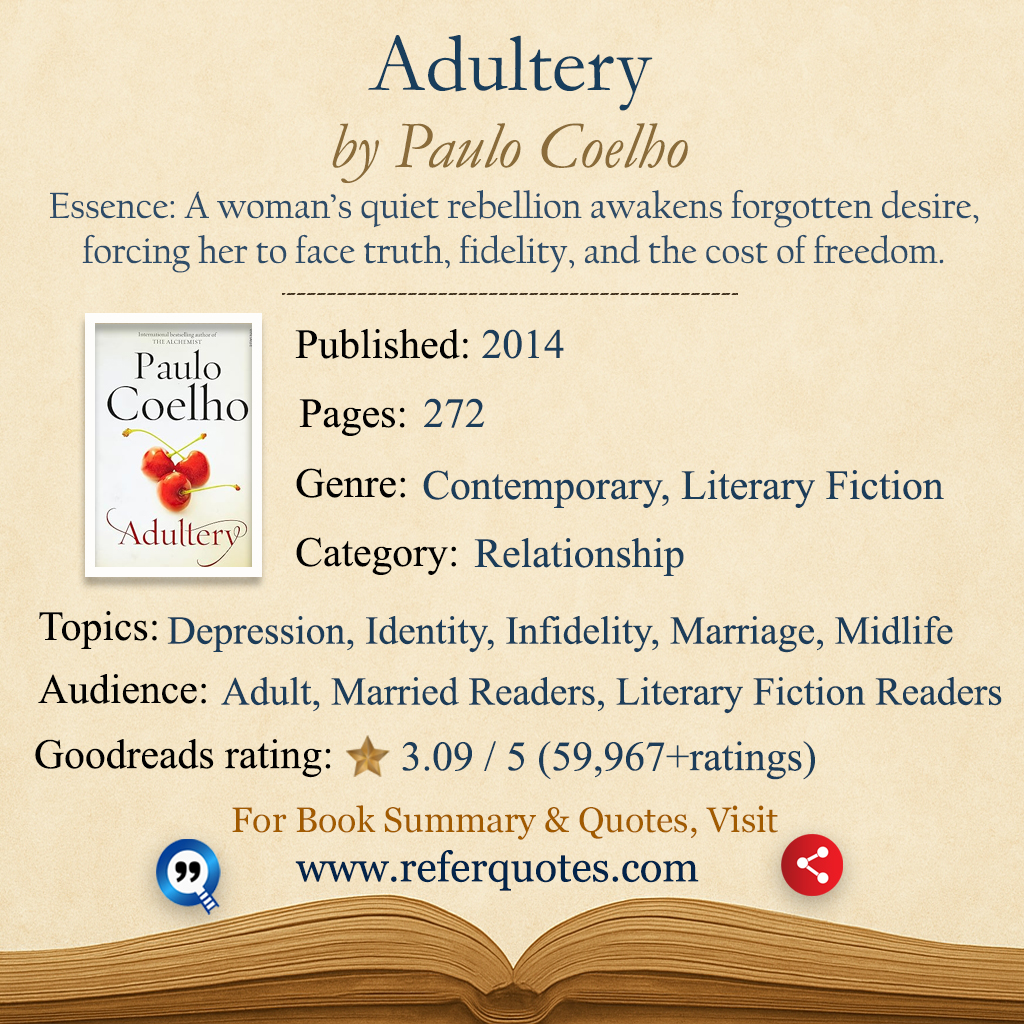
Adultery by Paulo Coelho is a provocative novel that many readers search for under “Adultery book summary.” Written by Paulo Coelho, it explores a successful Geneva journalist whose hidden void pushes her into an affair that upends the facade of a perfect life. What does this book contain? A candid look at desire, routine, depression, and the sacred messiness of marriage. Coelho blends psychological drama with spiritual inquiry to confront why we risk everything we love for a taste of feeling alive.
- Midlife longing meets moral consequences in a modern marriage.
- A fast, intimate read on identity, desire, and the cost of truth.
Book Summary
| Language | Portuguese (47) |
|---|---|
| Published On | 2014 (2) |
| Timeperiod | Contemporary (218) |
| Genre | contemporary (1), literary fiction (5) |
| Category | Relationship (60) |
| Topics | depression (1), identity (13), infidelity (1), marriage (4), midlife (1) |
| Audiences | adults (2), Book (13), fans of literary fiction (1), married readers (1) |
Table of Contents
- What’s Inside Adultery
- Book Summary
- Chapter Summary
- Adultery Insights
- Usage & Application
- Life Lessons
- FAQ
- Famous Quotes from Adultery
What’s Inside Adultery
Synopsis
A Geneva journalist with a perfect life feels numb, rekindles a risky affair with a former lover, and is forced to confront desire, depression, and the meaning of love, fidelity, and freedom.
Book Summary
Adultery book summary: Paulo Coelho’s novel follows Linda, a successful Swiss journalist who appears to “have it all” yet secretly feels hollow. When she reconnects with Jacob, a former boyfriend-turned-politician, an affair spirals into obsession, forcing her to confront fear, numbness, and the fragile architecture of marriage. What does this book talk about? The cost of desire, the seduction of routine, and the hard work of choosing love after disillusionment. Why is this novel important? It captures a modern midlife crisis with spiritual clarity, showing how seeking intensity can either destroy or deepen commitment when paired with honesty and responsibility.
- Emotional thriller of conscience: temptation, secrecy, and consequence.
- Lens on depression and the search for meaning beneath success.
- Explores how truth-telling can rebuild or rupture a marriage.
- Invites reflection on passion versus stability in long-term love.
Chapter Summary
Adultery Insights
| Book Title | Adultery |
| Author | Paulo Coelho |
| Publisher | Alfred A. Knopf |
| Translation | Originally in Portuguese (Adultério, 2014); English translation by Margaret Jull Costa, 2014. |
| Details | Publication Year: 2014 (Brazil); ISBN: 978-0-385-34896-0; Latest Edition: Vintage International 2015; 272 pages. |
| Goodreads Rating | 3.09 / 5 - 59,967 ratings - 5,359 reviews |
About the Author
Paulo Coelho is a Brazilian novelist known for weaving spirituality and philosophy into stories that feel both magical and real. 165 million copies sold with readers in 80+ languages
Official Website |Facebook | Instagram | YouTube |
Usage & Application
How to Use This Book
You can apply this book’s insights in real life immediately.
First, if you feel “stuck” in routine, audit your week: track energy highs/lows in 30-minute blocks for 7 days, then reallocate 20% of your time toward activities that score 8/10 for meaning.
Second, if you’re battling temptation, set a 72-hour rule: delay any high-stakes emotional decision (email, meeting, secret) for three days; discuss the impulse with one trusted person before acting.
Third, for couples, run a monthly “State of Us” meeting: each partner shares one unmet need, one appreciation, and one experiment (e.g., tech-free walks, new shared hobby). These small, consistent moves deliver compounding returns, less secrecy, more clarity, and deeper connection, without the collateral damage of impulsive choices.
Video Book Summary
Life Lessons
- Intensity is not intimacy; lasting love is built on daily truth, not secret thrills.
- Routine can numb purpose; intentional novelty revives meaning without betrayal.
- Unchecked emptiness escalates into risk-taking, name it early, out loud.
- Desire needs boundaries; commitment needs curiosity.
- Radical honesty is painful but often the shortest path back to trust.