
Book Summary
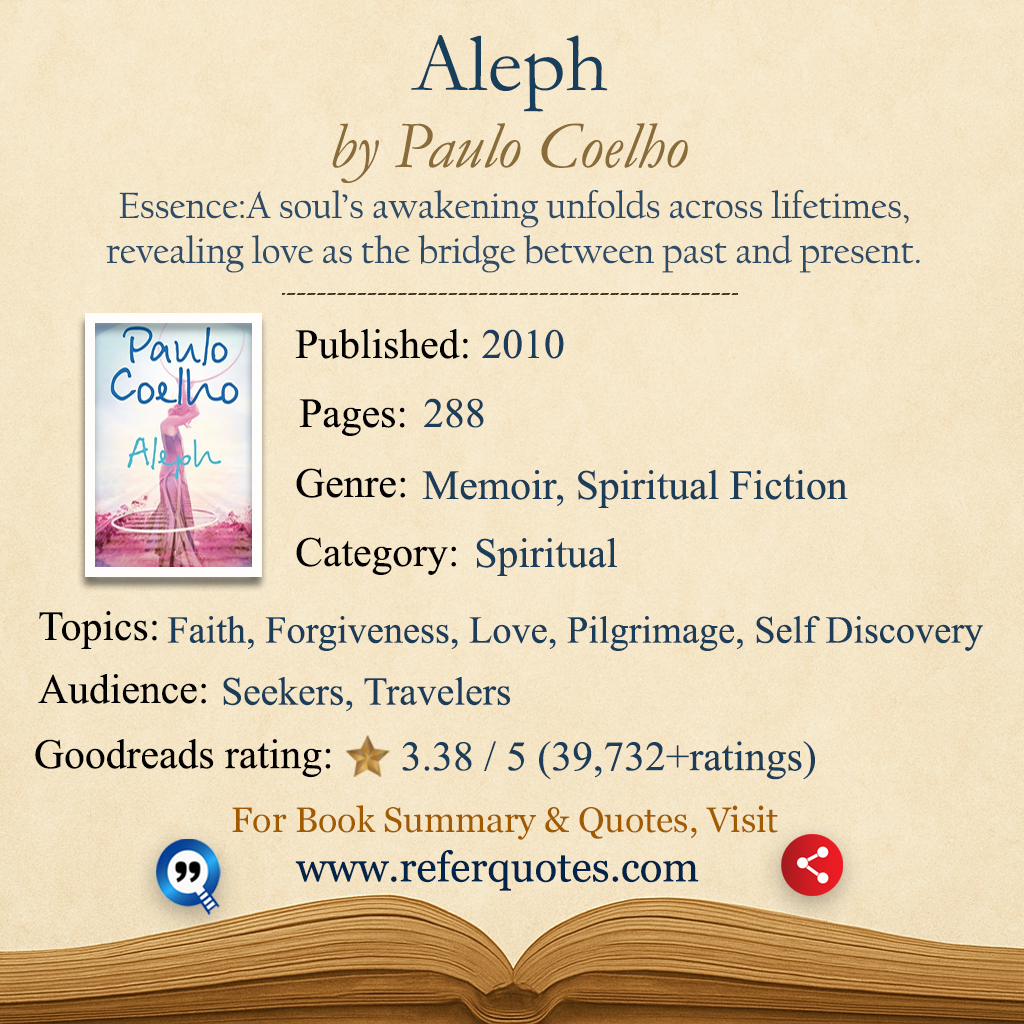
| Language | Portuguese (47) |
|---|---|
| Published On | 2010 (7) |
| Timeperiod | Contemporary (218) |
| Genre | memoir (3), spiritual fiction (1) |
| Category | Spiritual (28) |
| Topics | faith (20), forgiveness (9), love (8), pilgrimage (2), self-discovery (6) |
| Audiences | Book (13), seekers (44), travelers (9) |
Table of Contents
- What’s Inside Aleph
- Book Summary
- Chapter Summary
- Aleph Insights
- Usage & Application
- Life Lessons
- FAQ
- Famous Quotes from Aleph
What’s Inside Aleph
Synopsis
On a transcontinental journey, Paulo Coelho confronts creative drift and unresolved karma, encounters the mystical Aleph, and, through Hilal, faces the past to reclaim forgiveness, presence, and spiritual momentum.
Book Summary
Aleph book summary: Paulo Coelho’s Aleph is a lean, autobiographical novel about a midlife spiritual reboot. After sensing that his growth has stalled, Coelho embarks on a global book tour, most intensely across the Trans-Siberian Railway, where he meets Hilal, a young violinist whose presence triggers vivid memories of a shared past life. What does this book talk about? The collision of fate, memory, and the present moment inside the mystical “Aleph,” a point where all times converge, enabling deep healing and forgiveness. Why is this book important? It shows that transformation often begins with movement, radical honesty, and the courage to forgive, yourself first.Key takeaways:- Forgiveness is the fastest route out of spiritual stagnation.- Physical travel can unlock interior change when intention is clear.- The present moment holds the power to revise the past’s grip. Love, offered without demand, dissolves lingering karmic knots.
Chapter Summary
- Departure: Feeling stalled, Paulo resolves to move, physically and spiritually, to reawaken purpose.
- Trans-Siberian Crossing: Rituals, coincidences, and discipline test his resolve on the rails.
- Meeting Hilal: A gifted violinist forces him to face a painful, shared past.
- Encounters with Faith: Dialogues, signs, and small miracles refine his understanding of destiny.
- The Aleph: In a singular mystical point, time collapses, revealing truth and a path to healing.
- Reckoning and Forgiveness: He practices accountability and releases what binds him.
- Return: Movement completes a circle; renewed clarity replaces spiritual drift.
Note: These are thematic movements, not official chapter titles.
Aleph Insights
| Book Title | Aleph |
| Author | Paulo Coelho |
| Publisher | Editora Sextante (Brazil, 2010, original Portuguese); Alfred A. Knopf (U.S., English translation, 2011). |
| Translation | Translated from Portuguese (O Aleph) into English by Margaret Jull Costa, 2011. |
| Details | Publication Year: 2010 (Brazil); ISBN: 978-0-307-58845-4; Latest Edition: Vintage International 2012; 288 pages. |
| Goodreads Rating | 3.38 / 5 - 39,732 ratings - 3,296 reviews |
About the Author
Paulo Coelho is a Brazilian novelist known for weaving spirituality and philosophy into stories that feel both magical and real. 165 million copies sold with readers in 80+ languages
Official Website |Facebook | Instagram | YouTube |
Usage & Application
How to Use This Book
If you feel stuck, at work, in relationships, or creatively, treat Aleph like a playbook.
First scenario: you’ve plateaued in your career. Use Coelho’s approach, change your environment for 7–14 days, schedule 3 new conversations, and set one difficult apology or amends. Expect fresh inputs to produce new outputs.
Second scenario: a relationship loop keeps repeating. Write a one-page “Aleph moment” clarifying the core wound, one brave action (often forgiveness), and one boundary you’ll keep.
Third scenario: creative block. Commit to 30 minutes of daily “movement”, a walk, a train ride, a different café, then ship one tiny deliverable daily (a paragraph, a riff, a sketch). Momentum beats inspiration.
Start today: pick one place to go, one person to forgive, and one page to write.
Video Book Summary
Life Lessons
- Movement, inner and outer, cures stagnation faster than overthinking.
- Forgiveness is a practical tool for reclaiming attention and energy.
- The present moment can rewrite the narrative you carry from the past.
- Synchronicity follows commitment; clarity attracts guidance.
- Love without possession heals more deeply than love with demands.