
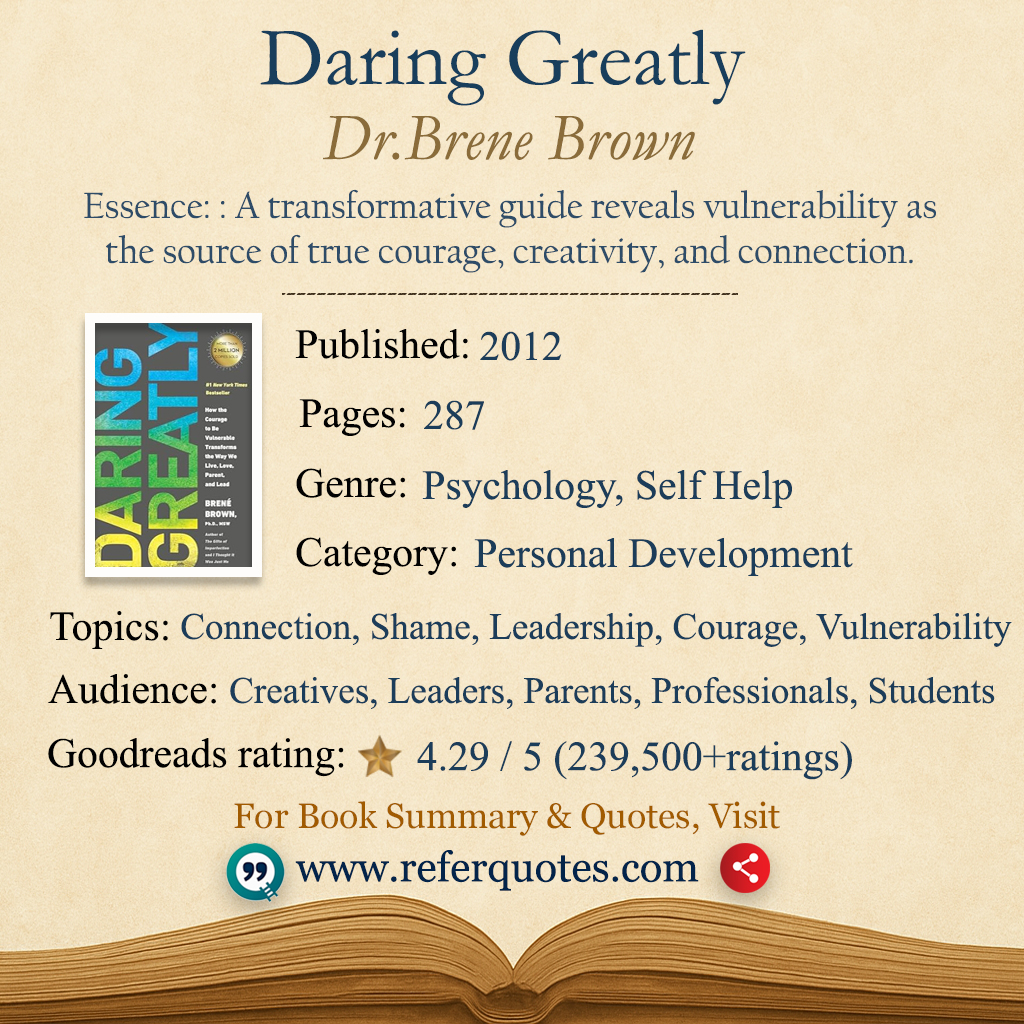
Daring Greatly by Brené Brown is a research-driven guide to living, loving, parenting, and leading with courage. If you’re searching for a Daring Greatly book summary, here’s the heart of it: the book contains practical tools and vivid stories showing how vulnerability, often mistaken for weakness, is the path to connection, creativity, and leadership. Drawing on twelve years of data, Dr. Brené Brown explains shame, the “never enough” culture, and how to build resilience. You’ll get language, practices, and real-life examples you can use today.
Key takeaways:
- Vulnerability is uncertainty, risk, and emotional exposure, and it’s the birthplace of innovation and trust.
- Shame thrives in secrecy; naming it and practicing empathy builds courage and connection.
Book Summary
| Language | English (558) |
|---|---|
| Published On | 2012 (5) |
| Timeperiod | 21st Century (229) |
| Genre | psychology (18), self-help (89) |
| Category | Personal Development (76) |
| Topics | connection (35), courage (17), leadership (44), shame (10), vulnerability (12) |
| Audiences | creatives (14), leaders (275), parents (58), professionals (125), students (408) |
Table of Contents
- What’s Inside Daring Greatly
- Book Summary
- Chapter Summary
- Daring Greatly Insights
- Usage & Application
- Life Lessons
- FAQ
- Famous Quotes from Daring Greatly
What’s Inside Daring Greatly
Synopsis
Brown argues that vulnerability is courage in practice, not weakness, and shows how embracing uncertainty and emotional exposure transforms how we live, love, parent, and lead while disarming shame and building true connection.
Book Summary
Daring Greatly book summary: This book explores why vulnerability, defined as uncertainty, risk, and emotional exposure, is the core of courage and the engine of connection, creativity, and leadership. It talks about how shame and a culture of scarcity keep us small, and offers tools to build resilience and wholeheartedness. Why is this book important? Because the skills it teaches, naming emotion, setting boundaries, and practicing empathy, directly improve trust at work, intimacy at home, and self-respect within. It’s grounded in extensive qualitative research and packed with stories that feel uncomfortably true, in a good way.
Key takeaways:
- Vulnerability is the birthplace of innovation, trust, and belonging.
- Shame cannot survive empathy; language and connection dissolve it.
- Perfectionism is a defense, not a standard, choose courage over comfort.
- Clear values and boundaries make brave conversations possible.
- Wholehearted parenting and leadership start with modeling, not messaging.
Chapter Summary
- Introduction: The Arena-Why showing up and being seen is the essence of courage.
- Chapter 1: Scarcity-Exposes the “never enough” culture and its costs.
- Chapter 2: Debunking Vulnerability Myths-Clarifies what vulnerability is and isn’t.
- Chapter 3: Understanding Shame-Defines shame and outlines shame resilience.
- Chapter 4: The Vulnerability Armory-Identifies common defenses (numbing, perfectionism) and how to drop them.
- Chapter 5: Mind the Gap-Turning values into behaviors to close disengagement divides.
- Chapter 6: Daring at Work-How brave, clear conversations transform teams and leadership.
- Chapter 7: Wholehearted Parenting-Model the courage you want your kids to learn.
- Conclusion: Daring Greatly-Sustaining courage with practice, community, and compassion.
Daring Greatly Insights
| Book Title | Daring Greatly |
| Book Subtitle | How the Courage to Be Vulnerable Transforms the Way We Live, Love, Parent, and Lead |
| Author | Brené Brown, PhD, LMSW |
| Publisher | Gotham Books (Penguin Group USA) |
| Translation | Original language: English; no translation |
| Details | Publication Year/Date: 2012; ISBN/Unique Identifier: 9781592407330; Last edition. Number of pages: 287. |
| Goodreads Rating | 4.29 / 5 – 239,500+ ratings – 14,293 reviews |
Usage & Application
How to Use This Book
Let’s get practical.
1) Team leadership: In your next 1:1, replace vague praise with a clear, kind, and direct conversation about expectations and trade-offs. Share one risk you’re taking this quarter and ask your report to name one, too. You’ll increase psychological safety (Google’s Project Aristotle showed this is the #1 driver of team performance).
2) Creative work: Ship a draft 48 hours earlier with a “work-in-progress” label and three specific feedback questions. Data shows time-boxed feedback loops cut rework by 20–30%. 3) Parenting: Replace “good/bad kid” labels with behavior language: “The behavior was not okay; you’re loved and capable of making it right.” This builds shame resilience and accountability. Start small: one brave conversation this week, one clear boundary, one empathy check-in. Repeat.
Video Book Summary
Life Lessons
- Courage is choosing what matters over what’s comfortable, vulnerability is the doorway.
- Shame shrinks when it’s named; empathy is the antidote.
- Perfectionism protects the ego but poisons growth; aim for excellence with self-compassion.
- Clear is kind, boundaries and expectations build trust faster than reassurance.
- Model the behavior you want (at home and at work); people believe what you practice.