
- Talent is overrated, systems and practice drive progress.
- Character skills (like grit and humility) can be learned.
Book Summary
| Language | English (574) |
|---|---|
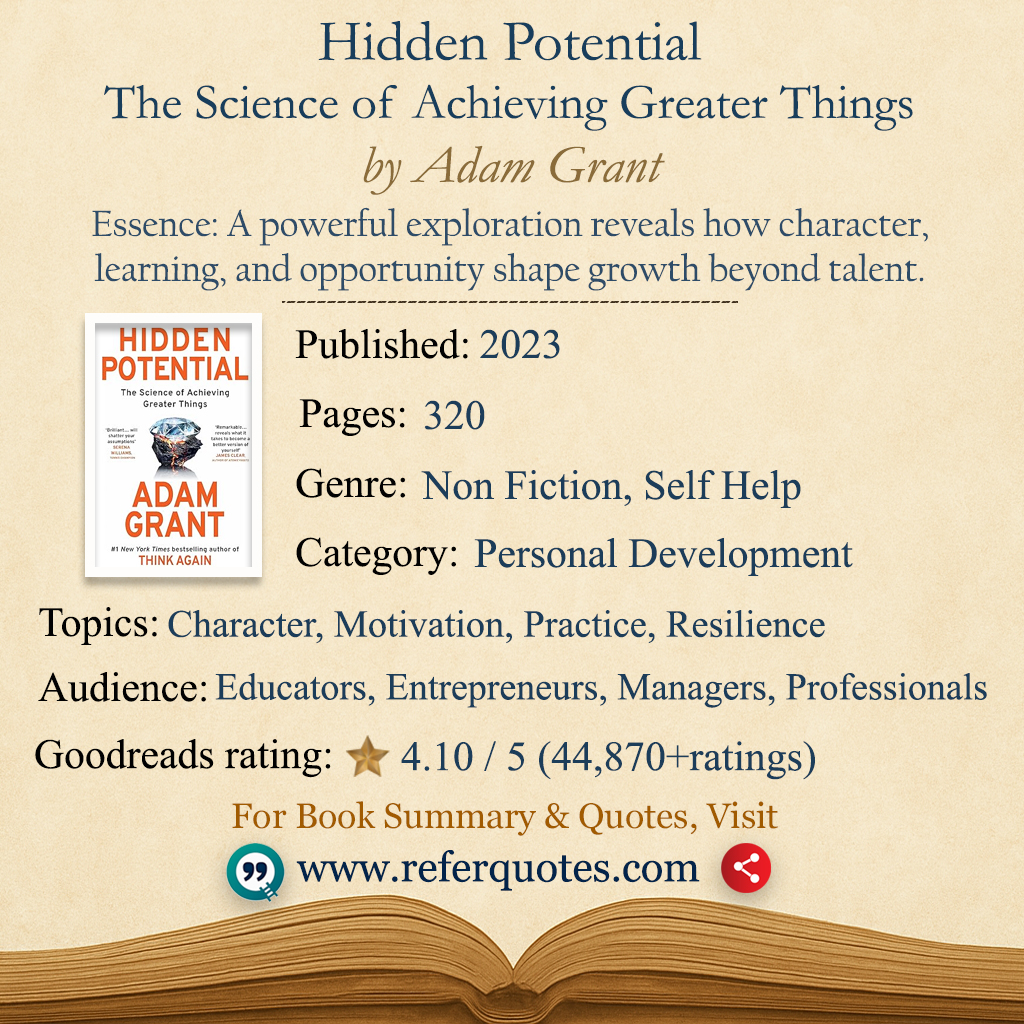
| Published On | 2023 (2) |
| Timeperiod | 21st Century (231) |
| Genre | nonfiction (88), self-help (89) |
| Category | Personal Development (77) |
| Topics | character (14), growth mindset (1), motivation (25), practice (2), resilience (17) |
| Audiences | educators (31), entrepreneurs (202), managers (140), professionals (129), students (422) |
Table of Contents
- What’s Inside Hidden Potential: The Science of Achieving Greater Things
- Book Summary
- Chapter Summary
- Hidden Potential: The Science of Achieving Greater Things Insights
- Usage & Application
- Life Lessons
- FAQ
- Famous Quotes from Hidden Potential: The Science of Achieving Greater Things
What’s Inside Hidden Potential: The Science of Achieving Greater Things
Synopsis
Adam Grant shows how ordinary people achieve extraordinary results by building the right systems: deliberate practice, wise feedback, supportive scaffolds, and teachable character skills. It’s a research-driven roadmap to grow faster, aim higher, and help others rise too.
Book Summary
- Progress beats pedigree: Build systems that make practice harder than performance.
- Character is a skill set: Humility, grit, and generosity can be trained.
- Friction helps: Intentional constraints sharpen learning and creative problem solving.
- Make excellence inclusive: Create networks and norms that raise everyone’s floor and ceiling.
Chapter Summary
Chapter 1: The Myth of Natural Talent – Greatness isn’t born; it’s built through character, persistence, and opportunity.
Chapter 2: Scaffolding Growth – Progress faster by creating systems and support that stretch your abilities.
Chapter 3: The Power of Frustration – Struggle isn’t a setback; it’s the signal of deep learning in motion.
Chapter 4: Character Over Confidence – Humility, grit, and curiosity outlast raw ability every time.
Chapter 5: Hidden Advantage of Imperfection – Flaws and detours become strengths when used as learning tools.
Chapter 6: Rethinking Practice – Quality practice means feedback, reflection, and experimentation, not repetition.
Chapter 7: Culture of Growth – Surround yourself with people and environments that challenge, not just cheer.
Chapter 8: Expanding Opportunity – When we design fairer systems, hidden potential becomes visible everywhere.
Chapter 9: The Long Game – Real success is measured by sustained progress, not early wins.
Chapter 10: Unlocking Collective Potential – Help others rise and you multiply your own growth.
Hidden Potential: The Science of Achieving Greater Things Insights
| Book Title | Hidden Potential |
| Book Subtitle | The Science of Achieving Greater Things |
| Author | Adam Grant |
| Publisher | Viking (Penguin Random House, US); W.H. Allen (PRH UK) |
| Translation | Original language: English; no translation required |
| Details | Publication Year/Date: 2023; ISBN/Unique Identifier: 978-0593653142; Last edition: Viking Press, 2023; Number of pages: 320 |
| Goodreads Rating | 4.10 / 5 – 44,870 ratings – 3,140 reviews |
About the Author
Dr. Adam Grant studies how people find motivation and meaning, and how leaders build better workplaces. He writer for New York Times and advises organizations on culture, and innovation.
| Official Website | Facebook | X| Instagram | YouTube
Usage & Application
How to Use This Book
Here’s how to apply it fast.
1) Career growth: Map a 30-day “stretch practice” plan, pick one skill, schedule three weekly drills that are harder than your real task (e.g., sales calls with time limits), and record results. Track a 15% weekly improvement target.
2) Team development: Build scaffolds, checklists, peer feedback rounds, and a weekly “friction sprint” where you add one constraint (time cap, fewer resources) to sharpen execution.
3) Learning a hobby or exam prep: Break skills into micro-steps, ask a coach or peer for pinpoint feedback (“What’s one thing to fix first?”), and run deliberate reps until error rates drop 20–30%. Use Grant’s core loop: stretch → feedback → refine → repeat. Start small, measure progress, and raise the bar quarterly.
Video Book Summary
Life Lessons
- Progress is a system: structure beats innate talent over time.
- Character can be trained, humility, grit, and generosity are learnable skills.
- Seek productive friction; constraints accelerate learning.
- Ask for precise feedback early to compound improvement.
- Make excellence inclusive by building scaffolds that help others rise.