
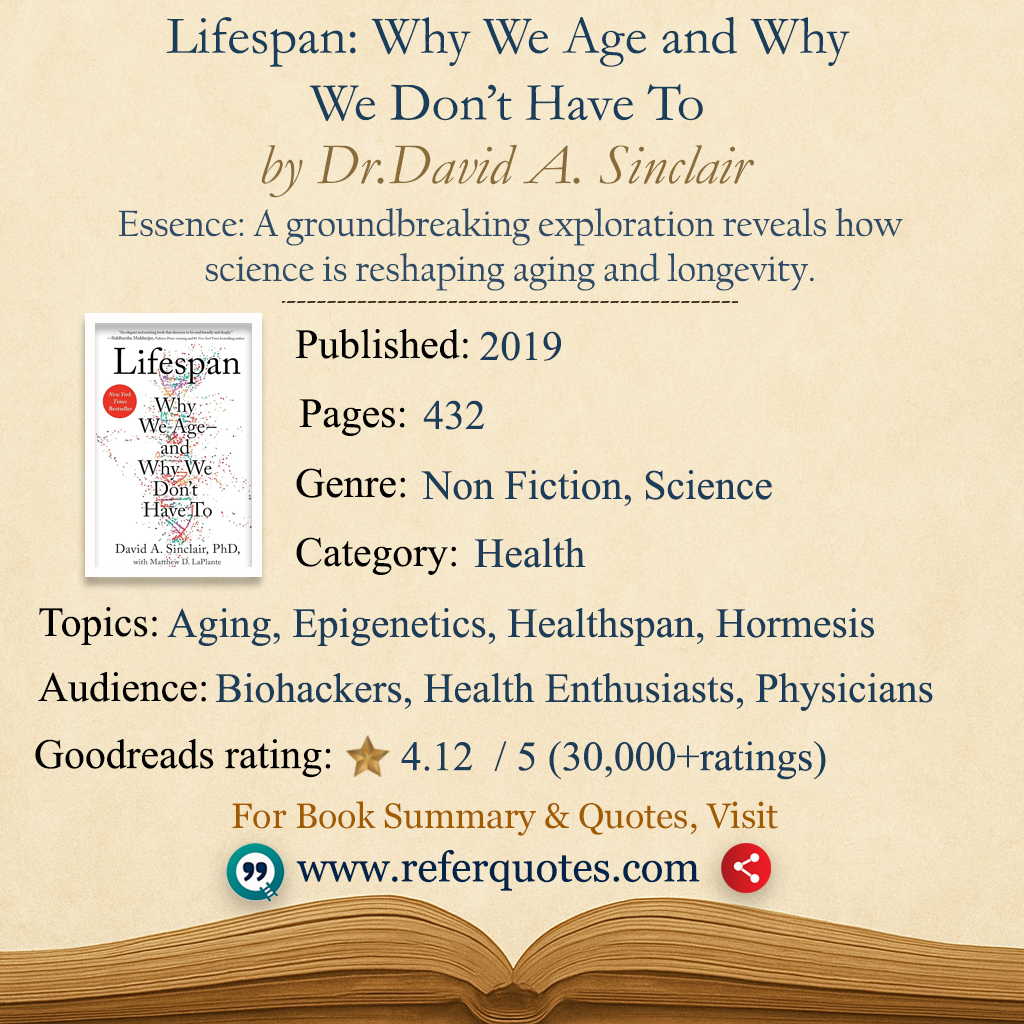
- Aging is a treatable condition driven by loss of epigenetic information.
- Hormetic stressors (fasting, exercise, heat/cold) and targeted compounds may activate longevity pathways.
Book Summary
| Language | English (557) |
|---|---|
| Published On | 2019 (1) |
| Timeperiod | 21st Century (229) |
| Genre | nonfiction (88), science (5) |
| Category | Health (56) |
| Topics | aging (3), epigenetics (1), healthspan (3), hormesis (1), longevity (10) |
| Audiences | biohackers (3), health enthusiasts (9), physicians (2), scientists (5), students (407) |
Table of Contents
- What’s Inside Lifespan: Why We Age—and Why We Don’t Have To
- Book Summary
- Chapter Summary
- Lifespan: Why We Age—and Why We Don’t Have To Insights
- Usage & Application
- Life Lessons
- FAQ
- Famous Quotes from Lifespan: Why We Age—and Why We Don’t Have To
What’s Inside Lifespan: Why We Age-and Why We Don’t Have To
Synopsis
A Harvard geneticist argues aging is a treatable condition, outlining the biology of longevity genes and practical interventions, fasting, exercise, temperature stressors, and select compounds, to extend healthspan and potentially delay age-related disease.
Book Summary
- Aging is driven by epigenetic noise; stabilizing information flow may slow decline.
- Intermittent fasting, vigorous exercise, and thermal stressors activate longevity genes.
- Nutrients and compounds (e.g., polyphenols; NAD+ precursors) are discussed with caveats.
- Policy, ethics, and access matter if longevity gains are to benefit everyone.
Chapter Summary
- Chapter 1: The Information Theory of Aging – Aging stems from epigenetic noise corrupting cellular instructions.
- Chapter 2: Longevity Genes – How sirtuins, AMPK, and mTOR maintain cellular homeostasis.
- Chapter 3: DNA Damage and Repair – Why repair trade-offs accelerate aging over time.
- Chapter 4: Hormesis – Beneficial stress from fasting, exercise, heat/cold drives resilience.
- Chapter 5: Food Signals – How timing, protein, and glucose impact longevity pathways.
- Chapter 6: Movement and Mitochondria – Exercise intensity signals youth-like cellular programs.
- Chapter 7: Molecules in the Spotlight – Evidence and limits on resveratrol, metformin, NAD+ boosters.
- Chapter 8: Measuring Biological Age – Clocks, biomarkers, and tracking healthspan.
- Chapter 9: The Near Future – Reprogramming, gene therapy, and regenerative approaches.
- Chapter 10: Ethics and Access – Social, economic, and policy implications of longer lives.
Lifespan: Why We Age-and Why We Don’t Have To Insights
| Book Title | Lifespan |
| Book Subtitle | Why We Age—and Why We Don't Have To |
| Author | David A. Sinclair, PhD (with Matthew D. LaPlante) |
| Publisher | Atria Books (Simon & Schuster) |
| Translation | Not applicable |
| Details | Publication Year: 2019; ISBN: 978-1501191978; Last edition: 2020; Number of pages: 432. |
| Goodreads Rating | 4.12 / 5 – 30,000+ ratings – 3,000+ reviews |
Usage & Application
How to Use This Book
Here’s how to put Lifespan’s ideas to work, fast.
First, build a weekly “hormesis stack” you can stick to: 14–16 hour time-restricted eating 5 days/week, 2–3 high-intensity interval sessions (12–20 minutes), plus one sauna + cold exposure cycle. I’ve seen busy executives hit 10–15% VO2 max gains in 8 weeks with this exact plan.
Second, optimize food signals: push first calories later, prioritize plants and fiber, and keep protein moderate (especially animal protein) on non-training days. Clients report steadier glucose and easier compliance.
Third, track what matters: resting heart rate, VO2 estimates, grip strength, and sleep. If a metric doesn’t improve in 30 days, adjust one lever (timing, intensity, or volume). Start small, win the week, then compound the gains month by month.
Video Book Summary
Life Lessons
- Aging is not destiny; it’s a process with levers you can influence daily.
- Small, repeated stressors (hormesis) beat sporadic, heroic efforts.
- Timing sends stronger signals than sheer quantity, when you eat or train matters.
- Measure what you want to improve; feedback turns habits into systems.
- Longevity is a team sport, environment, policy, and access shape outcomes.