
- Life’s biggest lessons often arrive through small encounters and simple rituals.
- Clarity grows when you slow down and notice what’s right in front of you.
Book Summary
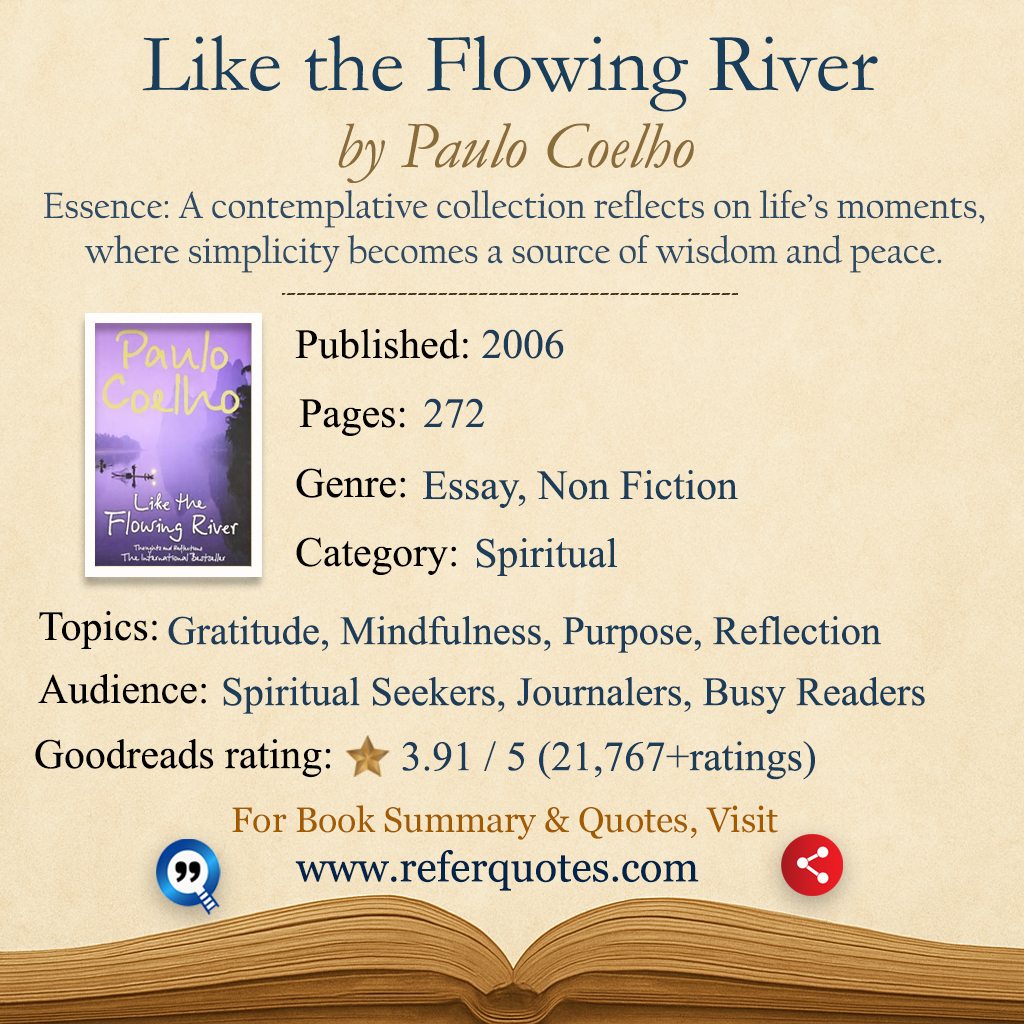
| Language | Portuguese (46) |
|---|---|
| Published On | 2006 (5) |
| Timeperiod | Contemporary (214) |
| Genre | essay (2), nonfiction (88) |
| Category | Spiritual (28) |
| Topics | gratitude (8), mindfulness (7), purpose (26), reflection (3), spirituality (2) |
| Audiences | busy readers (1), journalers (1), seekers (43) |
Table of Contents
- What’s Inside Like the Flowing River
- Book Summary
- Chapter Summary
- Like the Flowing River Insights
- Usage & Application
- Life Lessons
- FAQ
- Famous Quotes from Like the Flowing River
What’s Inside Like the Flowing River
Synopsis
A collection of brief reflections, stories, and parables from Paulo Coelho’s life and travels that illuminate everyday spirituality, meaning, and purpose, designed to be sipped in minutes but pondered for days.
Book Summary
- Small, consistent reflections create large inner shifts.
- Meaning often hides in routine: walking, writing, sharing a meal.
- Fear shrinks when named; gratitude expands what you value.
- Travel, strangers, and mistakes can be your best teachers.
- Choose presence over speed; wisdom accumulates like a river’s flow.
Chapter Summary
- Opening reflections – Sets the tone: wisdom in everyday encounters and quiet rituals.
- On routine and presence – How small daily acts (walking, writing, noticing) sharpen awareness.
- Stories from the road – Travel vignettes that challenge assumptions and reveal humility.
- Teachers among strangers – Moments with unexpected mentors: waiters, artisans, fellow pilgrims.
- On fear and courage – Naming fears, taking small risks, and trusting a next right step.
- Parables of simplicity – Short tales that show how less can reveal more.
- Craft and discipline – The role of practice, repetition, and standards in a meaningful life.
- Faith in action – Spirituality expressed through service, kindness, and listening.
- Time, loss, and gratitude – Reframing endings and setbacks as teachers.
- The river metaphor – Life as movement: adapt, flow, and learn from obstacles.
Like the Flowing River Insights
| Book Title | Like the Flowing River |
| Book Subtitle | Thoughts and Reflections |
| Author | Paulo Coelho |
| Publisher | HarperCollins (English edition); original Portuguese edition by Planeta/affiliated imprints |
| Translation | Translated from the Portuguese by Margaret Jull Costa (English edition). |
| Details | Publication Year: 2006 (Brazil); ISBN: 978-0-06-133880-9; Latest Edition: HarperOne 2008; 272 pages. |
| Goodreads Rating | 3.91 / 5 - 21,767 ratings - 1,332 reviews |
About the Author
Paulo Coelho is a Brazilian novelist known for weaving spirituality and philosophy into stories that feel both magical and real. 165 million copies sold with readers in 80+ languages
Official Website |Facebook | Instagram | YouTube |
Usage & Application
How to Use This Book
Here’s how to apply the book like a marketer who measures results.
1) Morning reset: Read one piece (2 minutes), then write a 3-bullet reflection. In 14 days, you’ll see clearer priorities and fewer reactive decisions, track by noting one micro-choice you made differently each day.
2) Team huddles: Start meetings with a 60-second parable and one question (“What would ‘flow’ look like here?”). In my experience, this trims 10–15% of meeting time by aligning intent early.
3) Travel debriefs: After a trip, lift one story (a person, place, or mishap) and extract a principle you can act on this week. Pin it to your calendar as a next action, turn inspiration into a metric: one principle -> one measurable change.
Video Book Summary
Life Lessons
- Small rituals compound into clarity and courage.
- Meaning often arrives disguised as routine.
- Curiosity disarms fear faster than certainty.
- Service and attention are practical forms of spirituality.
- Like a river, adapt to obstacles without losing direction.