
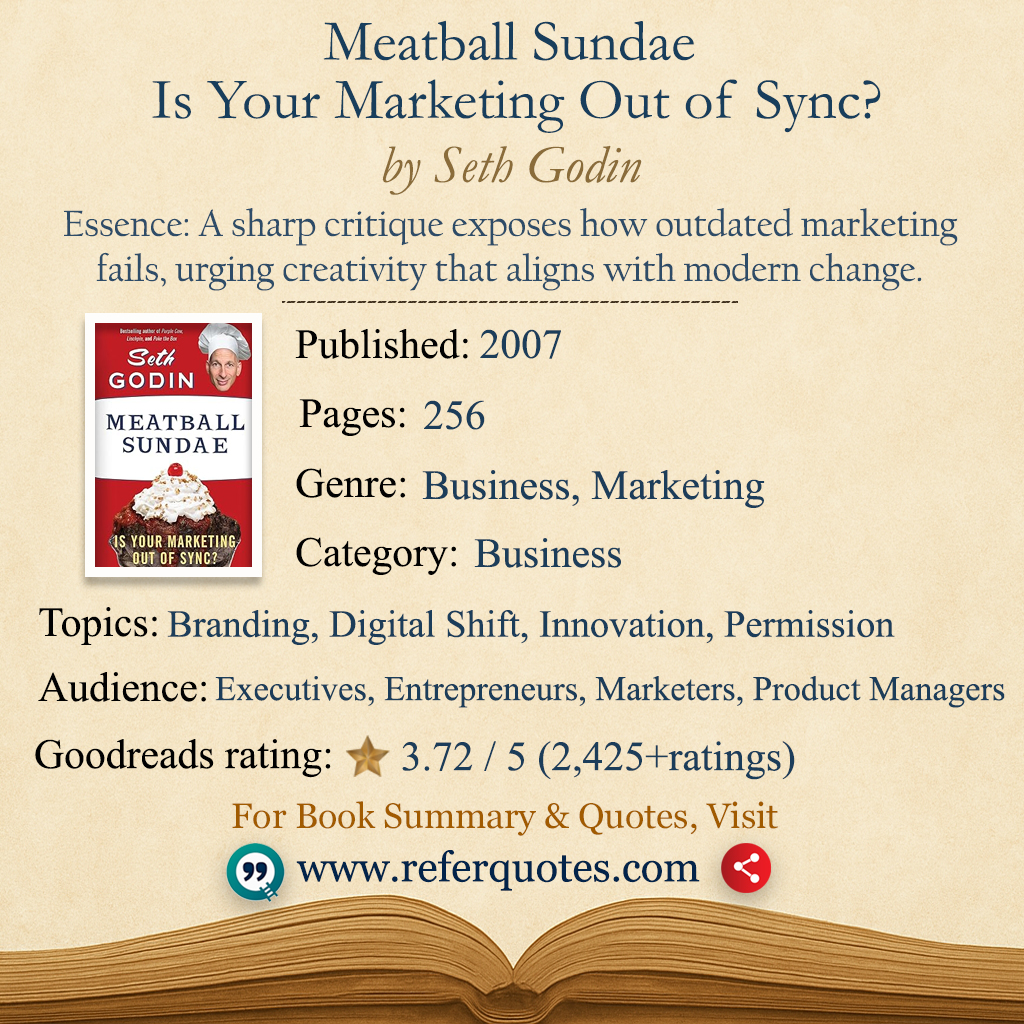
- New marketing only works when the product and story fit the medium.
- Stop chasing hacks; redesign what you sell to earn attention and trust.
Book Summary
| Language | English (546) |
|---|---|
| Published On | 2007 (4) |
| Timeperiod | 21st Century (225) |
| Genre | business (16), marketing (2) |
| Category | Business (40) |
| Topics | branding (3), digital shift (1), innovation (4), permission (1) |
| Audiences | entrepreneurs (192), executives (20), marketers (19), product managers (6) |
Table of Contents
- What’s Inside Meatball Sundae: Is Your Marketing Out of Sync?
- Book Summary
- Chapter Summary
- Meatball Sundae: Is Your Marketing Out of Sync? Insights
- Usage & Application
- Life Lessons
- FAQ
- Famous Quotes from Meatball Sundae: Is Your Marketing Out of Sync?
What’s Inside Meatball Sundae: Is Your Marketing Out of Sync?
Synopsis
A no-fluff guide to aligning your product and story with the realities of new marketing, so you stop adding flashy toppings to a commodity and start building offerings that earn attention, trust, and growth.
Book Summary
- Match your product and story to the medium, don’t retrofit tactics onto a commodity.
- Design for networks and permission; earned attention beats rented reach.
- Authenticity and usefulness travel farther than hype in fragmented media.
- Fix the offer first, then pick channels, metrics, and cadence.
Chapter Summary
- Introduction – Meatballs vs. sundaes: why mismatched marketing fails.
- Chapter 1 – The end of interruption: old mass media rules don’t hold.
- Chapter 2 – Trend 1: Direct producer-to-consumer connections reshape trust.
- Chapter 3 – Trend 2: The amplified consumer voice changes power dynamics.
- Chapter 4 – Trend 3: Authentic stories win in cluttered markets.
- Chapter 5 – Trend 4: Short attention spans and the long tail shift strategy.
- Chapter 6 – Trend 5: Infinite channels fragment reach and demand fit.
- Chapter 7 – Trend 6: New gatekeepers emerge (platforms, communities).
- Chapter 8 – Trend 7: The fall of mass + rise of micro-tribes.
- Chapter 9 – Trend 8: Search and findability beat interruption.
- Chapter 10 – Trend 9: Permission and community-driven growth.
- Chapter 11 – Trend 10: Transparency and authenticity as levers.
- Chapter 12 – Trend 11: Networks accelerate idea viruses.
- Chapter 13 – Trend 12: Frictionless commerce changes pricing and access.
- Chapter 14 – Trend 13: User-generated content and co-creation.
- Chapter 15 – Trend 14: Rapid prototyping and iteration in public.
- Chapter 16 – Strategy: Redesign the product to match new marketing.
- Chapter 17 – Tactics: Tools, metrics, and channels that reinforce fit.
- Chapter 18 – Case studies: What alignment looks like in practice.
- Conclusion – A checklist to avoid building another meatball sundae.
Meatball Sundae: Is Your Marketing Out of Sync? Insights
| Book Title | Meatball Sundae |
| Book Subtitle | Is Your Marketing Out of Sync? |
| Author | Seth Godin |
| Publisher | Portfolio (Penguin Group) |
| Translation | None (originally in English) |
| Details | Publication Year/Date: 2007; ISBN: 9781591841746; Latest Edition: Portfolio Hardcover (2007); Number of Pages: 256. |
| Goodreads Rating | 3.72 / 5 – 2,425 ratings – 130+ reviews |
About the Author
Seth Godin earned MBA from Stanford University and writes and teaches about marketing, leadership, and creative work.
| Official Website | Facebook | X
Usage & Application
How to Use This Book
If your PPC is rising while conversion flatlines, you don’t have a traffic problem, you have a fit problem. Pause the spend and rework the offer: tighten the niche, rewrite the story in customer language, and ship a pilot to a 1,000 person micro-tribe.
When the story pulls, scale the channel. Second, in a legacy brand launch, skip the flashy campaign. Build a permission asset first: a 10 part email series with a concrete outcome (e.g., cut churn 18%). Measure reply rate, not impressions.
When you hit 20–30% open and 5% reply, layer in retargeting. Finally, for SaaS stuck at $2M ARR, bundle a feature that eliminates a hated workflow, price it as an add-on, and launch via customer champions on LinkedIn. Real proof > big reach.
Video Book Summary
Life Lessons
- Marketing can’t fix a product–market mismatch; rebuild the offer first.
- Earn permission and trust; rented attention decays fast.
- Authentic stories travel in networks; hype burns out in fragments.
- Design for tribes and participation, not for everyone.
- Alignment (product, story, medium) compounds; misalignment multiplies waste.