
Nonviolent Communication: A Language of Life by Dr. Marshall B. Rosenberg distills a practical, empathetic method for everyday conversations. If you’re searching for a Nonviolent Communication: A Language of Life book summary, here’s the gist fast: the book contains a simple four-step process, observations, feelings, needs, and requests, plus real scripts, dialogues, and case examples for work, home, and community conflicts. It’s written by the founder of NVC and grounded in decades of mediation and training. You’ll learn how to defuse defensiveness, transform judgments into needs, and make clear, doable requests that build trust.
Key takeaways:
• Replace blame with empathy
• Turn conflict into connection
Book Summary
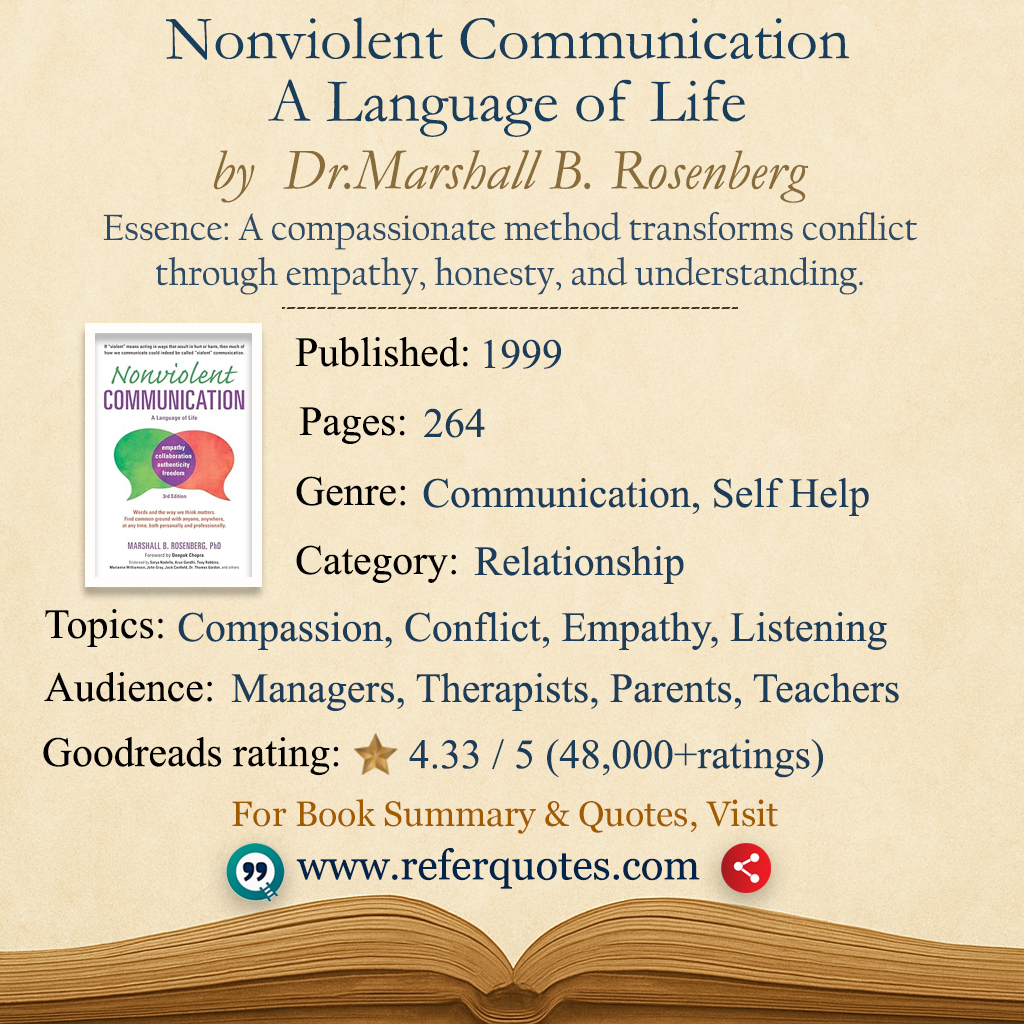
| Language | English (583) |
|---|---|
| Published On | 1999 (1) |
| Timeperiod | Contemporary (222) |
| Genre | communication (13), self-help (89) |
| Category | Relationship (61) |
| Topics | compassion (3), conflict (20), empathy (39), listening (21), relationship (3) |
| Audiences | managers (142), mediators (10), parents (59), teachers (190), therapists (53) |
Table of Contents
- What’s Inside Nonviolent Communication: A Language of Life
- Book Summary
- Chapter Summary
- Nonviolent Communication: A Language of Life Insights
- Usage & Application
- Life Lessons
- FAQ
- Famous Quotes from Nonviolent Communication: A Language of Life
What’s Inside Nonviolent Communication: A Language of Life
Synopsis
A concise, step-by-step method to speak and listen with empathy, replacing blame and defensiveness with clarity about feelings, needs, and specific requests to build trust and resolve conflict.
Book Summary
Nonviolent Communication: A Language of Life book summary: This guide by Marshall B. Rosenberg introduces a practical four-part framework, observe without evaluating, name feelings, identify needs, and make clear requests. Direct answer: the book talks about how to communicate so people willingly cooperate, even under stress, using empathy and honesty instead of blame or coercion. Why is this book important? It gives you repeatable conversation tools that work across marriages, teams, classrooms, and cross-cultural settings, reducing conflict while increasing connection and accountability. It resonates because all humans share needs (safety, respect, belonging), and NVC shows how to surface them quickly.
Key takeaways:
• Judgments are unmet needs in disguise
• Empathy defuses defensiveness faster than advice
• Clear, doable requests beat vague demands
• Anger is a wake-up call for needs
• Appreciation is most powerful when need-based
Chapter Summary
- 1. Giving From the Heart – Why compassion-based intention changes conversations.
- 2. Communication That Blocks Compassion – How moralistic judgments, labels, and comparisons escalate conflict.
- 3. Observing Without Evaluating – Separate facts from interpretations to lower defensiveness.
- 4. Identifying and Expressing Feelings – Name emotions precisely to create clarity.
- 5. Taking Responsibility for Our Feelings – Link feelings to needs, not others’ actions.
- 6. Requesting That Which Would Enrich Life – Make specific, doable, present-moment requests.
- 7. Receiving Empathically – Listen for feelings and needs beneath words.
- 8. The Power of Empathy – Use presence, not fixes, to create change.
- 9. Connecting Compassionately with Ourselves – Self-empathy to reduce shame and reactivity.
- 10. Expressing Anger Fully – Transform blame into needs and actionable requests.
- 11. The Protective Use of Force – When and how to prevent harm without punishment.
- 12. Liberating Ourselves and Counseling Others – Move beyond guilt; support change via needs.
- 13. Expressing Appreciation in NVC – Give gratitude as observation, feeling, and need met.
Nonviolent Communication: A Language of Life Insights
| Book Title | Nonviolent Communication: A Language of Life |
| Book Subtitle | Life-Changing Tools for Healthy Relationships |
| Author | Marshall B. Rosenberg |
| Publisher | PuddleDancer Press |
| Translation | Not applicable (originally published in English) |
| Details | Publication Year: 1999; ISBN: 9781892005038; Last edition: 3rd Edition (2015); Number of pages: 264. |
| Goodreads Rating | 4.33 / 5 – 48,000 ratings – 4,733 reviews |
Usage & Application
How to Use This Book
Most people argue because they’re unclear about needs. Here’s how to apply NVC quickly.
Scenario 1 (Work): Your teammate misses a deadline. Skip blame. Say, “When the draft wasn’t in by Tuesday (observation), I felt anxious (feeling) because I need reliability (need). Would you be willing to share a new timeline by 4 pm and ping me on Slack?” (request). Result: fewer escalations, clearer commitments.
Scenario 2 (Home): Your partner leaves dishes out. “When I saw dishes in the sink, I felt overwhelmed because I need order after work. Would you put them in the washer before 8 pm tonight?” Measurable change beats vague complaints.
Scenario 3 (Parenting): Child won’t log off. “I’m worried because I need rest and quiet. Would you finish this round and come to dinner in five minutes?” Respect + clarity = cooperation.
Video Book Summary
Life Lessons
- Separate facts from interpretations to lower emotional heat.
- Behind every criticism lies an unmet need, name it to transform conflict.
- Empathy first; solutions second, presence opens the door to change.
- Make specific, doable requests; avoid vague demands and ultimatums.
- Express appreciation by linking actions to needs met, not to judgments.