
– Use “hypnotic rhythm” intentionally to lock in winning habits, not fears.
Book Summary
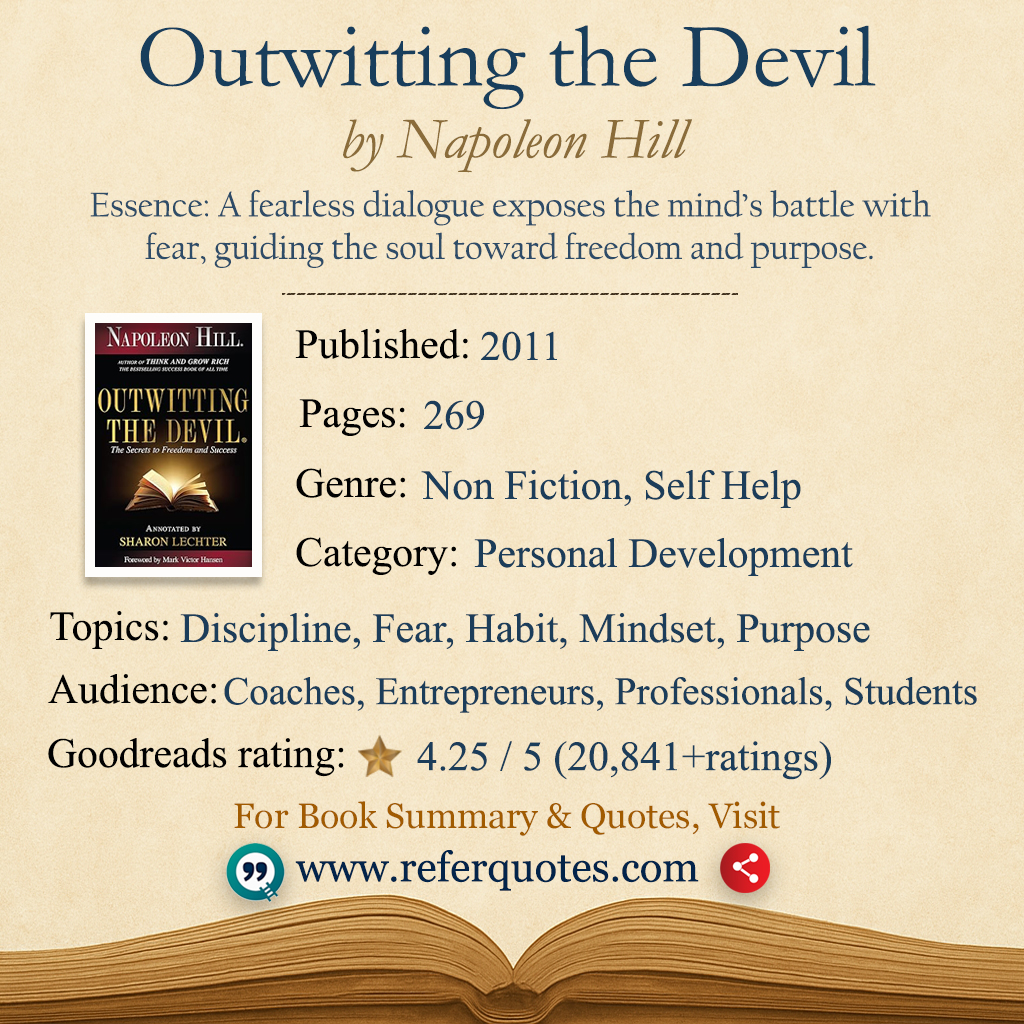
| Language | English (557) |
|---|---|
| Published On | 2011 (2) |
| Timeperiod | Modern (118) |
| Genre | nonfiction (88), self-help (89) |
| Category | Personal Development (76) |
| Topics | discipline (30), fear (12), habit (11), mindset (41), purpose (26) |
| Audiences | coaches (122), entrepreneurs (199), professionals (125), students (407) |
Table of Contents
- What’s Inside Outwitting the Devil
- Book Summary
- Chapter Summary
- Outwitting the Devil Insights
- Usage & Application
- Life Lessons
- FAQ
- Famous Quotes from Outwitting the Devil
What’s Inside Outwitting the Devil
Synopsis
A provocative, interview-style guide where Napoleon Hill exposes the mental traps, fear, drifting, and bad habits, the “Devil” uses to control lives, then shows how to reclaim freedom through purpose, discipline, and intentional habit-building.
Book Summary
Outwitting the Devil by Napoleon Hill book summary: This controversial 1938 manuscript (published in 2011) is framed as a fearless interrogation of the “Devil,” revealing how fear, drifting, and social conditioning steal our potential. The book summary is simple: identify the traps, reclaim your thinking, and build habits that serve your purpose. Why is this book important? It translates abstract success advice into sharp, practical warnings about how we unconsciously surrender control, then provides tools to win it back. Through ideas like definiteness of purpose, self-discipline, and “hypnotic rhythm,” Hill offers a blueprint to convert fear into focused momentum. It resonates because it addresses universal anxieties, money, failure, criticism, and shows how to create freedom through daily actions.
Key takeaways:
– Defeat “drifting” with a written life purpose and daily priorities.
– Replace fear-driven loops with intentional routines (hypnotic rhythm).
– Build self-discipline to control thoughts, time, and environment.
– Treat adversity as training that compounds long-term advantage.
Chapter Summary
- Chapter 1 – Why the Manuscript Was Shelved: The 1938 context, controversy, and later publication.
- Chapter 2 – The Interview Device: Hill’s “conversation” with the Devil as a truth-revealing framework.
- Chapter 3 – Drifting: How aimlessness lets fear and habit take control.
- Chapter 4 – Definiteness of Purpose: Choosing a central aim to focus all effort.
- Chapter 5 – Self-Discipline: Governing thoughts, emotions, and actions.
- Chapter 6 – Learning from Adversity: Turning setbacks into training and insight.
- Chapter 7 – Hypnotic Rhythm: How repeated actions harden into destiny.
- Chapter 8 – Environment, Time, Harmony: Curating inputs that compound progress.
- Chapter 9 – The Six Fears: Poverty, criticism, ill health, loss of love, old age, death.
- Chapter 10 – Education & Religion: Institutions that can liberate, or program, your mind.
- Chapter 11 – Habit Architecture: Designing routines that serve your purpose.
- Chapter 12 – Non-Drifters: Traits, practices, and mental models of high-agency people.
- Chapter 13 – Outwitting the Devil: A step-by-step plan to protect freedom and success.
Outwitting the Devil Insights
| Book Title | Outwitting the Devil |
| Book Subtitle | The Secret to Freedom and Success |
| Author | Napoleon Hill |
| Publisher | Sterling Publishing in collaboration with The Napoleon Hill Foundation (2011); later reprints by Sound Wisdom and others |
| Translation | Originally written and published in English; no translation required |
| Details | Publication Year/Date: 1938 (written), 2011 (first published) | ISBN: 978-1-937856-53-5 | Latest Edition: Sterling Publishing, 2011 | Number of pages: 269 |
| Goodreads Rating | 4.25 / 5 – 20,841 ratings – 1,845 reviews |
About the Author
Napoleon Hill, author of many books on achievement and personal philosophy. He spent years studying the habits of top performers, which led to classic Think and Grow Rich.
| Official Website | Facebook | X| Instagram | YouTube
Usage & Application
How to Use This Book
Here’s how to apply it fast, no fluff.
1) Career reset: If you’re stuck in reactive tasks, define a one-sentence purpose tied to a measurable outcome (e.g., grow pipeline by 30% in 90 days). Block 2 hours daily for high-leverage actions only. Track wins weekly.
2) Side business launch: Kill “drifting” by shipping one deliverable every 48 hours (offer page, lead magnet, outreach list). Use hypnotic rhythm: same time, same place, zero exceptions.
3) Overcoming fear of criticism: Set a feedback quota (5 asks/week). Score comments 1–5 for usefulness and iterate. This reframes fear into data. The playbook: purpose → discipline → environment → repetition. If you want compounding results, stack small, repeatable behaviors and starve distractions.
Start today: write your purpose, pick one habit you’ll repeat daily, and remove one fear-triggering input.
Video Book Summary
Life Lessons
- Definiteness of purpose beats drifting, clarity converts energy into momentum.
- Habits harden into destiny; design them intentionally (hypnotic rhythm).
- Fear shrinks under action and data; measure, iterate, and move.
- Self-discipline is freedom, control inputs, time, and narrative.
- Adversity, properly framed, becomes your competitive edge.