
- Starting and shipping are skills you can practice daily.
- Risk is manageable; inaction is the bigger threat.
Book Summary
| Language | English (564) |
|---|---|
| Published On | 2011 (2) |
| Timeperiod | 21st Century (230) |
| Genre | nonfiction (88), self-help (89) |
| Category | Personal Development (77) |
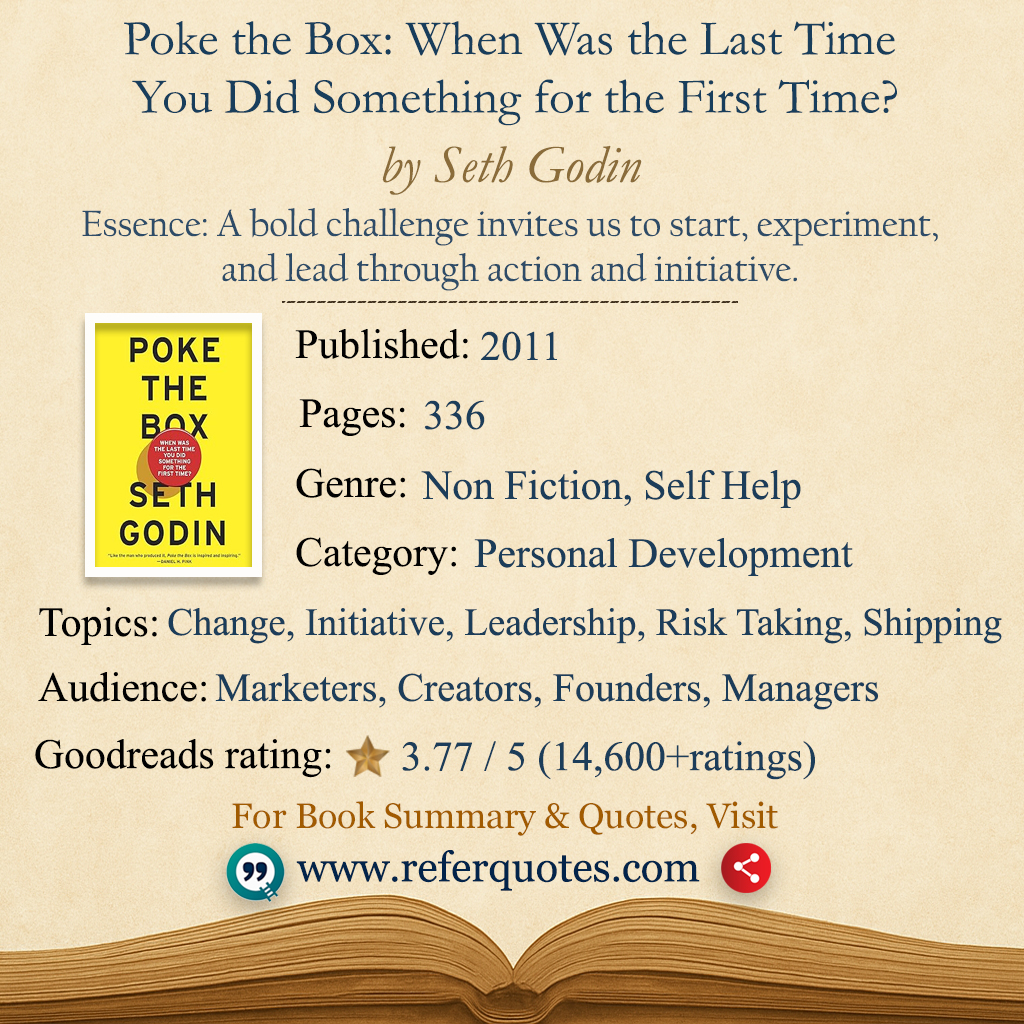
| Topics | change (11), initiative (3), leadership (44), risk-taking (1), shipping (1) |
| Audiences | creators (3), founders (11), managers (140), marketers (19), students (414) |
Table of Contents
- What’s Inside Poke the Box
- Book Summary
- Chapter Summary
- Poke the Box Insights
- Usage & Application
- Life Lessons
- FAQ
- Famous Quotes from Poke the Box
What’s Inside Poke the Box
Synopsis
A concise manifesto urging you to stop waiting for permission, start experiments, and ship your work. Godin reframes risk, celebrates initiative, and shows how small, consistent launches create momentum and real world impact.
Book Summary
- Starting is a practice; the more you ship, the braver you get.
- Perfection is a stall tactic, use small bets and short cycles.
- Permission is overrated; responsibility and initiative matter more.
- Feedback from shipped work beats hypothetical debate every time.
Chapter Summary
- Foreword: A manifesto for starters, why action beats permission.
- 1. The Box: Treat life and work like a test lab poke, observe, adjust.
- 2. Start Now: Momentum comes from the first step, not perfect plans.
- 3. Shipping Habit: Make delivery cycles short; learn from market reality.
- 4. Fear and Failure: Redefine failure as data; avoid the paralysis of perfection.
- 5. Initiative as Asset: Initiative compounds organizations reward starters.
- 6. Permission vs. Responsibility: Don’t wait for a green light; own the outcome.
- 7. Small Bets: Prototype, iterate, and scale what works.
- 8. The Compass: Use values and constraints to guide decisions.
- 9. Leading Without Authority: Influence by doing; model the behavior.
- 10. Make a Ruckus: Ship consistently; change your corner of the world.
- Afterword: Keep poking, your next launch starts today.
Poke the Box Insights
| Book Title | Poke the Box |
| Book Subtitle | When Was the Last Time You Did Something for the First Time? |
| Author | Seth Godin |
| Publisher | The Domino Project (Do You Zoom, Inc., powered by Amazon) |
| Translation | Original language: English (no translation required). |
| Details | Publication Year: 2011; ISBN: 9781936719006; Last edition: Portfolio/Penguin, 83 pages. |
| Goodreads Rating | 3.77 / 5 – 14,600 ratings – 896 reviews |
About the Author
Seth Godin earned MBA from Stanford University and writes and teaches about marketing, leadership, and creative work.
| Official Website | Facebook | X
Usage & Application
How to Use This Book
Struggling to launch? Use a 7-day shipping sprint: define a tiny deliverable (landing page, demo, memo), set a non-negotiable deadline, and ship, then collect 10 pieces of feedback and iterate.
Building a product? Run a 2-week pilot with 20 users, publish your roadmap, and publicly commit to weekly releases. In a corporate role? Propose a low-risk experiment (e.g., a 1% test on a checkout flow); quantify the expected lift (say 0.3–0.7% conversion), ship the variant, and broadcast results internally.
These micro-moves reduce fear, build credibility, and create momentum you can’t fake. Start smaller than feels comfortable, ship sooner than feels safe, and let data, not doubtdrive your next move.
Video Book Summary
Life Lessons
- Action creates clarity; speculation creates anxiety.
- Shipping on a schedule builds trust, feedback, and resilience.
- Risk is inevitable use small, reversible bets to learn fast.
- Permission is a story; responsibility is a choice.
- Leadership starts when you start, title optional.