
- Learn the difference between assets vs. liabilities and why business ownership is a gateway to better investments.
- Develop “investor IQ” to evaluate deals, manage risk, and create cash-flowing assets.
Book Summary
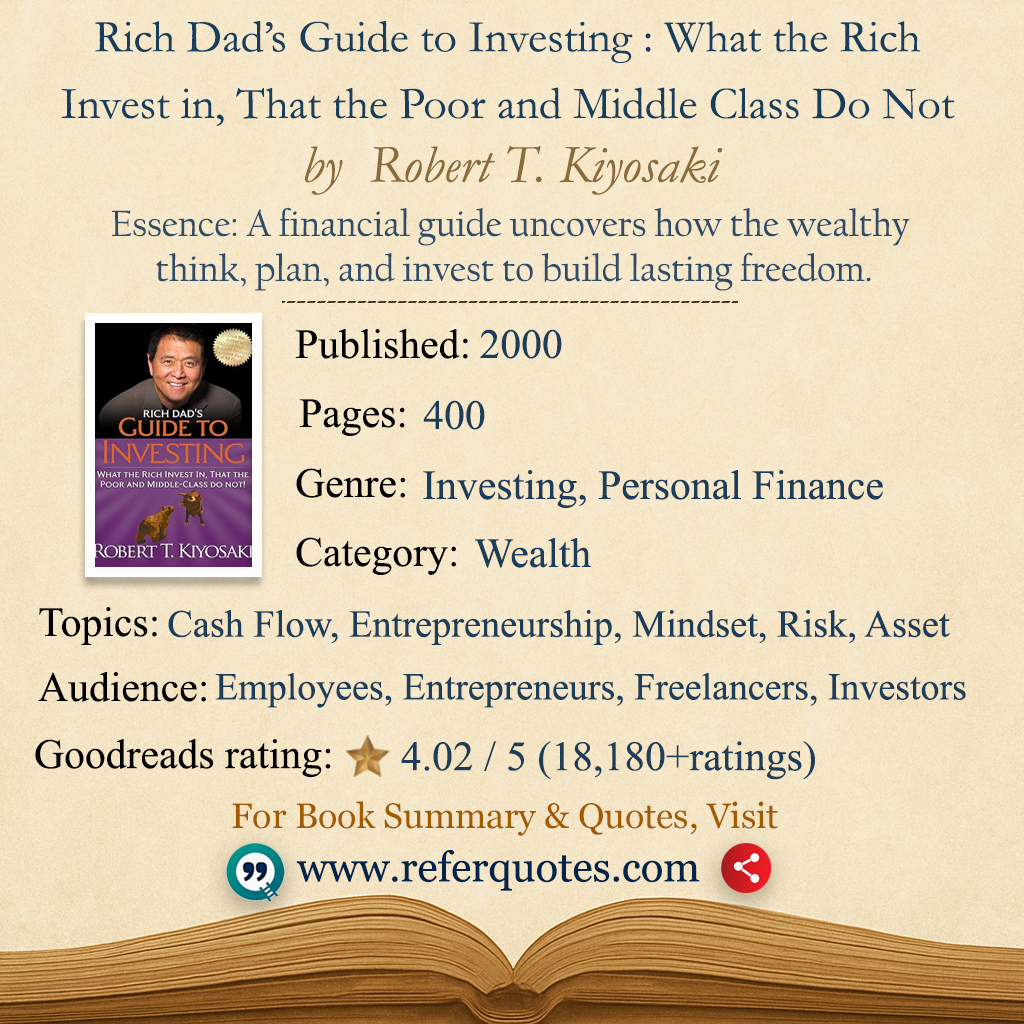
| Language | English (583) |
|---|---|
| Published On | 2000 (5) |
| Timeperiod | Contemporary (222) |
| Genre | investing (4), personal finance (2) |
| Category | Wealth (120) |
| Topics | asset (1), cashflow (3), entrepreneurship (6), mindset (42), risk (17) |
| Audiences | employees (12), entrepreneurs (202), freelancers (6), investors (96), small business owners (1) |
Table of Contents
- What’s Inside Rich Dad’s Guide to Investing: What the Rich Invest in, That the Poor and Middle Class Do Not
- Book Summary
- Chapter Summary
- Rich Dad’s Guide to Investing: What the Rich Invest in, That the Poor and Middle Class Do Not Insights
- Usage & Application
- Life Lessons
- FAQ
- Famous Quotes from Rich Dad’s Guide to Investing: What the Rich Invest in, That the Poor and Middle Class Do Not
What’s Inside Rich Dad’s Guide to Investing: What the Rich Invest in, That the Poor and Middle Class Do Not
Synopsis
Kiyosaki explains how the wealthy invest by first building businesses, becoming insiders, and acquiring cash-flowing assets, offering mental models, controls, and practical steps to move from employee to entrepreneur to investor.
Book Summary
- Move from employee/self-employed to business owner/investor to access better deals and tax advantages.
- Use investor IQ and “10 controls” to judge risk, returns, and alignment.
- Acquire cash-flowing assets first; pursue capital gains second.
- Design legal structures to protect assets and optimize taxes.
- Learn by doing: start small, iterate, and level up deal quality over time.
Chapter Summary
- Preface – Why most people never see the investments the rich do.
- 1. What Should I Invest In? – Start with cash flowing assets and skills, not hot tips.
- 2. Types of Investors – From passive savers to business-owner investors.
- 3. Before You Invest – Build financial statements, goals, and a learning plan.
- 4. The Investment Triangle – Foundation, control, and risk considerations.
- 5. The 10 Investor Controls – Rules for due diligence, leverage, and exits.
- 6. Risk vs. Risky – Education and control reduce risk more than diversification alone.
- 7. Becoming an Insider – Why owning a business unlocks higher-quality deals.
- 8. Legal Structures – Entities for protection, taxes, and scalability.
- 9. Cash Flow First – Create or buy assets that pay you monthly.
- 10. Raising Capital – Attract money by mastering the numbers and the pitch.
- 11. Private vs. Public Deals – How access changes with sophistication and network.
- 12. Start Small, Start Now – Learn by doing with limited downside.
- 13. Building a Team – CPAs, attorneys, and advisors as leverage.
- 14. The Path Forward – From first asset to portfolio and financial freedom.
Rich Dad’s Guide to Investing: What the Rich Invest in, That the Poor and Middle Class Do Not Insights
| Book Title | Rich Dad’s Guide to Investing |
| Book Subtitle | What the Rich Invest in, That the Poor and Middle Class Do Not! |
| Author | Robert T. Kiyosaki |
| Publisher | Warner Books (Business Plus) |
| Translation | Not applicable (originally published in English). |
| Details | Publication Year: 2000; ISBN: 978-1612680217; Latest Edition: 2011; Number of Pages: 400 |
| Goodreads Rating | 4.02 / 5 – 18,180 ratings – 610+ reviews |
Usage & Application
How to Use This Book
Too many people chase stock tips and end up with anxiety, not returns. Do this instead.
Scenario 1: You’re a solopreneur freelancing at $80/hour. Apply Kiyosaki’s approach, incorporate, productize your service (a $999 package), and use profits to buy a cash-flowing index fund or rental share. In 12 months, you convert active income into assets.
Scenario 2: You run a small e-commerce store. Build your investor IQ with monthly reporting, add a bookkeeper, and reinvest 20% of profits into a dividend ETF or private note at 8–12% APR. You’ll stabilize cash flow and compound.
Bonus move: Map his “10 controls” to every decision deal terms, taxes, insurance, management, so you reduce risk, not ambition. Start small, iterate, and let assets pay for your next asset.
Video Book Summary
Life Lessons
- Wealth comes from owning or creating assets that generate cash flow, not trading time for money.
- The best investments go to insiders, build or buy a business to access them.
- Risk is managed by education, controls, and structure, not by blind diversification.
- Use entities and teams (CPA, attorney) to protect assets and optimize taxes.
- Start small and compound; learning velocity beats perfect timing.