
- Analyze businesses as owners, not traders.
- Insist on a margin of safety to limit downside risk.
Book Summary
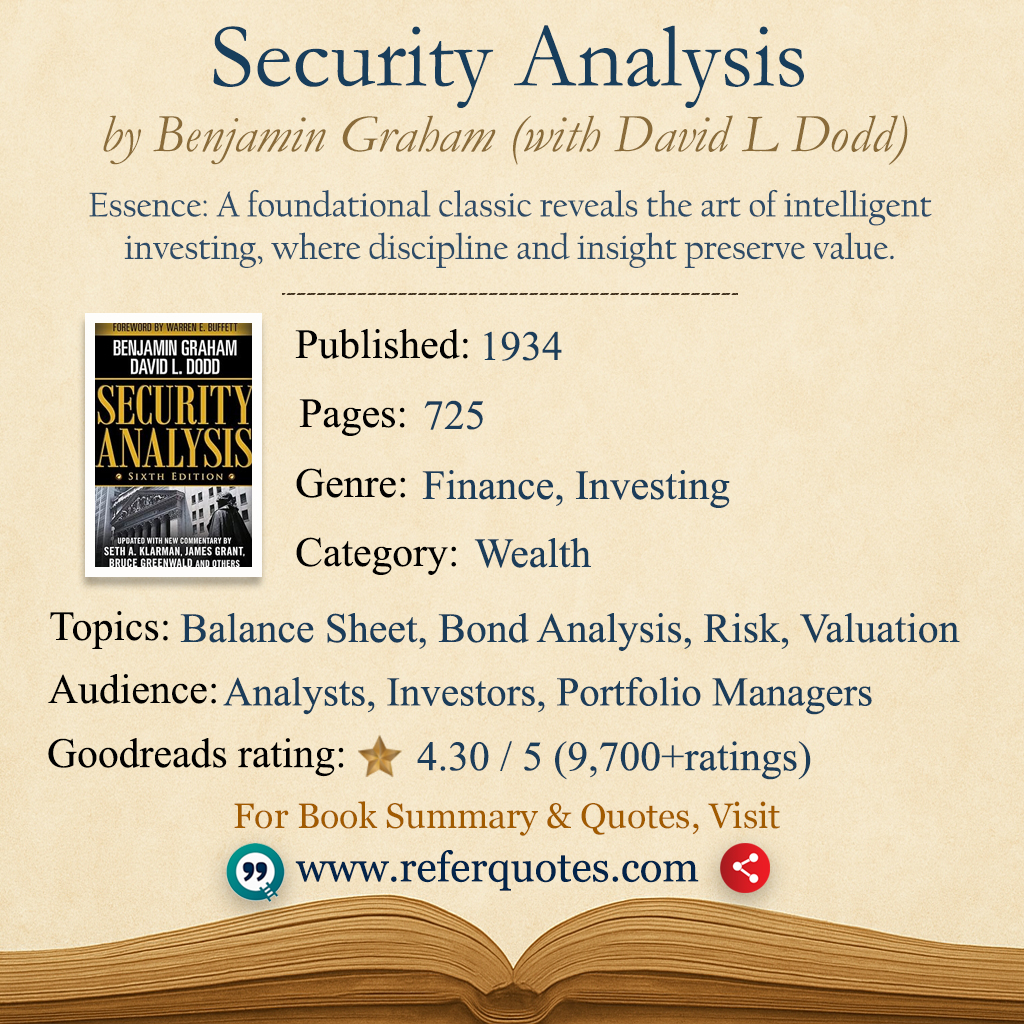
| Language | English (589) |
|---|---|
| Published On | 1934 (3) |
| Timeperiod | Modern (139) |
| Genre | finance (6), investing (4) |
| Category | Wealth (120) |
| Topics | balance sheet (2), bond analysis (1), risk (17), valuation (3), value investing (2) |
| Audiences | analysts (12), investors (98), mba students (1), portfolio managers (2) |
Table of Contents
- What’s Inside Security Analysis
- Book Summary
- Chapter Summary
- Security Analysis Insights
- Usage & Application
- Life Lessons
- FAQ
- Famous Quotes from Security Analysis
What’s Inside Security Analysis
Synopsis
A rigorous, principles-first manual that teaches you how to appraise securities, bonds, preferreds, and common stocks, by intrinsic value, demand a margin of safety, and separate true investment from speculation in all market climates.
Book Summary
- Treat stocks as ownership interests; value cash flows and assets, not price action.
- Use conservative assumptions and verify with multiple valuation cross-checks.
- Always require a margin of safety to absorb errors and volatility.
- Prefer evidence (financials, covenants, coverage ratios) over stories and sentiment.
- Focus on process quality, results follow from repeatable discipline.
Chapter Summary
- Part I: Survey and Approach – Defines investment vs. speculation; introduces intrinsic value and margin of safety.
- Part II: Fixed Value Investments – Framework for bonds and preferreds: coverage ratios, covenants, protection tests.
- Part III: Common Stock Analysis – Asset values, earnings power, dividends, and qualitative factors for equities.
- Part IV: Special Situations – Liquidations, reorganizations, and workouts as mispriced opportunities.
- Part V: Group and Industry Studies – Compares sectors to highlight patterns in quality, stability, and valuation.
- Part VI: Summary and Conclusions – Codifies principles: conservative assumptions, verification, and safety margin.
Security Analysis Insights
| Book Title | Security Analysis |
| Book Subtitle | Sixth Edition, Foreword by Warren Buffett |
| Author | Benjamin Graham and David L. Dodd |
| Publisher | McGraw-Hill |
| Translation | Original language: English; no translation required. |
| Details | Publication Year/Date: 1934; ISBN/Unique Identifier: 9780071592536; Last edition: 6th Edition (2008), Number of pages: 725. |
| Goodreads Rating | 4.30 / 5 – 9,700 ratings – 238 reviews |
Usage & Application
How to Use This Book
Here’s how to put Graham’s playbook to work today.
First, if you’re evaluating a dividend stock, build a simple owner’s earnings model, haircut growth by 30%, and check interest coverage and payout ratios. If the implied yield under conservative assumptions is still attractive, you’ve likely found value.
Second, when screening corporate bonds, filter for interest coverage >4x, net debt/EBITDA <3x, and strong covenants, then price in a default spread consistent with recessionary stress.
Third, in small-cap research, anchor on tangible book, normalize margins to 5-year medians, and demand a 25–40% discount to your base-case valuation. This process improves win rates, reduces downside, and keeps you from chasing narratives.
Start small: pick one sector, document assumptions, and require a margin of safety before you hit “buy.”
Video Book Summary
Life Lessons
- True investment begins with protection of capital; return comes second.
- Price is not value, verify value with multiple, independent tests.
- Conservatism in assumptions beats precision in forecasts.
- A margin of safety turns uncertainty into acceptable risk.
- Discipline and process compound more reliably than hunches.