
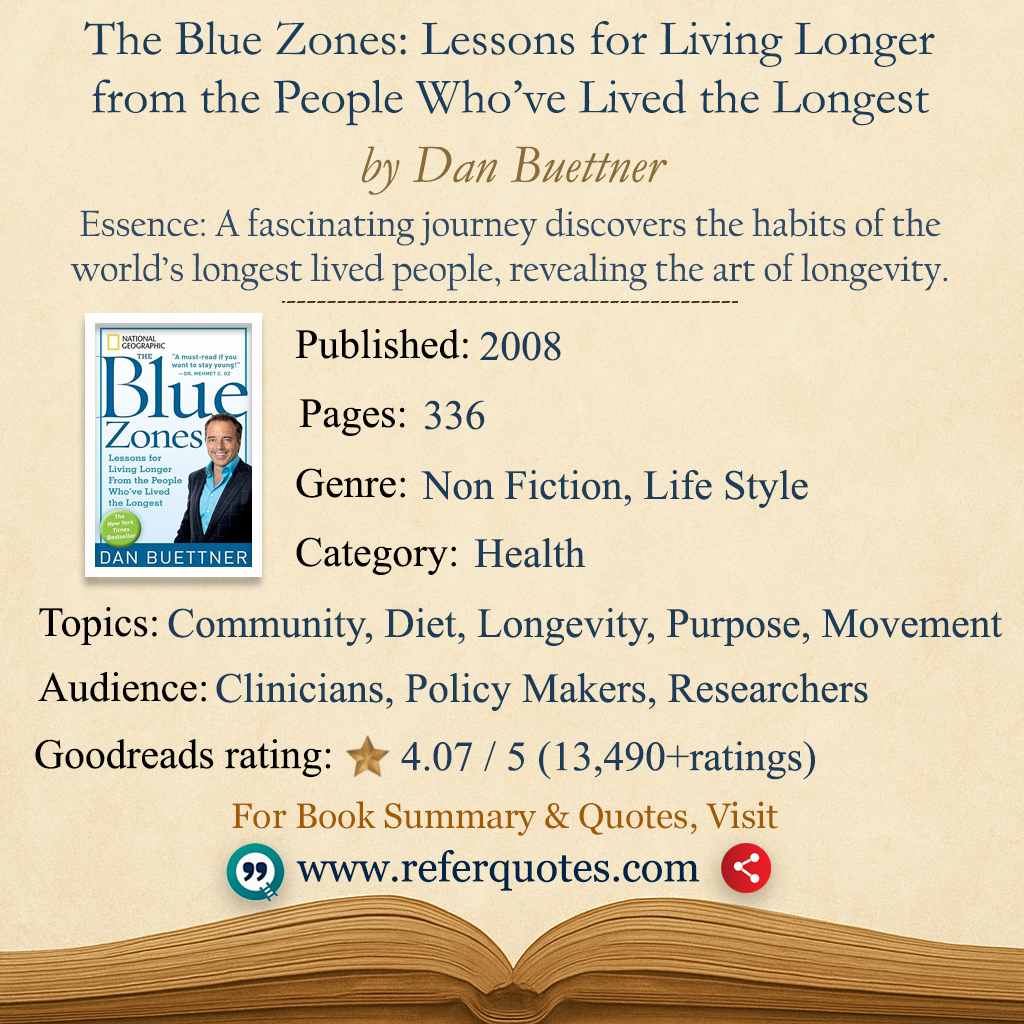
- Small, daily habits especially eating mostly plants, natural movement, and strong social ties, compound into decades of added life.
- Longevity is a community design problem as much as a personal discipline challenge.
Book Summary
| Language | English (548) |
|---|---|
| Published On | 2008 (4) |
| Timeperiod | 21st Century (226) |
| Genre | lifestyle (1), nonfiction (88) |
| Category | Health (56) |
| Topics | community (3), diet (6), longevity (10), movement (3), purpose (26) |
| Audiences | clinicians (7), health seekers (1), policy makers (3), researchers (11), wellness coaches (7) |
Table of Contents
- What’s Inside The Blue Zones: Lessons for Living Longer from the People Who’ve Lived the Longest
- Book Summary
- Chapter Summary
- The Blue Zones: Lessons for Living Longer from the People Who’ve Lived the Longest Insights
- Usage & Application
- Life Lessons
- FAQ
- Famous Quotes from The Blue Zones: Lessons for Living Longer from the People Who’ve Lived the Longest
What’s Inside The Blue Zones: Lessons for Living Longer from the People Who’ve Lived the Longest
Synopsis
A global investigation into the world’s longest-lived communities, distilling their daily habits, diets, environments, and social structures into actionable practices anyone can adopt to live longer, healthier, and happier.
Book Summary
- Prioritize plant-forward eating and the 80% rule to avoid chronic overeating.
- Build daily natural movement into your environment instead of chasing willpower.
- Cultivate purpose, downshift to reduce stress, and anchor into faith or community.
- Invest in close family ties and a “right tribe” that normalizes healthy choices.
Chapter Summary
- Introduction – Defines Blue Zones and the evidence behind identifying longevity hotspots.
- Sardinia, Italy – Mountain life, familial bonds, and natural movement in daily routines.
- Okinawa, Japan – Plant-based staples, ikigai (purpose), and moai (social groups).
- Loma Linda, California – Faith-based lifestyle, rest, and community support among Adventists.
- Nicoya Peninsula, Costa Rica – Calcium-rich water, purpose after retirement, and strong families.
- Ikaria, Greece (updated edition) – Mediterranean diet, slow living, naps, and communal life.
- The Power 9 – Distills shared habits into nine longevity principles.
- Making It Work – Practical strategies to apply Blue Zones lessons at home and in communities.
The Blue Zones: Lessons for Living Longer from the People Who’ve Lived the Longest Insights
| Book Title | The Blue Zones |
| Book Subtitle | Lessons for Living Longer from the People Who've Lived the Longest |
| Author | Dan Buettner |
| Publisher | National Geographic Society |
| Translation | Original language: English (not a translation). |
| Details | Publication Year/Date: 2008; ISBN: 978-1426207556; Last edition: National Geographic Society (2012), 336 pages. |
| Goodreads Rating | 4.07 / 5 – 13,490 ratings – 1,315 reviews |
About the Author
Dan Buettner, a National Geographic Fellow who led teams to identify Blue Zones across five regions and turned those insights into citywide programs that improve well-being.
| Official Website | Facebook | X| Instagram | YouTube
Usage & Application
How to Use This Book
Here’s how to put this into action fast.
Scenario 1: You’re a busy professional gaining weight yearly. Switch to a plant-slant lunch (beans + greens + whole grains), cap portions with the 80% rule, and design friction put fruit on your desk, sneakers by the door to trigger natural movement.
Scenario 2: You manage a team with burnout. Add a 10-minute daily downshift ritual (walk-meeting or breathwork), schedule one shared plant-forward team meal weekly, and pair coworkers as accountability “moai” buddies.
Scenario 3: City or HR wellness lead? Reconfigure cafeterias to default to beans, greens, and whole grains; add walking loops and nudge signage; celebrate purpose workshops. Small environmental tweaks outperform willpower by 2–3x. Start today: change your pantry, calendar, and social circle, your habits will follow.
Video Book Summary
Life Lessons
- Design beats discipline: shape your environment so healthy choices are the default.
- Move naturally: build light, frequent activity into chores, commuting, and leisure.
- Eat mostly plants and stop at 80% full to avoid chronic overeating.
- Belong and connect: strong family and community ties protect health and extend life.
- Live with purpose and downshift daily to lower stress and inflammation.