
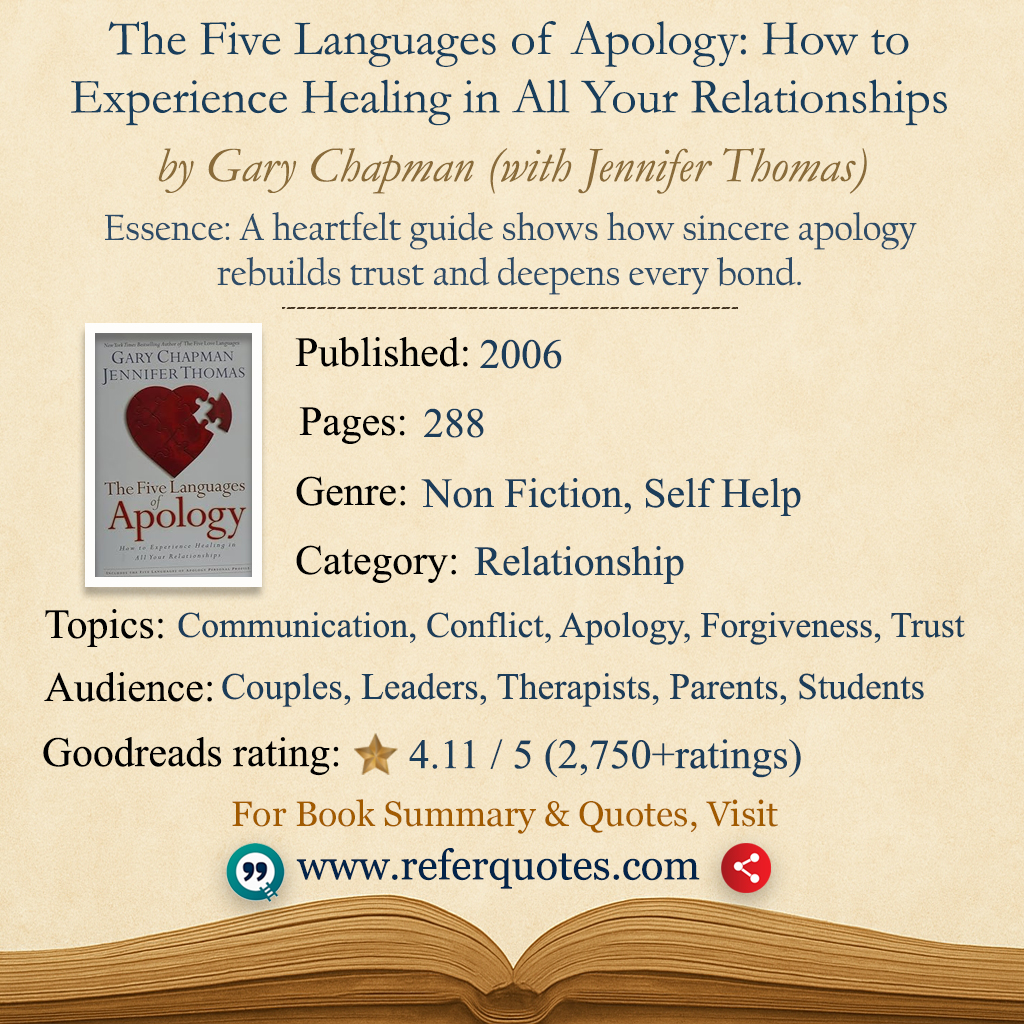
The Five Languages of Apology: How to Experience Healing in All Your Relationships by Gary Chapman (with Jennifer Thomas) is a practical guide to making things right. If you’re looking for The Five Languages of Apology: How to Experience Healing in All Your Relationships book summary, here’s the core: it explains five distinct ways people prefer to receive apologies and how to repair trust effectively. You get a clear framework, self-assessments, and real examples to apply immediately. This book contains the five apology languages, scripts that work, and step-by-step ways to rebuild damaged relationships.
Key takeaways:
- Learn the five apology languages so your “sorry” actually lands.
- Use targeted apologies to heal trust with partners, family, co-workers.
Book Summary
| Language | English (580) |
|---|---|
| Published On | 2006 (5) |
| Timeperiod | 21st Century (232) |
| Genre | nonfiction (88), self-help (89) |
| Category | Relationship (61) |
| Topics | apology (2), communication (51), conflict (19), forgiveness (9), trust (28) |
| Audiences | couples (21), leaders (288), parents (59), students (427), therapists (52) |
Table of Contents
- What’s Inside The Five Languages of Apology: How to Experience Healing in All Your Relationships
- Book Summary
- Chapter Summary
- The Five Languages of Apology: How to Experience Healing in All Your Relationships Insights
- Usage & Application
- Life Lessons
- FAQ
- Famous Quotes from The Five Languages of Apology: How to Experience Healing in All Your Relationships
What’s Inside The Five Languages of Apology: How to Experience Healing in All Your Relationships
Synopsis
Chapman and Thomas outline five distinct apology languages and show how to match your apology to what the other person needs to hear. The book offers scripts, examples, and assessments to rebuild trust, resolve conflict, and restore relationships.
Book Summary
The Five Languages of Apology: How to Experience Healing in All Your Relationships book summary: This book introduces five distinct ways people prefer to receive apologies, Expressing Regret, Accepting Responsibility, Making Restitution, Genuinely Repenting, and Requesting Forgiveness, and shows how to use them to repair trust. It talks about how mismatched apology styles cause conflict to linger and how to tailor your apology so the other person feels understood and safe. Why is this book important? Because well-meaning apologies often miss the mark; matching the person’s apology language turns intent into healing action that actually restores the relationship. You’ll find assessments, scripts, and examples you can use with partners, family, friends, and teams.
Key takeaways:
- Diagnose your apology language and the other person’s to avoid repeat conflict.
- Use concrete, responsibility-taking language that names the harm.
- Pair apology with restitution and changed behavior to rebuild trust.
- Adapt apologies across cultures, power dynamics, and workplaces.
- Turn breakdowns into turning points using a repeatable framework.
Chapter Summary
- Chapter 1 – Why Apologies Matter: How broken trust erodes relationships and why generic “sorry” often fails.
- Chapter 2 – Discovering Apology Languages: Overview of the five languages and assessment.
- Chapter 3 – Expressing Regret: Naming the hurt and validating feelings without excuses.
- Chapter 4 – Accepting Responsibility: Owning actions, impact, and consequences clearly.
- Chapter 5 – Making Restitution: Tangible steps to make things right and restore equity.
- Chapter 6 – Genuinely Repenting: Commitments and habits that prevent repeat harm.
- Chapter 7 – Requesting Forgiveness: Inviting choice and control back to the offended party.
- Chapter 8 – Applying in Marriage and Family: Tailoring apologies for partners, parents, and kids.
- Chapter 9 – Work and Leadership: Repairing trust with colleagues, teams, and customers.
- Chapter 10 – Barriers and Missteps: Defensiveness, cultural nuance, and power dynamics.
- Chapter 11 – Building a Lifestyle of Repair: Daily practices to keep trust strong.
The Five Languages of Apology: How to Experience Healing in All Your Relationships Insights
| Book Title | The Five Languages of Apology |
| Book Subtitle | How to Experience Healing in All Your Relationships |
| Author | Gary Chapman; Jennifer Thomas |
| Publisher | Northfield Publishing (an imprint of Moody Publishers) |
| Translation | Original in English; not a translation |
| Details | Publication Year: 2006; ISBN: 978-1881273578; Last Edition: 2008; Number of Pages: 288. |
| Goodreads Rating | 4.11 / 5 – 2,750 ratings – 233 reviews |
Usage & Application
How to Use This Book
When you’ve blown a deadline and frustrated your team, don’t stop at “sorry.” Say, “I missed the mark; that put pressure on you (accepting responsibility). I’ll handle the client comms and finish the deck tonight (restitution). I’ve blocked time to avoid repeats (repentance).
Will you accept my apology?” In marriage, replace vague apologies with specifics: “I dismissed your concern (responsibility). I’m listening now and scheduling the appointment you asked for (restitution). I’ll check in weekly so it doesn’t slip (repentance).”
With a teenager, validate feelings first, then offer options for repair. Use the assessment to find each person’s top two apology languages. Track outcomes: fewer repeats, faster recovery, and stronger trust. Your next step: pick one relationship, map their apology language, and deliver a tailored apology within 24 hours.
Video Book Summary
Life Lessons
- Effective apologies are audience-specific; the right language turns intent into impact.
- Owning harm without excuses is the fastest path to rebuilding trust.
- Restitution and changed behavior make apologies credible and durable.
- Requesting forgiveness returns agency to the offended person and closes the loop.
- Repair is a repeatable skill that strengthens every relationship over time.