
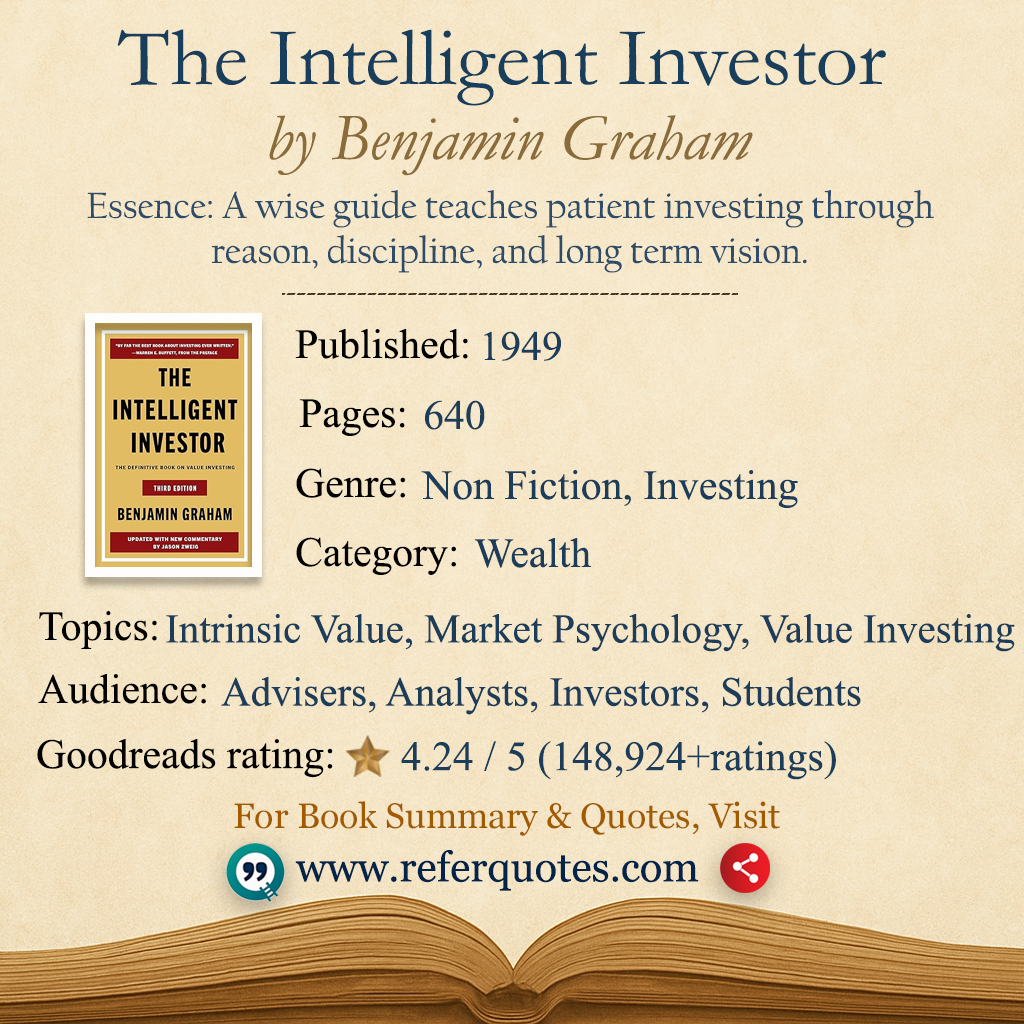
The Intelligent Investor by Benjamin Graham is the timeless guide to value investing that Warren Buffett calls “by far the best book on investing ever written.” If you’re searching for a clear The Intelligent Investor book summary, here’s the essence: the book contains a complete framework for building wealth through disciplined analysis, risk control, and long-term thinking. It teaches you how to separate speculation from investment and how to protect yourself against market swings. Authored by the father of value investing, it blends principles, case studies, and practical checklists.
Key takeaways:
- Focus on “margin of safety” and intrinsic value, not market hype.
- Adopt a defensive or enterprising strategy that fits your temperament and effort.
Book Summary
| Language | English (552) |
|---|---|
| Published On | 1949 (2) |
| Timeperiod | Modern (115) |
| Genre | investing (4), nonfiction (88) |
| Category | Wealth (110) |
| Topics | intrinsic value (1), market psychology (1), portfolio policy (1), risk management (1), value investing (2) |
| Audiences | advisers (1), analysts (8), investors (85), students (403) |
Table of Contents
- What’s Inside The Intelligent Investor
- Book Summary
- Chapter Summary
- The Intelligent Investor Insights
- Usage & Application
- Life Lessons
- FAQ
- Famous Quotes from The Intelligent Investor
What’s Inside The Intelligent Investor
Synopsis
A rigorous, plainspoken manual that teaches you how to invest with discipline, assess intrinsic value, control risk, and exploit market fluctuations, anchored by the core principle of margin of safety and a temperament-first approach to long-term returns.
Book Summary
The Intelligent Investor book summary centers on Graham’s evidence-based playbook for buying securities below intrinsic value and protecting yourself from Wall Street’s mood swings. The book talks about two realistic paths, defensive (hands-off, diversified, low-cost) and enterprising (active, research-driven), and shows how to choose based on your temperament and effort. Why is this book important? It reframes investing as a behavior and risk-control discipline, not a prediction game. It arms you with margin of safety, rational portfolio policy, and a method to ignore market noise, universal skills that compound across careers and life decisions.
Key takeaways:
- Prioritize margin of safety to minimize downside and allow upside to compound.
- Treat Mr. Market as your servant, not your guide, use volatility to your advantage.
- Match strategy to character: defensive vs. enterprising, not one-size-fits-all.
- Analyze earnings quality, balance-sheet strength, and valuation, not headlines.
- Costs, taxes, and discipline matter as much as stock picking.
Chapter Summary
- Ch. 1 – Investment vs. Speculation: Defines investing as safety of principal and adequate return.
- Ch. 2 – The Investor and Inflation: How inflation distorts returns and what protects purchasing power.
- Ch. 3 – A Century of Market History: Puts valuations in historical context to set expectations.
- Ch. 4 – Portfolio Policy (Defensive): Simple asset allocation and diversification rules.
- Ch. 5 – Defensive Investor & Common Stocks: Criteria for safe, low-effort stock selection.
- Ch. 6 – Portfolio Policy (Enterprising) – Negative: What to avoid to reduce errors.
- Ch. 7 – Portfolio Policy (Enterprising) – Positive: Where to hunt for mispriced assets.
- Ch. 8 – The Investor and Market Fluctuations: Use volatility; don’t be used by it.
- Ch. 9 – Investing in Investment Funds: Pros/cons of mutual funds and fees.
- Ch.10 – The Investor and His Advisers: How to evaluate professional advice.
- Ch.11 – Security Analysis for the Lay Investor: A practical, simplified checklist.
- Ch.12 – Per-Share Earnings: Adjust for accounting quirks and cyclical effects.
- Ch.13 – Four Listed Companies: Case studies in quality and valuation.
- Ch.14 – Stock Selection (Defensive): Quantitative filters for sensible picks.
- Ch.15 – Stock Selection (Enterprising): Deeper research and special situations.
- Ch.16 – Convertibles and Warrants: Hidden risks and valuation traps.
- Ch.17 – Four Case Histories: Lessons from successes and mistakes.
- Ch.18 – Eight Pairs of Companies: Comparative analysis to spot value.
- Ch.19 – Shareholders and Managements; Dividends: Governance and payout policy.
- Ch.20 – Margin of Safety: The central principle of sound investing.
The Intelligent Investor Insights
| Book Title | The Intelligent Investor |
| Book Subtitle | The Definitive Book on Value Investing. A Book of Practical Counsel. |
| Author | Benjamin Graham |
| Publisher | Harper & Brothers (1949); HarperBusiness/HarperCollins (Revised ed., 2003) |
| Translation | None (originally published in English) |
| Details | Publication Year/Date: 1949; ISBN/Unique Identifier: 978-0060555665; Last edition: Revised Edition by Jason Zweig (2006), 640 pages. |
| Goodreads Rating | 4.24 / 5 – 148,924 ratings – 4,066 reviews |
About the Author
Benjamin Graham, has brought investing to masses by focussing on analysis and risk control. He is the mentor to Warren Buffett as his ideas form the basis of value investing.
Usage & Application
How to Use This Book
Most people think investing is about picking winners. Wrong. It’s about rules you can follow on your worst day. Here’s how to apply Graham today:
1) You’re a busy professional with a 401(k). Go defensive: 60/40 (or age-adjusted) index funds, rebalance annually, and ignore CNBC. That one move can cut fees by 1%+ a year and add six figures over decades.
2) You’re a builder who loves research. Go enterprising: screen for low P/E, low debt, consistent free cash flow, and a 25–40% margin of safety; buy in tranches and let volatility work for you.
3) You’re sitting on cash post-bear market. Use Mr. Market: set buy ranges based on intrinsic value, not price memory. Next step: write a one-page policy (allocation, screens, sell rules) and stick to it for 12 months.
Video Book Summary
Life Lessons
- Temperament beats IQ: discipline and patience drive returns.
- Margin of safety protects you from being precisely wrong.
- Price is what you pay; value is what you get, learn to estimate it.
- Volatility is a tool, not a threat; let Mr. Market serve you.
- Match your strategy to your effort and character, then automate discipline.