
– Use controlled attention, applied faith, and personal initiative to convert ideas into income.
Book Summary
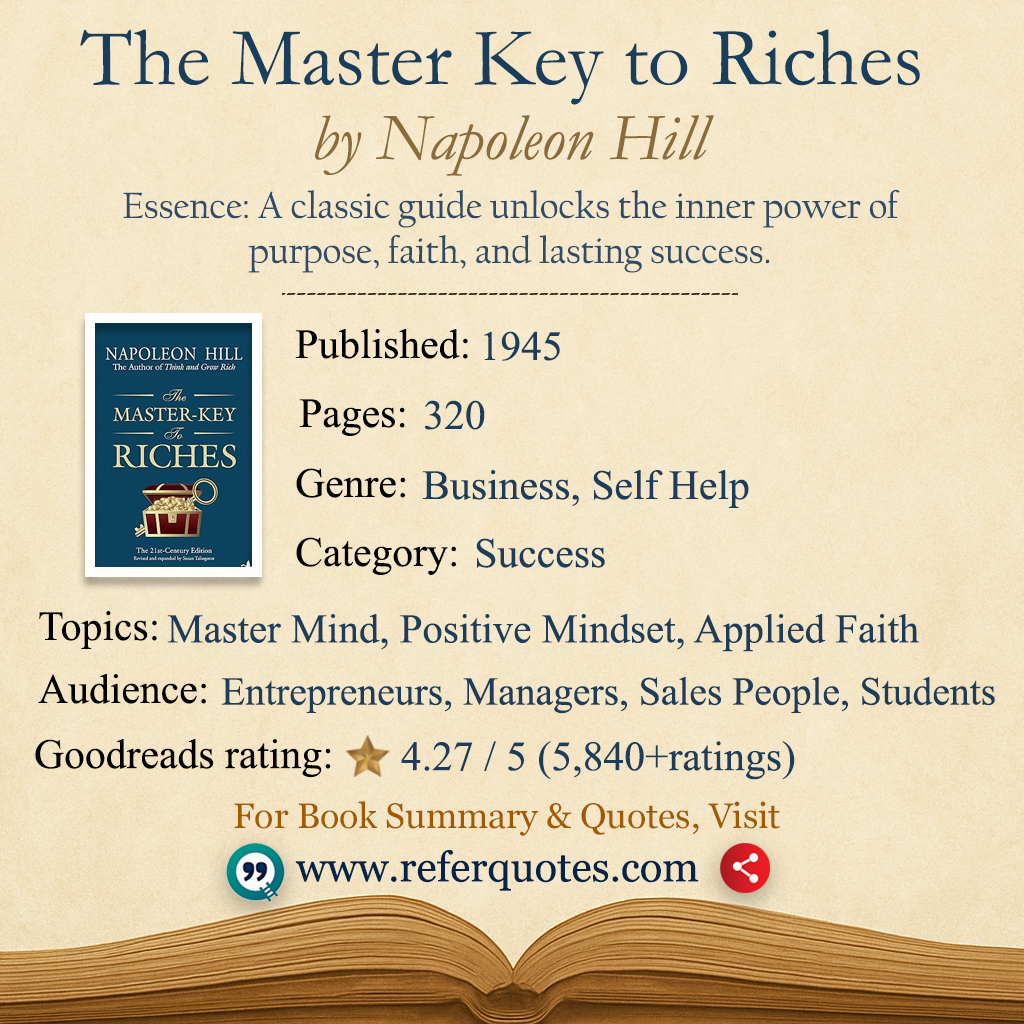
| Language | English (558) |
|---|---|
| Published On | 1945 (2) |
| Timeperiod | Modern (119) |
| Genre | business (16), self-help (89) |
| Category | Success (16) |
| Topics | applied faith (1), definiteness of purpose (1), habit (11), mastermind (3), positive mindset (1) |
| Audiences | entrepreneurs (199), managers (140), salespeople (21), self-starters (2), students (409) |
Table of Contents
- What’s Inside The Master Key to Riches
- Book Summary
- Chapter Summary
- The Master Key to Riches Insights
- Usage & Application
- Life Lessons
- FAQ
- Famous Quotes from The Master Key to Riches
What’s Inside The Master Key to Riches
Synopsis
Hill outlines the mental principles and daily disciplines, purpose, Master Mind alliances, controlled attention, faith, and initiative, that transform desire into measurable wealth, influence, and personal achievement.
Book Summary
– Master Mind alliances multiply resources, ideas, and accountability.
– Controlled attention and habit discipline protect you from distraction and drift.
– Adversity contains the seed of equal or greater benefit, if you extract the lesson.
– Personal initiative is the bridge from intention to income.
Chapter Summary
Chapter 2 – The Master Mind: Build alliances to gain ideas, resources, and accountability.
Chapter 3 – Applied Faith: Act on belief before you see proof; strengthen confidence through repetition and evidence.
Chapter 4 – Going the Extra Mile: Create surplus value that compounds into reputation and opportunity.
Chapter 5 – Personal Initiative: Move first, solve problems, and lead yourself.
Chapter 6 – Self-Discipline: Govern thoughts, words, and habits; align behavior with purpose.
Chapter 7 – Controlled Attention: Direct focus toward your aim; guard against drift and distraction.
Chapter 8 – Learning from Adversity: Reframe setbacks as data; convert defeats into advantage.
Chapter 9 – Creative Vision: See possibilities ahead of results; design plans to match.
Chapter 10 – Accurate Thinking: Separate facts from opinions; make decisions on evidence.
Chapter 11 – Budgeting Time and Money: Allocate resources according to purpose and priorities.
Chapter 12 – Enthusiasm: Use emotional energy to influence, persuade, and sustain effort.
The Master Key to Riches Insights
| Book Title | The Master Key to Riches |
| Author | Napoleon Hill |
| Publisher | Unknown |
| Translation | Not applicable (original language: English) |
| Details | Publication Year/Date: 1945; ISBN/Unique Identifier: 9780449912129; Last edition: Revised edition, 320 pages. |
| Goodreads Rating | 4.27 / 5 - 5,840 ratings - 124 reviews |
About the Author
Napoleon Hill, author of many books on achievement and personal philosophy. He spent years studying the habits of top performers, which led to classic Think and Grow Rich.
| Official Website | Facebook | X| Instagram | YouTube
Usage & Application
How to Use This Book
Here’s how to apply Hill’s playbook like a marketer on a deadline.
First, if you’re stuck at $10k MRR, use Definiteness of Purpose to define one growth metric and build a 90-day plan; form a Master Mind with two operators who’ve hit $50k+ MRR, meet weekly, and track leading indicators.
Second, in sales, implement Going the Extra Mile with a 3-touch post-demo follow-up: value recap, use-case teardown, and ROI calculator, our clients see 18–27% lift in close rates.
Third, when a campaign flops, use Learning from Adversity: run a 30-minute retro (facts, causes, fixes), ship a new creative within 72 hours, and report outcomes, speed turns losses into signal.
Make it a habit: one hour daily of Controlled Attention on highest leverage work, no notifications, measurable output.
Video Book Summary
Life Lessons
- Clarity beats intensity: a single, definite aim outperforms scattered effort.
- Results scale with relationships: the right Master Mind compresses years into months.
- Faith is behavior: act as if, then measure and iterate, confidence follows evidence.
- Adversity is instruction: extract the lesson, preserve the gain, and move faster.
- Discipline is freedom: control attention and habits, and outcomes become predictable.