
Book Summary
| Language | English (548) |
|---|---|
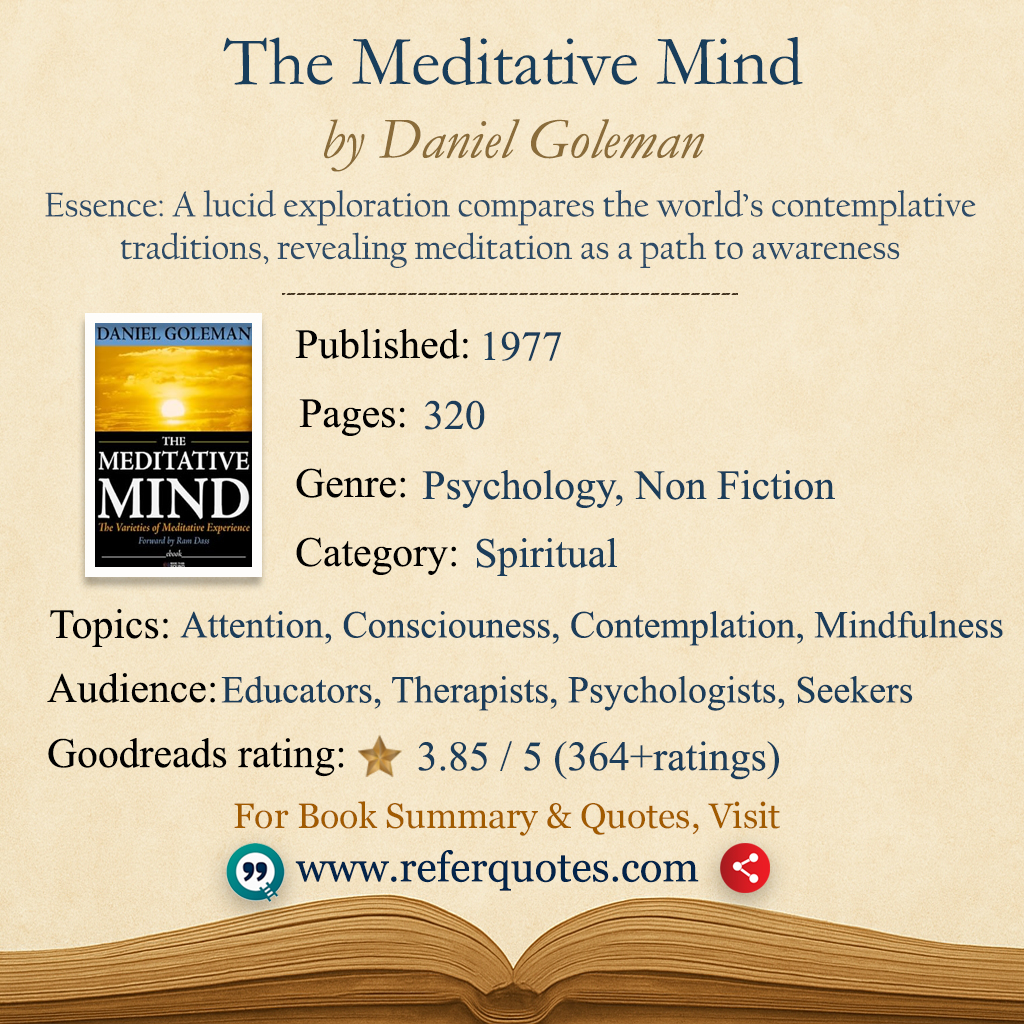
| Published On | 1977 (2) |
| Timeperiod | Modern (114) |
| Genre | nonfiction (88), psychology (18) |
| Category | Spiritual (28) |
| Topics | attention (10), consciousness (2), contemplation (1), meditation (1), mindfulness (7) |
| Audiences | educators (31), meditators (2), psychologists (12), seekers (43), therapists (51) |
Table of Contents
- What’s Inside The Meditative Mind: The Varieties of Meditative Experience
- Book Summary
- Chapter Summary
- The Meditative Mind: The Varieties of Meditative Experience Insights
- Usage & Application
- Life Lessons
- FAQ
- Famous Quotes from The Meditative Mind: The Varieties of Meditative Experience
What’s Inside The Meditative Mind: The Varieties of Meditative Experience
Synopsis
A comparative guide to how major contemplative traditions train attention and emotion, chart progress, and describe outcomes, linking classical meditative maps with modern psychology and empirical findings.
Book Summary
The Meditative Mind: The Varieties of Meditative Experience book summary: Daniel Goleman surveys Buddhist, Hindu, Sufi, Christian, and Jewish contemplative systems to show how different methods shape attention, emotion, and awareness. It answers, clearly and quickly, what each practice aims to cultivate and how progress is recognized. Why this book matters: it bridges rigorous psychological insight with time tested spiritual maps, helping you choose a practice aligned with your goals and understand likely benefits and pitfalls.
– Compares attentional training (e.g., mindfulness, concentration) across traditions.
– Clarifies developmental “stages” and common obstacles in practice.
– Connects ancient frameworks with empirical research.
– Offers practical guidance on choosing and evaluating a method.
– Encourages ethical grounding and consistency to sustain gains.
Chapter Summary
Foundation – Awareness, discipline, compassion, and non-attachment as the pillars of inner growth.
Attention – Train the mind to focus and observe without distraction.
Mindfulness – Cultivate moment-to-moment awareness free from judgment.
Concentration – Deepen stillness through single pointed focus and mental clarity.
Insight – See the impermanent, interconnected nature of experience.
Devotion – Open the heart through love, faith, and surrender.
Transformation – Let meditation reshape perception, emotion, and behavior.
Liberation – Transcend ego and duality to rest in pure awareness.
Putting It Together – Integrate meditative wisdom into daily life for balanced mind, compassion, and freedom.
The Meditative Mind: The Varieties of Meditative Experience Insights
| Book Title | The Meditative Mind |
| Book Subtitle | The Varieties of Meditative Experience |
| Author | Daniel Goleman |
| Publisher | Anchor Press/Doubleday (1977, as “The Varieties of the Meditative Experience”); Jeremy P. Tarcher/Putnam (1988 revised as “The Meditative Mind”; later reprints) |
| Translation | None (original English) |
| Details | Publication Year/Date: 1977 (originally as The Varieties of Meditative Experience, revised 1988 as The Meditative Mind); ISBN: 9780874778335; Last Edition: Tarcher/Putnam 1988; Number of pages: 320. |
| Goodreads Rating | 3.85 / 5 – 364 ratings – 31 reviews |
About the Author
Dr. Daniel Goleman is a psychologist and bestselling author whose journalism at The New York Times brought brain and behavior science to a wide audience.
| Official Website
Usage & Application
How to Use This Book
Here’s how to put this to work fast.
Scenario 1: You’re overwhelmed at work and trying apps that don’t stick. Use Goleman’s attention maps to pick one core skill (breath-focused concentration or open monitoring). Commit 10 minutes daily for 30 days track stress and focus; aim for a 20% reduction in context-switching.
Scenario 2: You lead a wellness program. Match practices to outcomes: concentration for sustained focus, loving-kindness for empathy and team cohesion, mindfulness for emotion regulation. Pilot with a 6-week curriculum, measure absenteeism and self-reports, and iterate weekly.
Scenario 3: You’re a therapist or coach. Integrate short, evidence-aligned practices that complement treatment goals (e.g., open monitoring before CBT exposure). Keep it simple, measurable, and habit-based.
Video Book Summary
Life Lessons
- Attention is trainable; method choice should match the outcome you want.
- Ethical intention and consistency stabilize long term benefits.
- Different traditions share common mechanisms despite varied language.
- Progress follows recognizable stages, expect plateaus and pitfalls.
- Scientific insight can refine ancient practices without diluting them.