
– Motivational interviewing and confident humility make you more persuasive and adaptable.
Book Summary
| Language | English (583) |
|---|---|
| Published On | 2021 (2) |
| Timeperiod | 21st Century (234) |
| Genre | nonfiction (88), psychology (18) |
| Category | Personal Development (78) |
| Topics | critical thinking (2), decision making (5), open mind (1), persuasion (11), unlearning (1) |
| Audiences | entrepreneurs (202), leaders (290), managers (142), professionals (131), students (431) |
Table of Contents
- What’s Inside Think Again: The Power of Knowing What You Don’t Know
- Book Summary
- Chapter Summary
- Think Again: The Power of Knowing What You Don’t Know Insights
- Usage & Application
- Life Lessons
- FAQ
- Famous Quotes from Think Again: The Power of Knowing What You Don’t Know
What’s Inside Think Again: The Power of Knowing What You Don’t Know
Synopsis
A research-driven playbook for unlearning outdated beliefs, embracing confident humility, and persuading others through curiosity, evidence, and better questions, so you make smarter decisions, build healthier teams, and adapt faster in a changing world.
Book Summary
Think Again book summary: This book talks about how to rethink your assumptions, unlearn stale beliefs, and make better decisions by thinking like a scientist. Adam Grant shows you how to avoid preacher, prosecutor, and politician traps and adopt a mindset of confident humility. Why is this book important? Because progress depends less on what you know and more on how quickly you can update what you think you know, at work, in relationships, and as citizens. You’ll learn practical tools like motivational interviewing, building challenge networks, and creating cultures that reward changing your mind when evidence changes.
Key takeaways:
– Thinking like a scientist beats defending your identity or tribe.
– Confidence + humility = better judgment and influence.
– Motivational interviewing persuades by helping others voice their own reasons to change.
– Challenge networks expose blind spots and improve decisions.
– Cultures thrive when they reward rethinking, not just being right.
Chapter Summary
Chapter 1: The Preacher, Prosecutor, Politician, and Scientist – Spot identity protective thinking and shift to evidence seeking habits.
Chapter 2: Confidence vs. Humility – Find the sweet spot: be sure enough to act, humble enough to rethink.
Chapter 3: The Joy of Being Wrong – Treat errors as data; detach opinions from identity.
Chapter 4: Good Fights – Use constructive debate rules to reduce polarization and sharpen ideas.
Chapter 5: Dances with Foes – Navigate disagreements with curiosity, not combat; ask better questions.
Chapter 6: Vaccine Whisperers & Climate Converts – Persuade with motivational interviewing and small concessions.
Chapter 7: Rethinking at Work – Build challenge networks; invite dissent to stress-test strategies.
Chapter 8: Breaking Routines – Replace “we’ve always done it this way” with experiments and small pilots.
Chapter 9: Escalation of Commitment – Cut sunk-cost bias; precommit to exit criteria and checklists.
Chapter 10: Facts, Falsehoods, and Nuance – Use probabilistic thinking; avoid binary frames and overconfidence.
Chapter 11: Actions for Impact – Practical tools to rethink as individuals, in conversations, and across teams.
Think Again: The Power of Knowing What You Don’t Know Insights
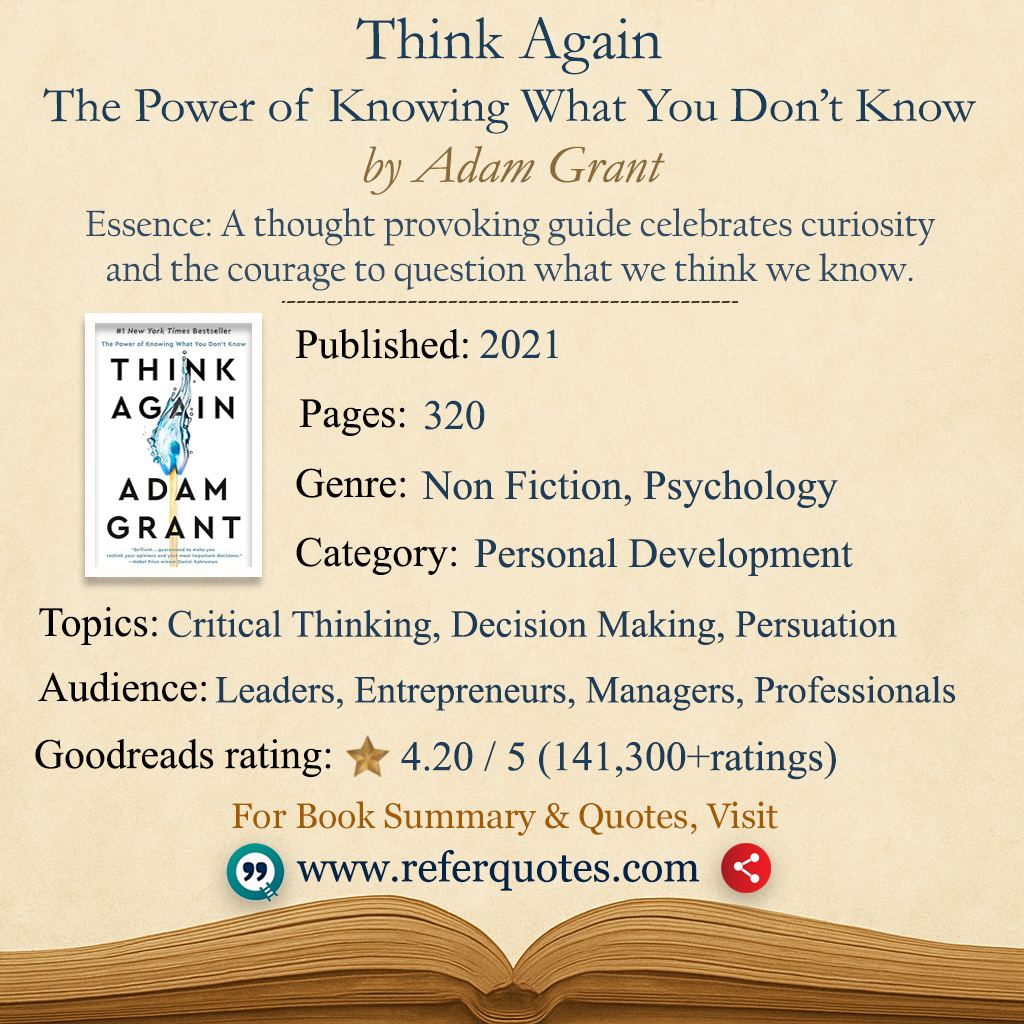
| Book Title | Think Again |
| Book Subtitle | The Power of Knowing What You Don't Know |
| Author | Adam Grant |
| Publisher | Viking |
| Translation | Original in English; no translation |
| Details | Publication Year/Date: 2021; ISBN/Unique Identifier: 978-1984878106; Last edition: Viking Press 2021; Number of pages: 320 |
| Goodreads Rating | 4.20 / 5 – 141,300 ratings – 9,143 reviews |
About the Author
Dr. Adam Grant studies how people find motivation and meaning, and how leaders build better workplaces. He writer for New York Times and advises organizations on culture, and innovation.
| Official Website | Facebook | X| Instagram | YouTube
Usage & Application
How to Use This Book
Struggling to change a stuck strategy?
Run a two-week experiment with clear success metrics. If the data flops, pivot, don’t defend the sunk cost. Hiring or promotions? Use a challenge network: share your choice with 3 skeptics and ask them to poke holes; you’ll surface blind spots before they get expensive. Selling an idea to a resistant stakeholder? Stop pitching.
Ask three open questions, reflect their words, and invite them to set a small test. When people generate their own reasons to change, adoption skyrockets. Coaching a team? Normalize “I might be wrong” and reward revisions made after new data.
You’ll reduce groupthink and raise performance. Start small, measure honestly, and iterate like a scientist, your win rate improves because your error rate teaches you faster.
Video Book Summary
Life Lessons
• Changing your mind when evidence changes is a strength, not a weakness.
• Curiosity and questions outperform certainty and speeches in persuasion.
• Build a challenge network to stress-test your thinking and reduce blind spots.
• Use experiments to replace opinion wars with data-driven decisions.
• Detach opinions from identity so mistakes become fuel for learning.