
- Success starts with a definite purpose and a written plan acted on daily.
- Your thoughts, reinforced by faith and repetition, program your subconscious to drive results.
Book Summary
| Language | English (556) |
|---|---|
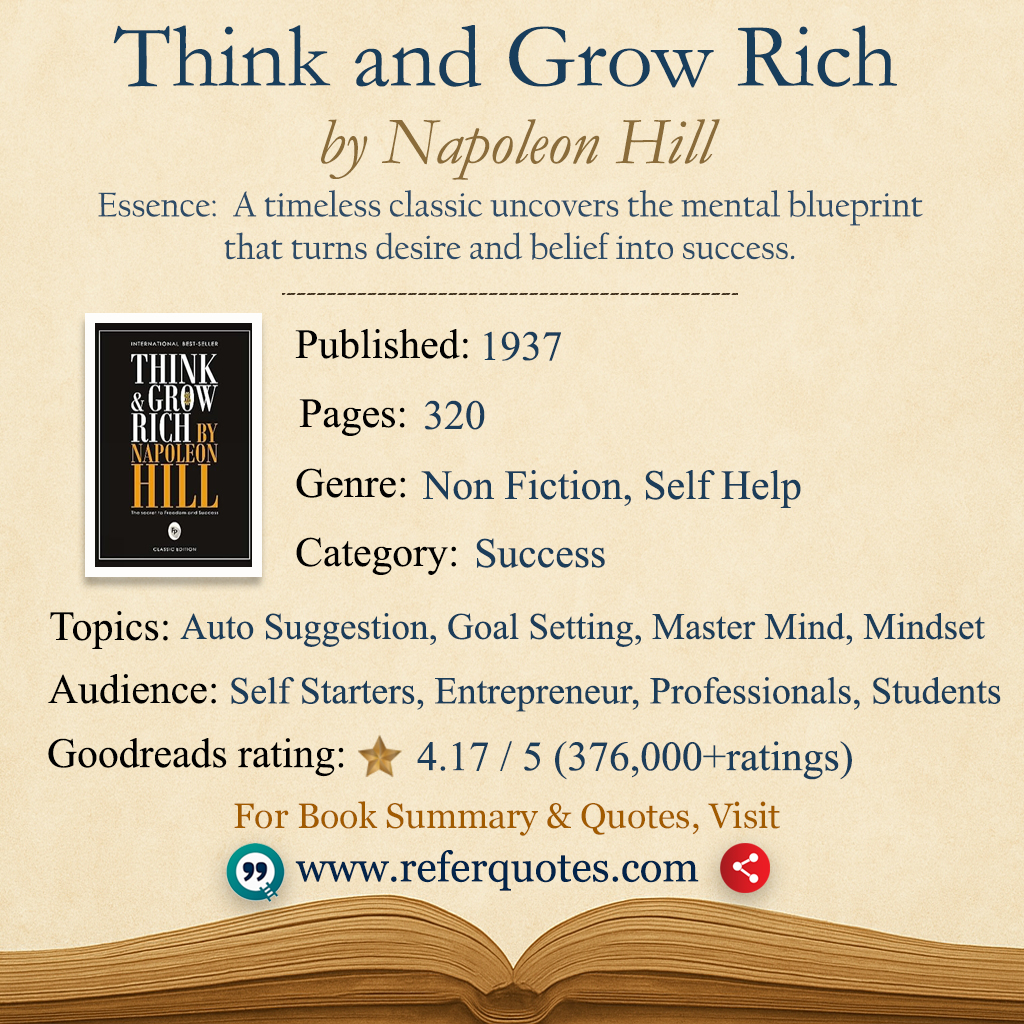
| Published On | 1937 (2) |
| Timeperiod | Modern (117) |
| Genre | nonfiction (88), self-help (89) |
| Category | Success (16) |
| Topics | autosuggestion (1), goal setting (10), mastermind (3), mindset (41), persistence (5) |
| Audiences | entrepreneurs (198), professionals (125), salespeople (21), self-starters (2), students (406) |
Table of Contents
- What’s Inside Think and Grow Rich
- Book Summary
- Chapter Summary
- Think and Grow Rich Insights
- Usage & Application
- Life Lessons
- FAQ
- Famous Quotes from Think and Grow Rich
What’s Inside Think and Grow Rich
Synopsis
A practical philosophy of achievement that converts desire into results through clearly defined goals, belief, autosuggestion, organized planning, persistence, and a supportive mastermind, summarizing success patterns observed in hundreds of high achievers.
Book Summary
- Define a specific, written goal with a deadline and a daily plan.
- Reinforce belief via repeated self-instruction (autosuggestion) and evidence.
- Build a mastermind to access skills, accountability, and momentum.
- Decide fast, persist long, and iterate your plan, not your goal.
- Master fear by acting on clear purpose and documented progress.
Chapter Summary
- Introduction – Thoughts shape outcomes; success follows a definable philosophy.
- 1. Thoughts Are Things – Your dominant thoughts, backed by emotion, become reality.
- 2. Desire – Clarify a burning desire with a specific, written goal and deadline.
- 3. Faith – Build unwavering belief through visualization and repeated affirmation.
- 4. Autosuggestion – Program the subconscious with positive, goal-focused self-talk.
- 5. Specialized Knowledge – Acquire targeted knowledge and apply it to your plan.
- 6. Imagination – Use synthetic and creative imagination to craft strategies.
- 7. Organized Planning – Convert desire into action via detailed, flexible plans.
- 8. Decision – Eliminate procrastination; decide quickly and change slowly.
- 9. Persistence – Sustain effort despite setbacks until results appear.
- 10. Power of the Master Mind – Leverage collective intelligence and support.
- 11. The Mystery of Sex Transmutation – Channel creative energy into productive work.
- 12. The Subconscious Mind – Align subconscious impulses with your goals.
- 13. The Brain – Think of the brain as a transmitter/receiver of ideas.
- 14. The Sixth Sense – Develop intuition to guide high-stakes decisions.
- How to Outwit the Six Ghosts of Fear – Confront fear, doubt, and indecision.
Think and Grow Rich Insights
| Book Title | Think and Grow Rich |
| Author | Napoleon Hill |
| Publisher | The Ralston Society (first edition, 1937); subsequent editions by multiple publishers including Tarcher/Penguin and The Napoleon Hill Foundation |
| Translation | Not applicable |
| Details | Publication Year: 1937; ISBN: 978-1-59330-200-9; Latest Edition: 2020; Number of Pages: 320 |
| Goodreads Rating | 4.17 / 5 – 376,000+ ratings – 11,000+ reviews |
About the Author
Napoleon Hill, author of many books on achievement and personal philosophy. He spent years studying the habits of top performers, which led to classic Think and Grow Rich.
| Official Website | Facebook | X| Instagram | YouTube
Usage & Application
How to Use This Book
Start with a 30-day sprint. Write a clear income or career goal (e.g., “$10,000/month in consulting revenue by Q4”), list five reasons it matters, and read it aloud twice daily.
Scenario 1: You’re launching a side business. Use organized planning: define your offer, build a weekly lead pipeline target (e.g., 20 outreach messages), and track conversions. Pair with a mastermind for accountability.
Scenario 2: You’re stuck at mid-level. Apply specialized knowledge: pick a high-leverage skill (e.g., SQL or copywriting), schedule 60 minutes/day for 8 weeks, and ship weekly projects.
Scenario 3: Sales slump. Use autosuggestion to reset belief, adopt a 2-hour daily prospecting block, and log 10 follow-ups/day. Iterate the plan, not the goal, based on real metrics.
Video Book Summary
Life Lessons
- Clarity plus commitment beats raw talent, every time.
- Your environment (mastermind) accelerates or blocks your growth.
- Belief is built by evidence: small wins stacked daily.
- Plans are prototypes, iterate relentlessly until they work.
- Fear fades when purpose and consistent action take the lead.