
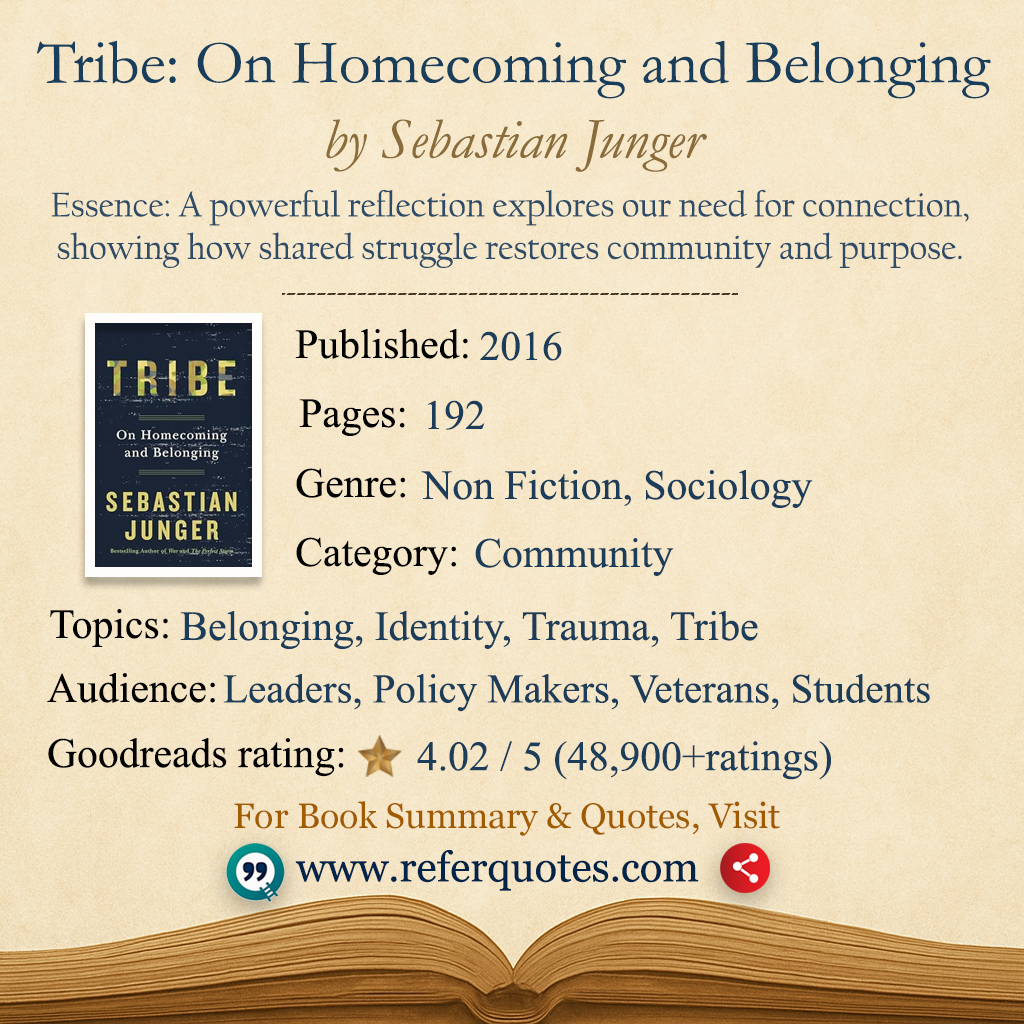
- Humans are wired for belonging; affluence and safety can paradoxically erode mental health.
- Shared purpose and mutual obligation reduce alienation and help people heal after trauma.
Book Summary
| Language | English (558) |
|---|---|
| Published On | 2016 (5) |
| Timeperiod | 21st Century (229) |
| Genre | nonfiction (88), sociology (2) |
| Category | Community (7) |
| Topics | belonging (6), identity (13), trauma (1), tribe (1) |
| Audiences | leaders (276), policymakers (2), students (409), veterans (2) |
Table of Contents
- What’s Inside Tribe: On Homecoming and Belonging
- Book Summary
- Chapter Summary
- Tribe: On Homecoming and Belonging Insights
- Usage & Application
- Life Lessons
- FAQ
- Famous Quotes from Tribe: On Homecoming and Belonging
What’s Inside Tribe: On Homecoming and Belonging
Synopsis
A sharp, humane argument that modern individualism isolates us, while small-group belonging, our ancestral “tribe”, delivers purpose, resilience, and healing, especially for veterans and communities facing crisis.
Book Summary
- Shared adversity and responsibility create stronger bonds than comfort alone.
- Veterans often struggle more with homecoming than combat due to social fragmentation.
- Disasters frequently lower depression and suicide by boosting communal purpose.
- Small “tribal” commitments, service, mentorship, mutual aid, build resilience.
- Belonging thrives where rights are balanced by responsibilities.
Chapter Summary
- The Men and the Dogs – How affluence and safety can isolate us; a street encounter reveals tribal generosity and dignity.
- War Makes You an Animal – Why combat forges deep cohesion and meaning; the evolutionary roots of group loyalty.
- In Bitter Safety I Awake – The hard part is coming home; PTSD, moral injury, and reintegration into an atomized society.
- Calling Home – Practical paths to rebuild tribe: mutual obligation, service, and small-group rituals that restore belonging.
Tribe: On Homecoming and Belonging Insights
| Book Title | Tribe |
| Book Subtitle | On Homecoming and Belonging |
| Author | Sebastian Junger |
| Publisher | Twelve (Hachette Book Group) |
| Translation | Original in English; no translation |
| Details | Publication Year: 2016; ISBN: 978-1-4555-6638-6; Last edition: 2017; Number of pages: 192. |
| Goodreads Rating | 4.02 / 5 – 48,900 ratings – 4,650 reviews |
About the Author
Sebastian Junger, journalist who co-directed the documentary Restrepo, which won the Grand Jury Prize at Sundance and was nominated for an Academy Award.
| Official Website
Usage & Application
How to Use This Book
You want results fast? Start where connection creates compounding returns.
1) Workplace: If your team is burnt out, run weekly 30-minute “after action reviews” with rotating ownership and clear norms for candor. Measure change in psychological safety scores in 4 weeks; expect a 15–25% bump in engagement.
2) Veteran transition: Pair each veteran with a three-person civilian council (peers, not pros) meeting biweekly with mutual goals (fitness, skills, volunteering). Track sleep and mood weekly; aim for a 20% improvement in 60 days.
3) Neighborhood resilience: Form a 10–15 person mutual aid pod with a shared contact tree and simple commitments (check-ins, tool sharing, meal swaps).
Run one small “stress drill” monthly (e.g., blackout practice). You’ll reduce friction, increase trust, and build the muscle memory that makes communities anti-fragile.
Video Book Summary
Life Lessons
- Belonging beats comfort: meaning comes from mutual obligation, not convenience.
- Shared adversity bonds; shared purpose heals.
- Rights need responsibilities or community frays.
- Small, repeated acts of service rebuild trust fast.
- Homecoming requires a role, not just a welcome.