
- Facing mortality clarifies what truly matters.
- “Normal” can be a trap; embracing difference can be healing.
Book Summary
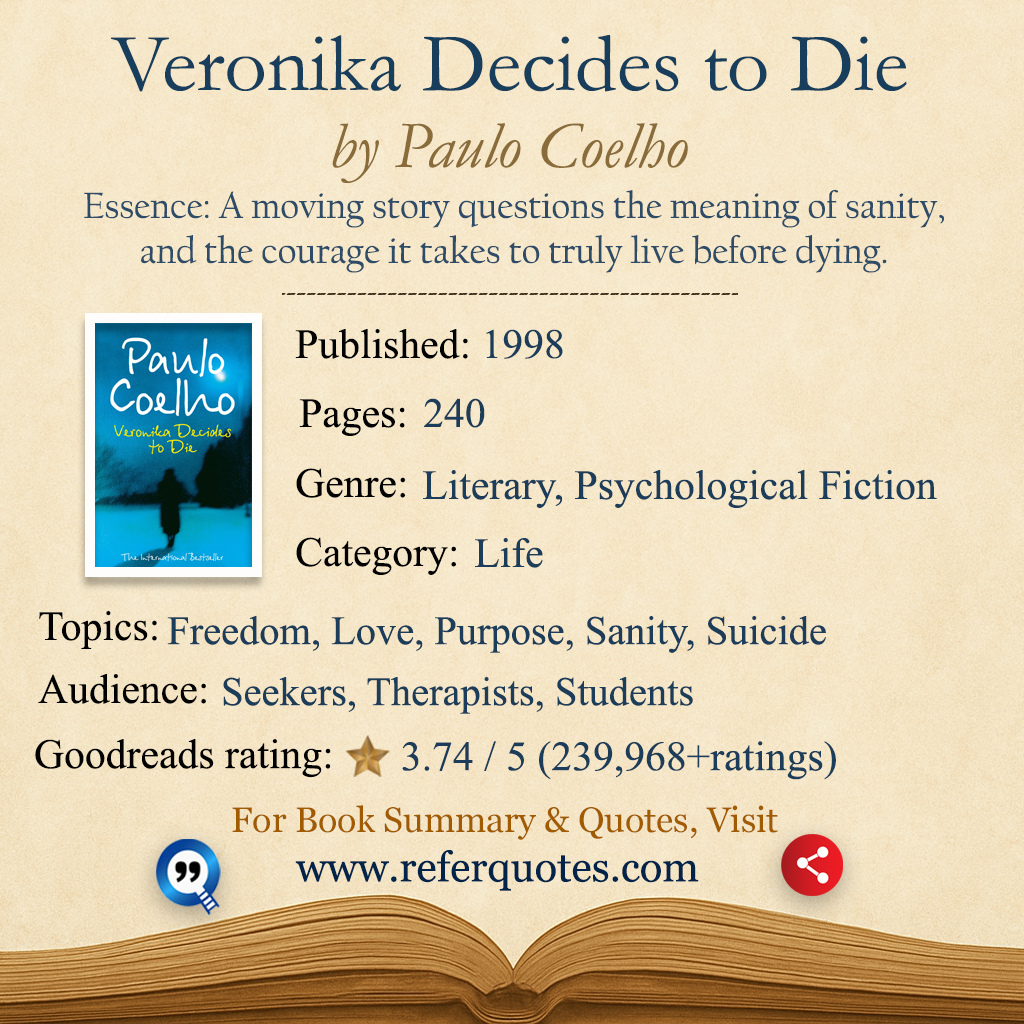
| Language | Portuguese (46) |
|---|---|
| Published On | 1998 (2) |
| Timeperiod | Contemporary (216) |
| Genre | literary fiction (5), psychological fiction (1) |
| Category | Life (30) |
| Topics | freedom (19), love (8), purpose (26), sanity (1), suicide (1) |
| Audiences | Book (13), seekers (43), students (406), therapists (51) |
Table of Contents
- What’s Inside Veronika Decides to Die
- Book Summary
- Chapter Summary
- Veronika Decides to Die Insights
- Usage & Application
- Life Lessons
- FAQ
- Famous Quotes from Veronika Decides to Die
What’s Inside Veronika Decides to Die
Synopsis
After a suicide attempt, Veronika awakens in a psychiatric hospital with only days to live. Confronting death liberates her to question normality, reclaim desire, and rediscover meaning through unexpected friendships, music, and love.
Book Summary
- Mortality can catalyze clarity and courage.
- “Normal” is a social construct; difference can be healing.
- Small acts of authenticity compound into life change.
- Compassion, including self-compassion, dissolves shame.
- Art and love reconnect us to aliveness.
Chapter Summary
- Chapter 1: Veronika’s suicide attempt and her quiet resignation from life.
- Chapter 2: Awakening at Villete; Dr. Igor’s diagnosis and the countdown.
- Chapter 3: Meeting Zedka; confronting the line between sanity and illness.
- Chapter 4: Mari’s story of anxiety, status, and secret collapse.
- Chapter 5: Eduard and the “Fraternity”; art as an alternative language.
- Chapter 6: Dr. Igor’s “vitriol” theory; bitterness as a corrosive life force.
- Chapter 7: Veronika returns to music; the piano as a portal to desire.
- Chapter 8: Experiments in freedom, testing limits inside the hospital.
- Chapter 9: Love and risk; Veronika and Eduard choose presence over fear.
- Chapter 10: Patients model authenticity; masks fall away.
- Chapter 11: The city outside mirrors the asylum’s rules; who is “normal”?
- Chapter 12: An opening rather than an ending; choosing life without guarantees.
Veronika Decides to Die Insights
| Book Title | Veronika Decides to Die |
| Author | Paulo Coelho |
| Publisher | HarperCollins (English-language edition); original Portuguese publisher (Brazil): Unknown |
| Translation | Originally in Portuguese; translated into English by Margaret Jull Costa (1999). |
| Details | Publication Year/Date: 1998; ISBN/Unique Identifier: 978-0-06-112426-6; Last edition: HarperCollins (2006), 240 pages. |
| Goodreads Rating | 3.74 / 5 - 239,968 ratings - 12,479 reviews |
About the Author
Paulo Coelho is a Brazilian novelist known for weaving spirituality and philosophy into stories that feel both magical and real. 165 million copies sold with readers in 80+ languages
Official Website |Facebook | Instagram | YouTube |
Usage & Application
How to Use This Book
If you feel boxed in by expectations, use this novel as a mirror to run low-risk experiments in authenticity.
Scenario 1: Burnout at work. Block 20 minutes daily to revive a shelved passion (music, sketching, writing). People who ritualize a daily creative act report measurable mood gains within two weeks; you’ll notice momentum as tiny wins stack. Scenario
2: Fear of judgment. Ship a small, imperfect version of a stalled project to five trusted users, ask one question: “What helped?” This shrinks perfectionism and creates data, not drama. Scenario
3: Flat relationships. Plan a weekly “unusual” micro-adventure (museum at lunch, tech-free walk, open-mic). Novelty increases perceived time and deepens bonds.
Start today: pick one constraint to break for seven days; review what felt alive and double down.
Video Book Summary
Life Lessons
- Facing limits clarifies values faster than endless options.
- Authenticity is a practice of small, repeated risks.
- “Normal” can be a cage; define sanity by aliveness, not approval.
- Art and connection are practical tools for healing.
- Compassion dissolves bitterness, freeing energy for choice.