
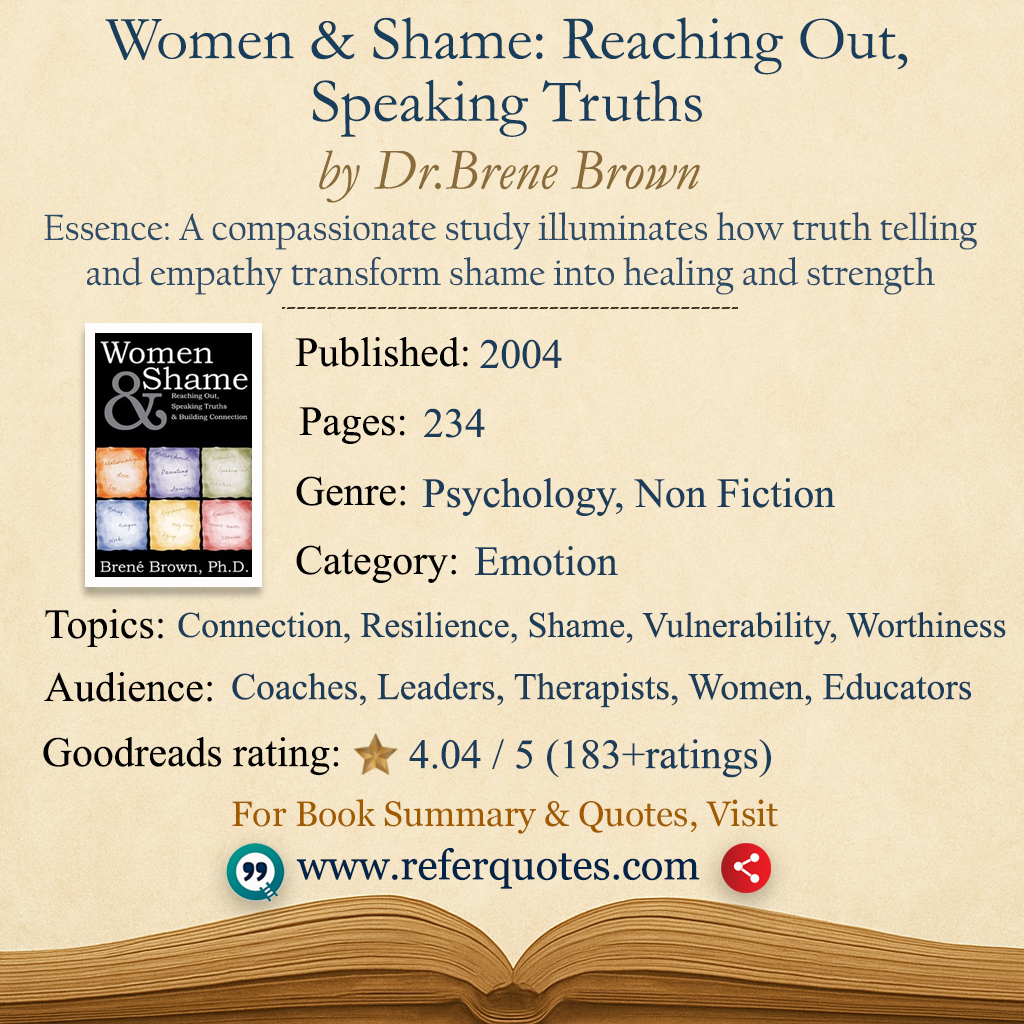
- Shame thrives in secrecy; empathy is its antidote.
- Language, awareness, and supportive relationships build shame resilience.
Book Summary
| Language | English (558) |
|---|---|
| Timeperiod | 21st Century (229) |
| Genre | nonfiction (88), psychology (18) |
| Category | Emotion (15) |
| Topics | connection (35), resilience (16), shame (10), vulnerability (12), worthiness (1) |
| Audiences | coaches (122), educators (31), leaders (276), therapists (51), women (14) |
Table of Contents
- What’s Inside Women & Shame: Reaching Out, Speaking Truths
- Book Summary
- Chapter Summary
- Women & Shame: Reaching Out, Speaking Truths Insights
- Usage & Application
- Life Lessons
- FAQ
- Famous Quotes from Women & Shame: Reaching Out, Speaking Truths
What’s Inside Women & Shame: Reaching Out, Speaking Truths
Synopsis
An early, research-driven investigation into how shame operates in women’s lives, presenting stories, patterns, language, and practical strategies to identify shame, speak it, and build resilience through empathy and connection.
Book Summary
- Shame needs secrecy; naming it in safe relationships reduces its power.
- Common triggers include body image, motherhood, work, and appearance ideals.
- Practicing empathy, both giving and receiving, is the core antidote to shame.
- Language plus boundaries equals sustainable resilience.
Chapter Summary
Chapter 2: Through stories and research, shame reveals its many disguises.
Chapter 3: Perfectionism becomes the armor women wear to stay worthy.
Chapter 4: The cultural double binds, be everything, yet never too much, tighten the grip of shame.
Chapter 5: Connection, empathy, and vulnerability begin to loosen shame’s hold.
Chapter 6: Women share what shame feels like in their bodies and voices.
Chapter 7: Shame resilience grows through awareness, courage, and compassion.
Chapter 8: Telling the truth about our struggles reclaims power from silence.
Chapter 9: Healing begins when women choose authenticity over approval.
Chapter 10: Freedom lies in embracing imperfection and living wholeheartedly.
Women & Shame: Reaching Out, Speaking Truths Insights
| Book Title | Women & Shame |
| Book Subtitle | Reaching Out, Speaking Truths |
| Author | Brené Brown |
| Publisher | Unknown |
| Translation | Not applicable (originally in English). |
| Details | Publication Year: 2004; (other edition details unknown) |
| Goodreads Rating | 4.04 / 5 - 183 ratings - 6 reviews |
About the Author
Dr. Brene Brown is the author Daring Greatly and The Power of Vulnerability. She researches and provides evidence based insights into practical tools to help people train themselves.
Official Website |Facebook | X | Instagram | YouTube |
Usage & Application
How to Use This Book
Here’s how to apply the ideas fast.
Scenario 1: Workplace setback. Use a 3-step script, (1) Name it: “I’m feeling ashamed about that mistake.” (2) Normalize it with a peer: “Everyone misses sometimes.” (3) Reframe: “This is data, not a verdict.” Do a 10-minute after-action review to extract one improvement you’ll test this week.
Scenario 2: Body-image spiral. Interrupt the loop by labeling the trigger, texting a trusted friend for reality-check empathy, and setting one boundary (e.g., no mirror-checking before a meeting). Track your self-talk for 7 days; aim for a 50% reduction in shaming phrases.
Scenario 3: Parenting moment. When your child melts down, model shame-resilience: name feelings, connect, and reinforce worthiness separate from behavior. Use a “repair within 24 hours” rule to keep trust strong.
Video Book Summary
Life Lessons
- Naming shame out loud in safe relationships dramatically weakens it.
- Empathy, not advice, dissolves isolation and accelerates healing.
- Clear boundaries protect worthiness and prevent perfectionism traps.
- Shared language turns vague pain into solvable patterns.
- Courage grows by small, consistent acts of reaching out and telling the truth.