
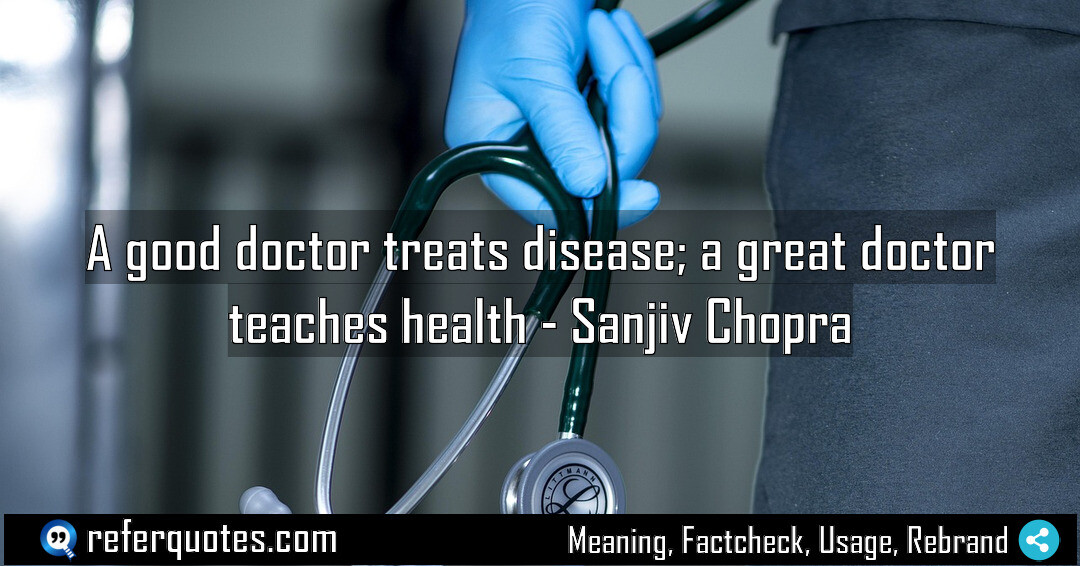
Find the usage, audience, meaning and summary of quote- A good doctor treats disease; a great doctor teaches health.
It reminds us that healing is not only about cures, it is about education, prevention, and empowerment.
Table of Contents
Meaning
A good doctor focuses on removing illness, which is necessary and valuable. A great doctor goes further by nurturing the habits, understanding, and awareness that help you stay healthy in the long run. It is the move from reacting to problems to building strength from within.
Explanation
A good doctor is skilled with diagnosis and medication. They step in when something is already wrong and they fix it. Their work saves lives. Yet a great doctor brings a deeper kind of care. They sit with you and help you understand the story behind your symptoms. They teach you how food, movement, sleep, stress, and emotional balance shape your body. They empower you with tools that reduce future risk and increase your quality of life. You stop feeling like a passive patient and start feeling like an active participant in your own wellbeing. That is the kind of care that stays with you long after the appointment ends.
Summary
| Category | Education (33) |
|---|---|
| Topics | ethics (5), healing (8) |
| Style | didactic (53), memorable (56) |
| Mood | inspiring (46), respectful (3) |
Origin & Factcheck
| Author | Sanjiv Chopra (10) |
|---|---|
| Book | Doctor Chopra Says: Medical Facts and Myths Everyone Should Know (10) |
About the Author
Dr. Sanjiv Chopra professor of medicine at Harvard Medical School. He writes and speaks on wellness, purpose, longevity, and leadership.
| Official Website | Facebook | X| Instagram
Quotation Source:
| A good doctor treats disease; a great doctor teaches health |
| Publication Year: 2010; ISBN: 978-0312611742; Last Edition: 1st Edition; Number of Pages: 304. |
| Chapter 7: The Role of the Doctor, Approximate page from 2010 edition |
Context
In the book where this quote appears, the message forms the backbone of the entire philosophy. The goal is not simply to simplify medical concepts. It is to give people the clarity and confidence to take charge of their health instead of feeling intimidated or dependent. The authors believe that education is the most sustainable form of healing. When people understand their own bodies, they become less vulnerable and more capable of making long lasting choices.
Usage Examples
This idea is incredibly versatile. I use it as a mental model all the time.
- For Healthcare Professionals: This becomes a guiding question. Are you simply treating what is in front of you, or are you helping your patients understand how to build a healthier future?
- For Leaders & Managers: It becomes a reminder that true leadership is not about solving every crisis. It is about developing people so they grow strong enough to face challenges without always needing intervention.
- For anyone who teaches or mentors: You can give answers or you can build mastery. One creates dependency. The other builds confidence that lasts for years.
To whom it appeals?
| Audience | doctors (15), students (434), trainers (17) |
|---|---|
This quote can be used in following contexts: leadership talks,education articles,medical school speeches,healthcare conferences,doctor appreciation events
FAQ
Question: Does this mean treating disease is unimportant?
Answer: Not at all. Treatment saves lives The idea is that the highest level of care includes teaching people how to avoid falling into the same cycle again.
Question: Can this principle work outside medicine?
Answer: It works everywhere. Whether you are a parent, coach, teacher, or manager, helping people become self-reliant is the greatest form of support.
Question: Why does this idea matter in today’s healthcare system?
Answer:Because most modern illnesses are lifestyle-driven. Medication can help, but it can’t replace daily habits. Doctors who teach prevention give their patients the chance to stay healthy long before disease appears.
Question:What if a patient isn’t interested in learning?
Answer:Then the role of a great doctor is to meet them where they are. Small, practical steps often work better than big instructions. When people feel respected rather than pressured, they become more open to learning.