
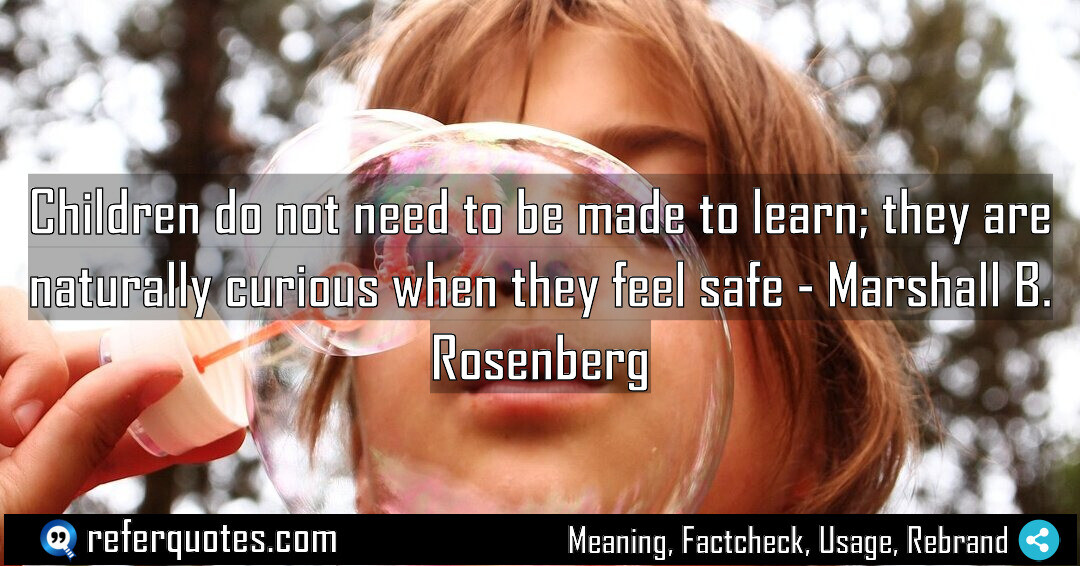
You know, when Marshall Rosenberg said “Children do not need to be made to learn,” he was onto something huge. It’s about trusting that a child’s natural curiosity is the real engine for learning, and our main job is to create a safe space for it to flourish. It completely reframes the entire dynamic of parenting and education.
Share Image Quote:Table of Contents
Meaning
The core message is that learning is a natural, hardwired human drive, not something that needs to be forced. The real prerequisite is psychological safety.
Explanation
Look, I’ve seen this play out so many times. We get so focused on the curriculum, the milestones, the “teaching,” that we forget the fundamental fuel: curiosity. And that curiosity? It’s incredibly fragile. It shuts down under threat, under pressure, under fear of getting it wrong. Rosenberg’s genius was connecting safety to learning. When a child feels safe—truly safe, emotionally and physically—their mind opens up. They ask “why,” they tinker, they explore. They’re not performing for a grade; they’re engaging with the world. Our role shifts from being a taskmaster to being a gardener. We don’t force the seed to grow; we just make sure the soil is rich and the environment is right.
Summary
| Category | Education (25) |
|---|---|
| Topics | curiosity (6), learning (15), safety (3) |
| Style | clear (38), didactic (48) |
| Mood | hopeful (31), motivating (28) |
Origin & Factcheck
This quote comes directly from Rosenberg’s 2005 book, Raising Children Compassionately: Parenting the Nonviolent Communication Way. It’s a core tenet of his Nonviolent Communication (NVC) framework, which he developed in the United States. You won’t find it attributed correctly to any other source.
| Author | Marshall B. Rosenberg (4) |
|---|---|
| Book | Raising Children Compassionately: Parenting the Nonviolent Communication Way (4) |
Quotation Source:
| Children do not need to be made to learn; they are naturally curious when they feel safe |
| Publication Year/Date: 2004; ISBN/Unique Identifier: 9781892005140; Last edition: PuddleDancer Press, 1st Edition, 48 pages. |
| Chapter: Natural Learning, Approximate page from 2004 edition |
Context
In the book, this isn’t just a standalone nice idea. It’s the bedrock of his entire approach to resolving conflicts with children. He argues that when we stop using coercive language (“You must do your homework”) and start connecting with feelings and needs, we create that essential safety. The learning then follows naturally from a place of mutual respect and connection.
Usage Examples
So how do you actually use this? It’s a mindset shift. For parents, instead of battling over homework, you might say, “I see you’re frustrated with that math problem. What part is tricky?” You’re creating safety to struggle. For teachers, it’s about designing a classroom where wrong answers are seen as stepping stones, not failures. For leaders and managers (because this applies to adults, too!), it’s about fostering a culture where people aren’t afraid to propose a wild idea. The audience is anyone responsible for guiding others.
To whom it appeals?
| Audience | educators (31), parents (57), psychologists (12), students (403), teachers (181) |
|---|---|
This quote can be used in following contexts: parenting seminars,education training,school policy debates,teacher blogs,child psychology resources
Common Questions
Question: But what if a child just isn’t curious about something they *need* to learn, like math?
Answer: Great question. The key is to find the hook. Connect it to their existing curiosity. Math isn’t just numbers; it’s the pattern in their favorite song, the physics of their skateboard trick. You bridge from their world to the subject.
Question: Does this mean there’s no place for discipline or structure?
Answer: Not at all. Structure provides a different kind of safety—the safety of predictability. The problem isn’t structure itself; it’s the *enforcement* of it. Are you using punishment and rewards, or are you using collaborative problem-solving?
Question: Is this just for young children?
Answer: Absolutely not. This is a lifelong human truth. Think about the last time you learned something quickly and joyfully. I bet you felt safe, unjudged, and intrinsically motivated. That’s the state we want to cultivate at any age.