
Table of Contents
Meaning
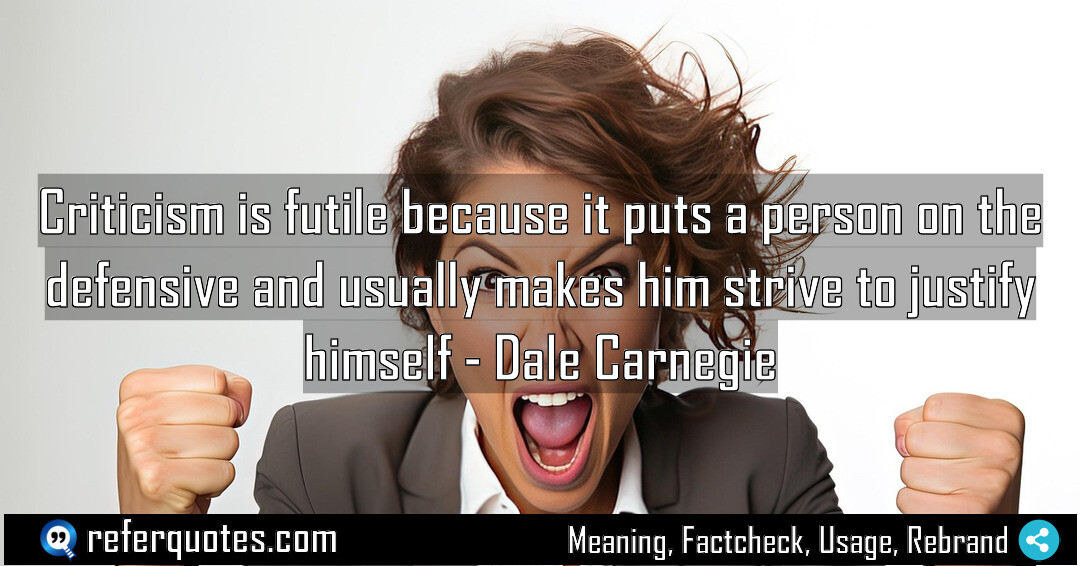
The core message is that criticism is not the right tool to create any change. It triggers a defensive reaction that makes people argue and defend their image rather than opening their minds.
Explanation
When you criticize someone, you’re not helping them to improve but, launching an attack on their ego. And the ego’s job is to defend itself at all costs. So instead of them thinking, “Wow, how can I improve?”, their entire mental energy goes into building points to justify themselves. I’ve seen it a thousand times in meetings and performance reviews. The moment you say “You did this wrong,” you’ve lost them. The conversation soon becomes winning an argument, rather than solving a problem.
Summary
| Category | Skill (89) |
|---|---|
| Topics | communication (51), criticism (3) |
| Style | analytical (18), didactic (54) |
| Mood | realistic (60), reflective (52) |
Origin & Factcheck
| Author | Dale Carnegie (174) |
|---|---|
| Book | How to Win Friends and Influence People (43) |
About the Author
Dale Carnegie, an American writer received worldwide recognition for his influential books on relationship, leadership, and public speaking. Among his timeless classics, the Dale Carnegie book list includes How to Win Friends and Influence People is the most influential which inspires millions even today.
Official Website
Quotation Source:
| Criticism is futile because it puts a person on the defensive and usually makes him strive to justify himself |
| Publication: 1936 original; ISBN/Unique: 978-0671027032; Number of pages: 260 |
| Part One: Fundamental Techniques in Handling People; Chapter 1: If you want to gather honey, don't kick over the beehive; Page: 5 |
Context
It’s the opening principle in a section titled “Fundamental Techniques in Handling People.” Carnegie lays it down as the first law of human relationship. Before you can even think about influencing anyone, you have to understand that criticism is not the right approach. This principle, sets the stage for everything that follows in his book about appreciation, empathy, and seeing things from the other person’s angle.
Usage Examples
This is applicable for anyone who has to lead, teach, parent, or collaborate. You stop criticising and start guiding.
- For Managers: Instead of telling an employee “Your report was not good,” try “I had a hard time following the data in section three. Could we walk through it together to make sure I’m on the right track?” This invites collaboration, not justification.
- For Parents: Instead of “You never clean your room!” which they’ll immediately argue with, “I know it’s a pain, but let’s get your room cleaned up so you can find your things easily and have friends over.” You’re addressing the need, instead of attacking the person’s ego.
- For Partners/Spouses: Instead of saying “You’re always late!”, try “I get really anxious when I’m waiting alone. What can we do to help us both get out the door on time?” You’re stating your feeling and asking for a solution.
To whom it appeals?
| Audience | counselors (29), leaders (295), managers (142), parents (60), teachers (193) |
|---|---|
This quote can be used in following contexts: leadership training,parenting guides,team management,communication books,self-improvement content
Common Questions
Question: So does this mean I should never give negative feedback?
Answer: Not at all. It means you must reframe it. Feedback is about behavior and solutions. Criticism is about blame and character. Focus on the positive feedback.
Question: What if the person genuinely did something wrong and needs to be corrected?
Answer: Correction is possible, but it starts with understanding their perspective first. Ask questions. “What was your thinking behind that approach?” opens a dialogue. “You did that wrong” make them shut the door to communication.
Question: Isn’t this just being manipulative?
Answer: That’s a great question. It’s only manipulative if your intent is selfish. If your genuine intent is to help the other person improve and strengthen the relationship, then it’s not manipulation. This is effective and empathetic way of communication.