
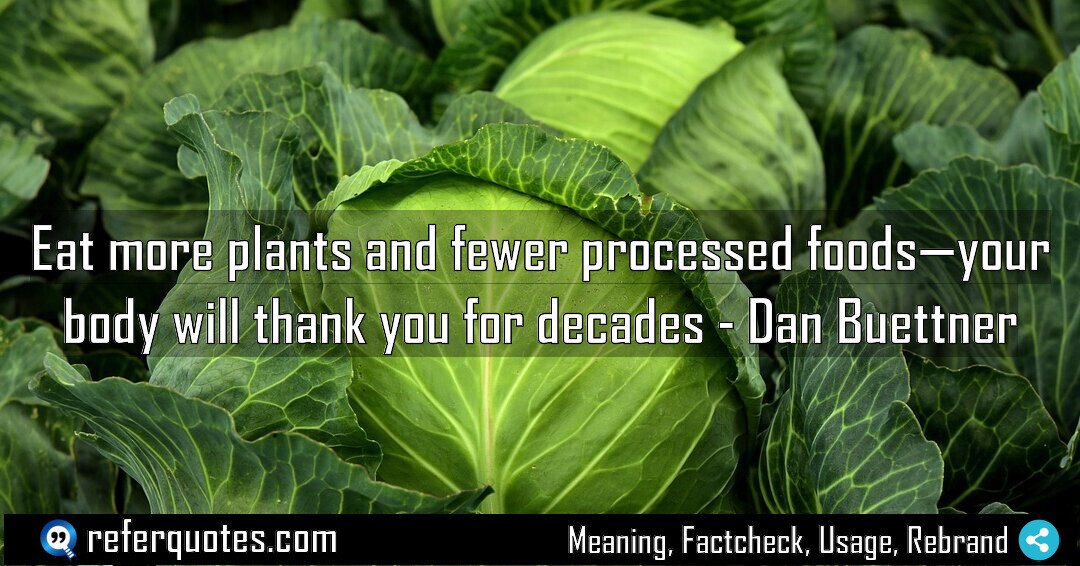
Find context, audience, FAQ, image, and usage of quote-Eat more plants and fewer processed foods, your body will thank you for decades.
It’s not a diet, it’s a longevity strategy. Your future self will genuinely feel the difference.
Share Image Quote:Table of Contents
Meaning
This is about a fundamental shift in your food philosophy. It’s a direct trade, swap out the man-made for the earth-grown.
Explanation
When we talk about plants, we’re not just talking about lettuce. We’re talking about a huge variety of beans, grains, nuts, vegetables, and fruits, all packed with fiber, antioxidants, and micronutrients that your body knows exactly how to use. Processed foods, on the other hand, are like a foreign language to your system. They cause inflammation, they disrupt your gut health, and they’re designed to make you overeat. The thank you for decades part? That’s the real payoff. It’s not about losing five pounds for a reunion. It’s about having the energy to play with your grandkids and avoiding the chronic diseases that plague so much of the modern world. It’s a cumulative investment.
Summary
| Category | Health (56) |
|---|---|
| Topics | diet (6), habits (18), nutrition (13) |
| Style | informative (5), simple (29) |
| Mood | encouraging (27) |
Origin & Factcheck
| Author | Dan Buettner (14) |
|---|---|
| Book | The Blue Zones: Lessons for Living Longer from the People Who've Lived the Longest (14) |
About the Author
Dan Buettner, a National Geographic Fellow who led teams to identify Blue Zones across five regions and turned those insights into citywide programs that improve well-being.
| Official Website | Facebook | X| Instagram | YouTube
Quotation Source:
| Eat more plants and fewer processed foods, your body will thank you for decades |
| Publication Year/Date: 2008; ISBN: 978-1426207556; Last edition: National Geographic Society (2012), 336 pages. |
| Chapter: Plant Slant, Approximate page from 2012 edition |
Context
Buettner didn’t just find people who lived long lives; he found the common denominators among them. And one of the most powerful, universal threads was their diet. They weren’t on fad diets or counting calories. Their eating habits were just a natural part of their culture, centered overwhelmingly on whole plant foods with minimal processed ingredients.
Usage Examples
- For a busy parent: Instead of packaged fruit snacks, offer apple slices with peanut butter. It’s about one simple, real-food swap at a time.
- For someone feeling sluggish: Challenge them to just one week. Try eating a plant-based lunch every day this week, a big salad with chickpeas, a grain bowl, and see how you feel by Friday. The difference in your energy can be startling.
- In a team meeting about wellness: Frame it as a positive, accessible goal. Let’s focus on what we can add in, more plants, rather than what we’re taking out. It’s a more sustainable approach to health.
To whom it appeals?
| Audience | dieticians (3), nutritionists (8), students (402), wellness readers (1) |
|---|---|
This quote can be used in following contexts: fitness blogs,health talks,nutrition campaigns,diet guides
Common Questions
Question: Does this mean I have to go fully vegan?
Answer: No. The Blue Zones diet is predominantly plant-based, not exclusively vegan. People in these areas do eat small amounts of meat and dairy, but it’s more of a occasional side dish, not the main event.
Question: What exactly counts as a processed food? Is all processing bad?
Answer: Great question. Canned beans, frozen vegetables, and whole-grain pasta are technically processed, and they’re perfectly healthy. The real culprits are ultra-processed foods, things like sugary cereals, packaged snacks, and sodas that are far removed from their original source and loaded with additives.
Question: I don’t have time to cook everything from scratch. How can I possibly do this?
Answer: You don’t need to! This is a common hurdle. Start with the 80/20 rule. Focus on making 80% of your plate whole plants, even if they’re from the frozen aisle or a can (just check for low sodium). The other 20% can be whatever fits your life. Progress, not perfection, is what your body will thank you for.