
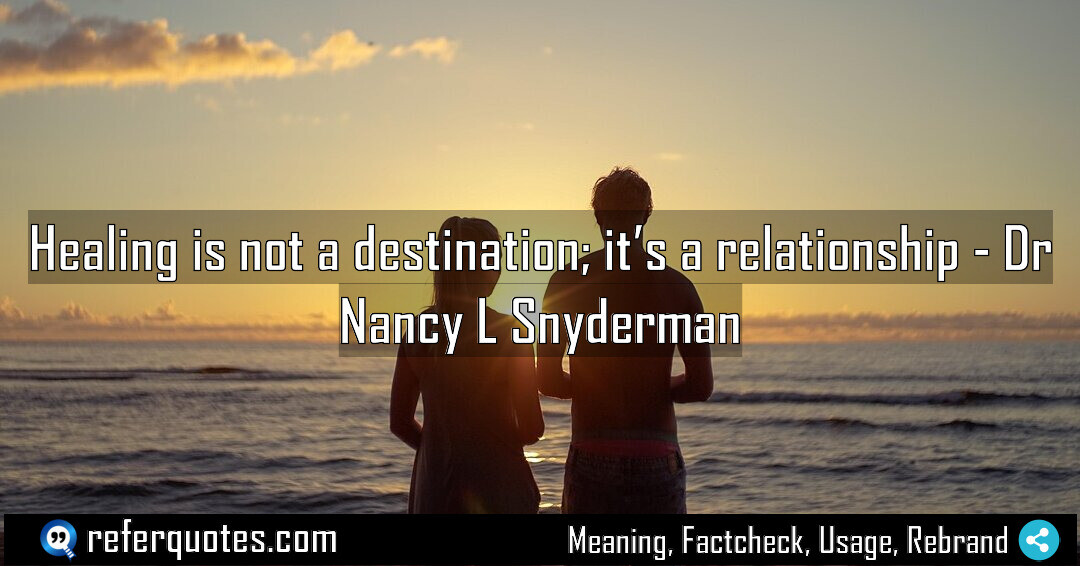
Find meaning, factcheck, origin, and usage of quote -Healing is not a destination; it’s a relationship
The above quote completely changeshow we think about getting better. It’s not a finish line you cross but an ongoing conversation you have with your own body and mind.
Share Image Quote:Table of Contents
Meaning
This quote means that healing isn’t a fixed point you arrive at and then you’re done. It’s an active, dynamic partnership with your own well-being.
Explanation
We’re so conditioned to think of health in terms of endpoints, “I’ll be healed when this cast is off” or “I’ll be better when my labs are normal.” But that’s a trap. When you see healing as a relationship, everything shifts. You start listening to your body’s signals, you learn its rhythms, you negotiate good days and bad days. It’s a continuous process of adjustment and understanding, not a one-time fix. You’re building a partnership with your own physical and mental state.
Summary
| Category | Emotion (15) |
|---|---|
| Topics | growth (35), healing (8) |
| Style | poetic (50) |
| Mood | calm (57), hopeful (33) |
Origin & Factcheck
| Author | Dr Nancy L Snyderman (13) |
|---|---|
| Book | Medical Myths That Can Kill You: And the 101 Truths That Will Save, Extend, and Improve Your Life (13) |
About the Author
Dr. Nancy Lynn Snyderman is an physician and award-winning medical journalist with more than 40 years of experience in clinical medicine. Her journalism has earned multiple Emmy Awards.
Quotation Source:
| Healing is not a destination; it’s a relationship |
| Publication Year/Date: 2008, ISBN: 978-0345496312, Last Edition: 1st Edition, Number of Pages: 304 |
| Chapter: Recovery Myths, Approximate page from 2008 edition |
Context
Snyderman places this idea in a book that’s all about empowering patients to question quick fixes and oversimplified medical advice. She’s arguing against the myth that there’s a single cure for everything. The quote is a call to move from a passive recipient of care to an active participant in your own long-term health.
Usage Examples
- For someone with a chronic illness: Instead of saying “I’m waiting for a cure,” they can focus on building a better relationship with their body today, managing symptoms and finding moments of quality life.
- For a leader coaching a burned-out team member: You can change their recovery. It’s not about taking a two-week vacation and being fixed. It’s about building a sustainable relationship with work, stress, and rest that prevents burnout from happening again.
- In personal growth: Healing from a past trauma isn’t about reaching a day when it no longer affects you. It’s about learning to have a new, less powerful relationship with that memory.
To whom it appeals?
| Audience | counselors (29), patients (21), students (432), therapists (53) |
|---|---|
This quote can be used in following contexts: therapy sessions,motivational seminars,healing workshops
FAQ
Question: Does this mean you’re never fully healed?
Answer: It means the definition of fully healed changes. It’s not about the absence of disease or pain, but about achieving a state of integration and management where you can live a full life.
Question: How do you start building this relationship?
Answer: Start by listening without judgment. Notice what your body or mind is telling you without immediately trying to fix it. It’s about curiosity, not criticism.
Question: Is this just for physical health?
Answer: No. This foundation is maybe even more powerful for emotional, psychological, and spiritual healing. The principle is universal.