
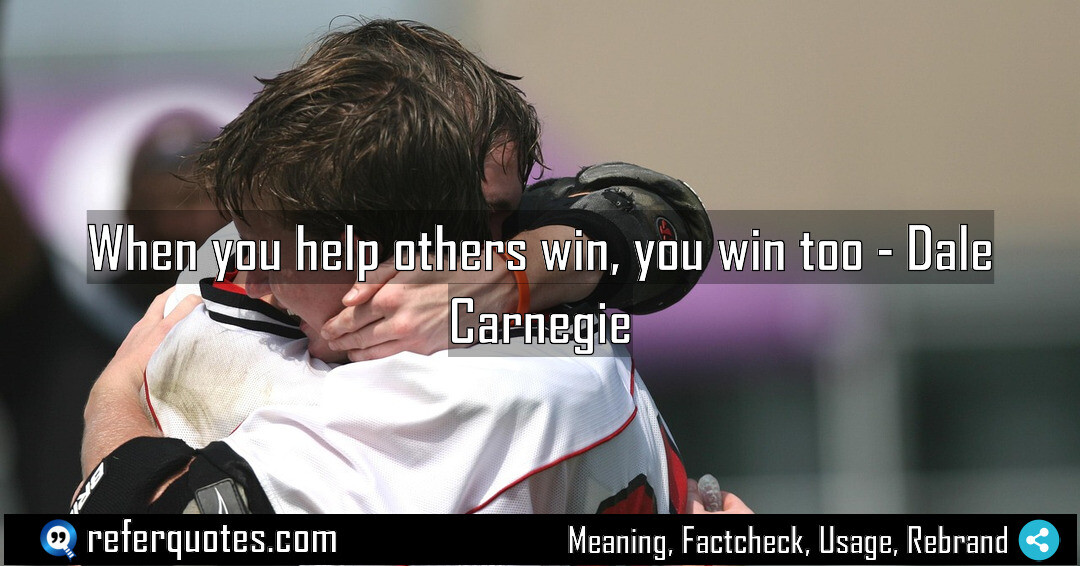
Find audience, author, image, and usage of quote-When you help others win, you win too.
It sounds simple, almost too good to be true, right? But in my experience, this is one of the most powerful and practical principles for sustainable success. It turns the entire game from a zero-sum competition to a collaborative journey where everyone rises together.
Share Image Quote:Table of Contents
Meaning
It tells us that success isn’t a finite pie where you have to grab your slice before someone else does. Instead, your victory is intrinsically linked to the victories of the people around you.
Explanation
When you genuinely invest in helping a colleague land a promotion, you’re not just being nice. You’re building a powerful ally. You’re creating a network of competence and trust. That person will remember, and when you need a hand on a future project or an advocate in a meeting, they’ll be there. Your win might not be immediate, but it compounds. It builds a reputation as a leader, a collaborator, someone people want to work with. And in today’s interconnected world, that social capital is your most valuable currency. It’s not about being selfless, it’s about being strategically generous. The energy you put into lifting others up creates a rising tide that, without fail, lifts your own boat too.
Summary
| Category | Skill (85) |
|---|---|
| Topics | service (11), teamwork (8) |
| Style | memorable (53), simple (29) |
| Mood | motivating (28), optimistic (9) |
Origin & Factcheck
| Author | Dale Carnegie (162) |
|---|---|
| Book | The Leader In You (84) |
About the Author
Dale Carnegie, an American writer received worldwide recognition for his influential books on relationship, leadership, and public speaking. Among his timeless classics, the Dale Carnegie book list includes How to Win Friends and Influence People is the most influential which inspires millions even today.
Official Website
Quotation Source:
| When you help others win, you win too |
| Publication Year/Date: 1993 (first edition) ISBN/Unique Identifier: 9781501181962 (Gallery Books 2017 reprint); also 9780671798093 (early Pocket Books hardcover) Last edition. Number of pages: Common reprints ~256 pages (varies by printing). |
| Chapter: Shared Success, Approximate page from 1993 edition |
Context
In the book, this idea isn’t presented as a fluffy feel-good statement. It’s defined as a fundamental leadership strategy. The context is about moving away from command-and-control leadership and towards a model of influence and inspiration, where your success is measured by the success of your team.
Usage Examples
- For a Manager: Instead of hoarding information, share your knowledge freely with your team. When they succeed on a project because of your guidance, you look like a brilliant leader who develops talent. That’s a win.
- For an Entrepreneur: Connect two contacts who could benefit from knowing each other, with no immediate benefit to you. You become a central, valuable node in your network. Opportunities will start flowing to you. That’s a win.
- For a Team Member: Stay late to help a teammate finish a presentation. You build trust and a rock-solid relationship. Next time you’re swamped, guess who’s going to volunteer to help you? That’s a win.
This is for anyone in any role who wants to build lasting influence and success, not just a series of isolated achievements.
To whom it appeals?
| Audience | coaches (119), leaders (268), managers (140), students (397), teachers (180) |
|---|---|
This quote can be used in following contexts: team building,leadership development,career mentoring,motivation programs,organizational development
FAQ
Question: Isn’t this just being a pushover?
Answer: Absolutely not. It’s about strategic empowerment, not being a doormat. You set boundaries, but within those, you operate with generosity. It’s a sign of strength and confidence.
Question: What if I help others and they don’t return the favor?
Answer: This is the most common fear. But you have to think long-term. Some people won’t reciprocate, that’s true. But the majority will, and the overall culture of collaboration you help create will benefit you immensely. It’s about the law of averages, not keeping a strict scorecard.
Question: How is this different from networking?
Answer: Traditional networking can feel transactional, what can you do for me? This is the opposite. It’s what can I do for you? without an immediate ask. It’s about building genuine relationships, which is a far more powerful and sustainable form of networking.