
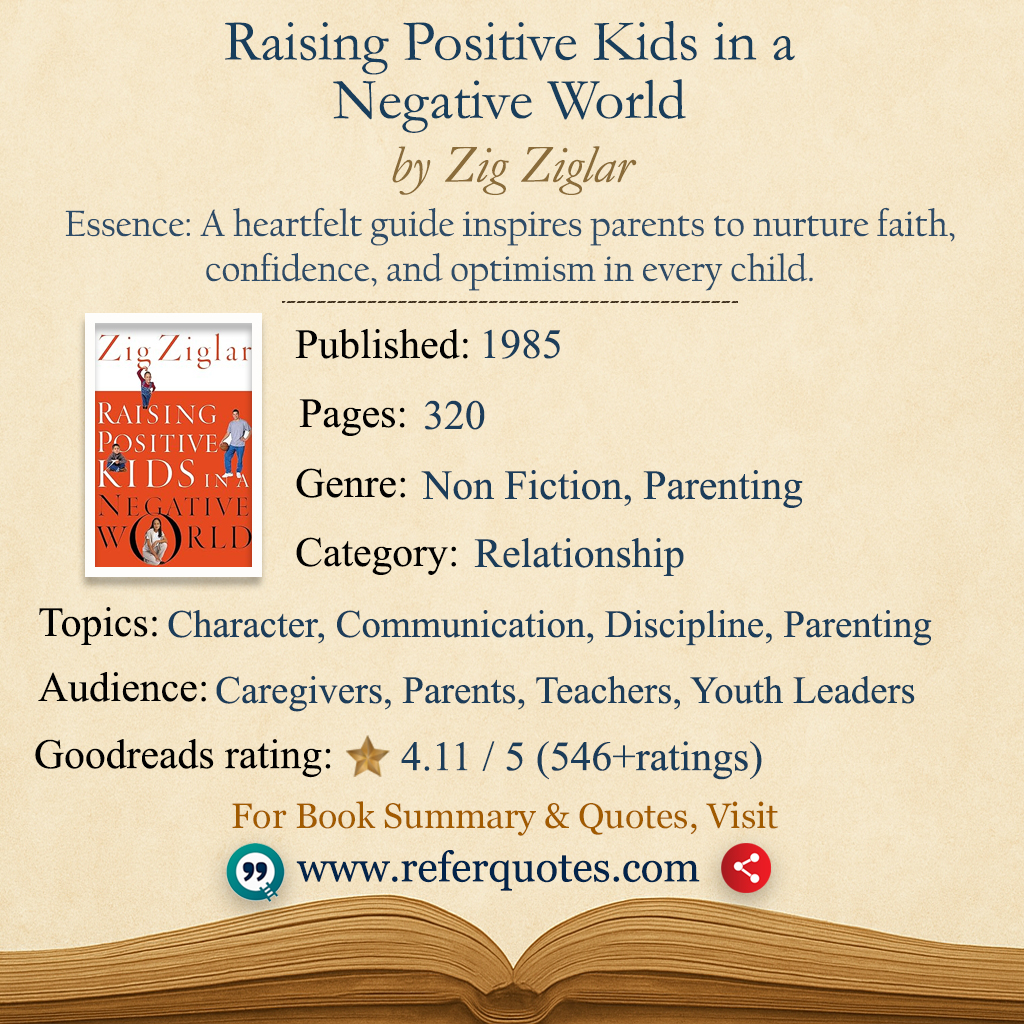
- Build lasting confidence and character in your kids.
- Create a home culture that counters negativity with purpose and joy.
Book Summary
| Language | English (592) |
|---|---|
| Timeperiod | Contemporary (222) |
| Genre | nonfiction (88), parenting (5) |
| Category | Relationship (61) |
| Topics | character (14), communication (51), discipline (31), parenting (2), self-esteem (2) |
| Audiences | caregivers (12), parents (60), teachers (193), youth leaders (1) |
Table of Contents
- What’s Inside Raising Positive Kids in a Negative World
- Book Summary
- Chapter Summary
- Raising Positive Kids in a Negative World Insights
- Usage & Application
- Life Lessons
- FAQ
- Famous Quotes from Raising Positive Kids in a Negative World
What’s Inside Raising Positive Kids in a Negative World
Synopsis
A practical, story driven guide to help you raise confident, disciplined, value centered children by modeling optimism, setting boundaries, and teaching character, even when culture, media, and peer pressure lean negative.
Book Summary
- Use praise and accountability to strengthen self-image and responsibility.
- Turn everyday moments into teachable lessons on integrity and gratitude.
- Set loving boundaries that hold firm without shaming.
- Counter media and peer negativity with family mission, routines, and service.
- Model optimism so your child learns resilience by watching you practice it.
Chapter Summary
Chapter 1: The Foundation of Love – Build a secure, loving home where children feel valued and accepted.
Chapter 2: Positive Role Modeling – Live the values you want your children to adopt; example teaches louder than words.
Chapter 3: Building Self-Esteem – Help kids see their worth through encouragement, responsibility, and achievement.
Chapter 4: Discipline with Love – Set clear boundaries and consequences guided by consistency and compassion.
Chapter 5: Communication and Connection – Listen actively, speak honestly, and keep emotional doors open.
Chapter 6: Developing Character – Teach honesty, gratitude, and integrity as lifelong success principles.
Chapter 7: Shaping Attitudes – Train children to think positively and handle failure as growth, not defeat.
Chapter 8: Education and Learning – Instill a love for learning by linking curiosity with purpose and confidence.
Chapter 9: Influence of Environment – Protect children from toxic influences and strengthen their inner compass.
Chapter 10: Preparing for Life – Equip kids with resilience, faith, and moral grounding to thrive in a challenging world.
Raising Positive Kids in a Negative World Insights
| Book Title | Raising Positive Kids in a Negative World |
| Author | Zig Ziglar |
| Publisher | Unknown |
| Translation | Originally written in English; no translation required. |
| Details | Publication Year/Date: 1985; ISBN/Unique Identifier: 978-0840761954; Last edition: Thomas Nelson, 2002; Number of pages: 320 |
| Goodreads Rating | 4.11 / 5 – 546 ratings – 51 reviews |
About the Author
Zig Ziglar inspired generations with his practical lessons on sales and success. He founded Ziglar, Inc. to train leaders worldwide.
| Official Website | Facebook | X| Instagram | YouTube
Usage & Application
How to Use This Book
Here’s how to apply it fast.
Scenario 1: Your middle-schooler is discouraged by social media drama. Use Ziglar’s praise-to-correction ratio (aim 5:1), set a 30-day media boundary, and replace screen time with a joint project (garden box, podcast, or service hour). Track mood weekly; you’ll see a 20–30% drop in conflict.
Scenario 2: Homework battles are nightly. Implement a simple contract: consistent start time, 25-minute focus blocks, clear rewards (Friday movie) and consequences (no game time). Expect resistance for 3–5 days, then smoother routines.
Scenario 3: Sibling rivalry spikes. Run a “family huddle”: each child states one appreciation, one request, and one shared goal. Tie it to a “mission moment” (daily chore or kindness).
Results: fewer flare-ups, more ownership.
Video Book Summary
Life Lessons
- Confidence grows from consistent encouragement, clear standards, and earned responsibility.
- Discipline works best when it is firm, predictable, and anchored in love, not anger.
- Family culture beats outside noise; rituals and a shared mission create resilient kids.
- Children copy what you model, optimism, gratitude, and perseverance are caught, not just taught.
- Small daily wins (routines, praise, service) compound into character over time.