
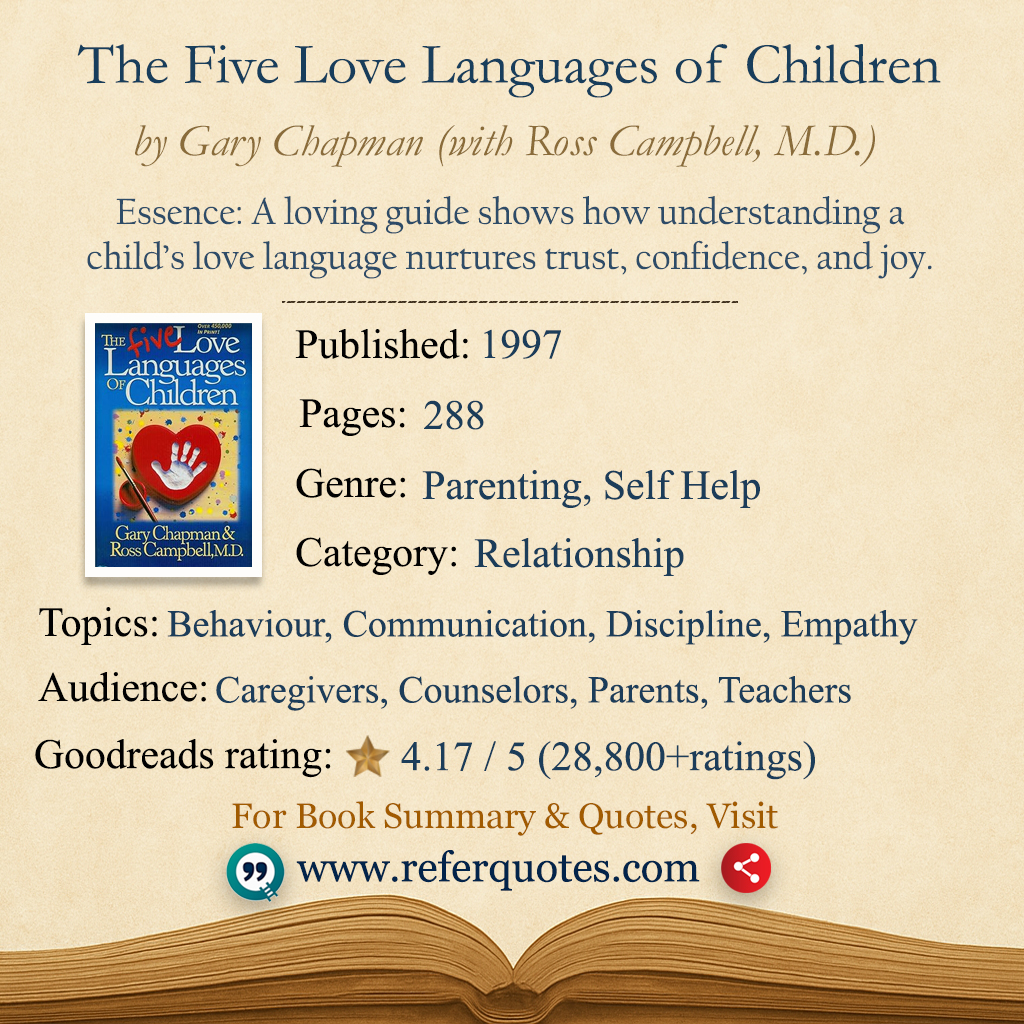
- Match your affection to a child’s primary love language to boost trust and cooperation.
- Discipline works best when love is unmistakably communicated beforehand.
Book Summary
| Language | English (584) |
|---|---|
| Published On | 1997 (5) |
| Timeperiod | Contemporary (222) |
| Genre | parenting (5), self-help (89) |
| Category | Relationship (61) |
| Topics | behavior (17), communication (51), discipline (30), empathy (39), love language (1) |
| Audiences | caregivers (12), counselors (29), parents (59), teachers (191) |
Table of Contents
- What’s Inside The Five Love Languages of Children
- Book Summary
- Chapter Summary
- The Five Love Languages of Children Insights
- Usage & Application
- Life Lessons
- FAQ
- Famous Quotes from The Five Love Languages of Children
What’s Inside The Five Love Languages of Children
Synopsis
A hands-on parenting guide that shows how to identify and speak a child’s primary love language, words, time, gifts, service, or touch, so discipline sticks, bonds strengthen, and everyday routines turn into moments of connection that shape character and confidence.
Book Summary
- Diagnose your child’s primary love language through patterns, not single moments.
- Fill the “emotional tank” before correction; discipline then lands as guidance, not rejection.
- Design micro-rituals (10–15 minutes) aligned to the language for daily consistency.
- Use all five languages weekly to avoid overdependence on one channel.
- Adapt delivery by age and context (siblings, school, transitions).
Chapter Summary
Chapter 1 – Love Is the Foundation:
Children thrive when they feel genuinely loved, unconditional love is the bedrock of healthy growth.
Chapter 2 – The Five Love Languages:
Every child has a unique emotional language, learn it to truly connect and communicate love effectively.
Chapter 3 – Words of Affirmation:
Speak life into your child; sincere, uplifting words nurture confidence and self-worth.
Chapter 4 – Quality Time:
Your undivided attention tells a child they matter more than anything else in the world.
Chapter 5 – Receiving Gifts:
Thoughtful gifts, not expensive ones, become tangible symbols of love and care.
Chapter 6 – Acts of Service:
When you help your child with patience and joy, you model love through selfless action.
Chapter 7 – Physical Touch:
Warm hugs, gentle pats, and loving closeness fill a child’s emotional tank like nothing else.
Chapter 8 – Discovering Your Child’s Primary Love Language:
Observe, listen, and experiment to uncover how your child best receives love.
Chapter 9 – Discipline and the Love Languages:
True discipline grows from love, not anger, guide behavior without breaking connection.
Chapter 10 – Learning and Love:
Children learn best when they feel secure and loved, emotion fuels education.
Chapter 11 – Anger and Love:
Help children manage anger with empathy; love soothes the storm, not punishment.
Chapter 12 – Speaking the Love Languages in a Single-Parent Family:
Love languages bridge emotional gaps, consistency and care can heal divided homes.
Chapter 13 – Love and Growing Together:
As children mature, love must evolve, keep learning their changing language to stay close.
The Five Love Languages of Children Insights
| Book Title | The Five Love Languages of Children |
| Book Subtitle | The Secret to Loving Children Effectively |
| Author | Gary Chapman; Ross Campbell, M.D. |
| Publisher | Northfield Publishing (Moody Publishers) |
| Translation | Original language: English; no translator required. Widely translated editions exist in multiple languages. |
| Details | Publication Year: 1997; ISBN: 978-0802403476; Latest Edition: 2012; Number of Pages: 288 |
| Goodreads Rating | 4.17 / 5 – 28,800 ratings – 2,549 reviews |
Usage & Application
How to Use This Book
Here’s how to put it to work fast.
Scenario 1: Your 7-year-old stalls at bedtime. If their language is quality time, try a 10-minute “bedtime buddy” routine—read one page together, ask one curiosity question, share one encouragement. Bedtime resistance drops because their tank is full.
Scenario 2: Your 10-year-old ignores chores. If their language is acts of service, start by jointly setting up the task (2 minutes), then hand it off with a clear checklist and a high-five. Follow with words of affirmation about effort, not outcome.
Scenario 3: Sibling jealousy flares. Stagger one-on-one micro-dates (15 minutes each) aligned to each child’s language. You’ll see fewer flare-ups in 72 hours because each child gets a predictable, personalized dose of connection.
Video Book Summary
Life Lessons
- Love is best heard in a child’s primary language; guess less, observe more.
- Correction sticks when connection comes first, fill the tank, then teach.
- Rituals beat willpower; small daily habits drive big behavior change.
- Balance matters, use all five languages to prevent dependency or blind spots.
- Adapt delivery as children grow; the language stays, methods evolve.