
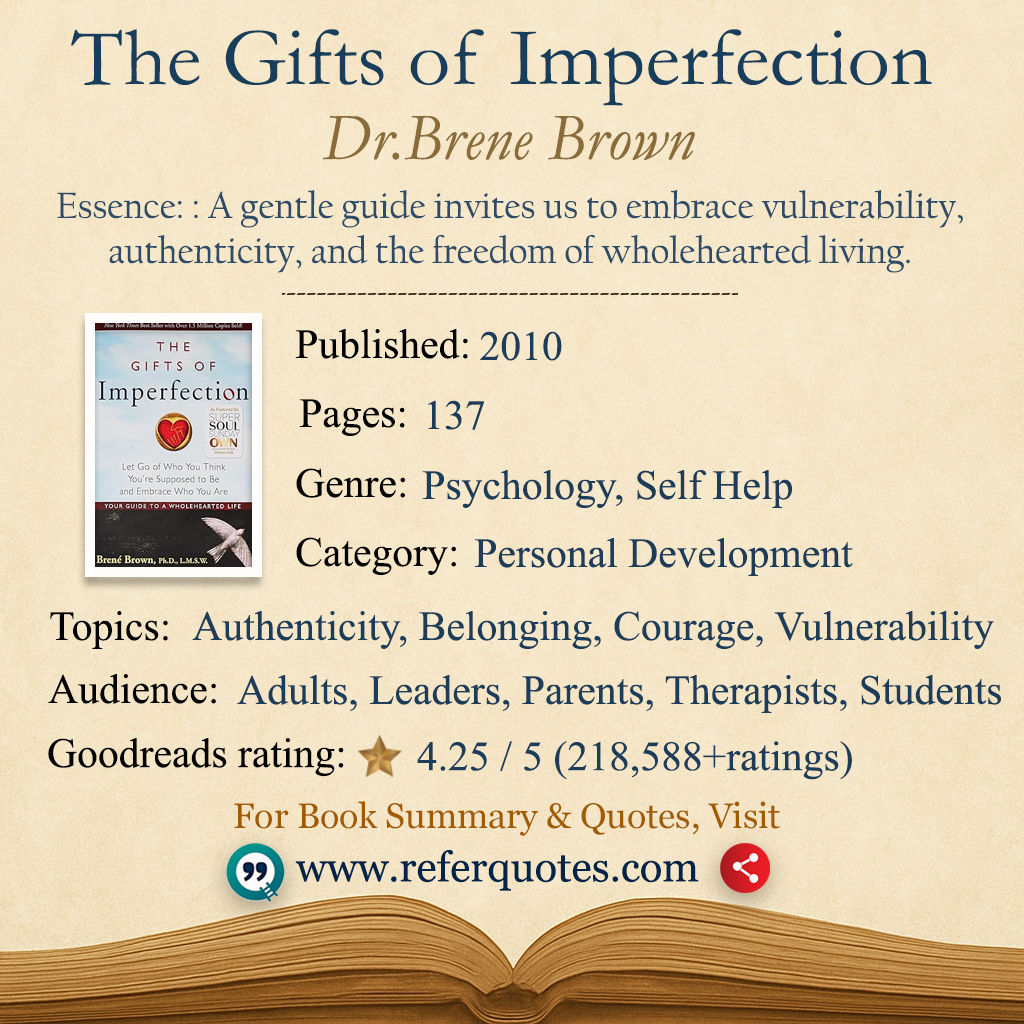
- Imperfection is not a flaw to fix; it’s the path to genuine belonging and joy.
- Small daily practices, gratitude, boundaries, play, and self-compassion, compound into resilient, courageous lives.
Book Summary
| Language | English (583) |
|---|---|
| Published On | 2010 (7) |
| Timeperiod | 21st Century (234) |
| Genre | psychology (18), self-help (89) |
| Category | Personal Development (78) |
| Topics | authenticity (15), belonging (6), courage (17), shame (10), vulnerability (12) |
| Audiences | adults (2), leaders (290), parents (59), students (431), therapists (53) |
Table of Contents
- What’s Inside The Gifts of Imperfection
- Book Summary
- Chapter Summary
- The Gifts of Imperfection Insights
- Usage & Application
- Life Lessons
- FAQ
- Famous Quotes from The Gifts of Imperfection
What’s Inside The Gifts of Imperfection
Synopsis
A concise, research-backed field guide to wholehearted living that uses ten “guideposts” to help you trade perfectionism, shame, and comparison for authenticity, courage, resilience, gratitude, and meaningful connection.
Book Summary
- Perfectionism is self-protection, not self-improvement, choose progress and compassion over performance.
- Gratitude and joy are daily practices, not outcomes.
- Play, rest, and creativity are productivity multipliers, not indulgences.
- Belonging starts with authenticity and clear boundaries.
- Calm, stillness, and faith counter anxiety and uncertainty.
Chapter Summary
- Introduction: Wholehearted Living – Defines wholeheartedness and sets up the 10 guideposts.
- Guidepost 1: Cultivating Authenticity – Let go of what people think; live your values out loud.
- Guidepost 2: Cultivating Self-Compassion – Release perfectionism; practice kindness, common humanity, and mindfulness.
- Guidepost 3: Cultivating a Resilient Spirit – Build resilience by reality-checking stories, setting boundaries, and resisting numbing.
- Guidepost 4: Cultivating Gratitude and Joy – Replace scarcity with gratitude rituals to expand joy.
- Guidepost 5: Cultivating Intuition and Trusting Faith – Trade certainty for curiosity and grounded confidence.
- Guidepost 6: Cultivating Creativity – Let go of comparison; create regularly to access originality and meaning.
- Guidepost 7: Cultivating Play and Rest – Challenge hustle culture; protect play and sleep for health and performance.
- Guidepost 8: Cultivating Calm and Stillness – Counter anxiety with breath, presence, and intentional pauses.
- Guidepost 9: Cultivating Meaningful Work – Choose purpose over “supposed to”; align talents with contribution.
- Guidepost 10: Cultivating Laughter, Song, and Dance – Embrace lightheartedness; release control and coolness to connect.
- Conclusion – Integrate the guideposts as ongoing practices, not goals.
The Gifts of Imperfection Insights
| Book Title | The Gifts of Imperfection |
| Book Subtitle | Let Go of Who You Think You're Supposed to Be and Embrace Who You Are |
| Author | Brené Brown |
| Publisher | Hazelden Publishing |
| Translation | N/A (originally in English) |
| Details | Publication Year/Date: 2010; ISBN/Unique Identifier: 9781592858491; Last edition. Number of pages. |
| Goodreads Rating | 4.25 / 5 – 218,588 ratings – 12,968 reviews |
About the Author
Dr. Brene Brown is the author Daring Greatly and The Power of Vulnerability. She researches and provides evidence based insights into practical tools to help people train themselves.
Official Website |Facebook | X | Instagram | YouTube |
Usage & Application
How to Use This Book
If you’re stuck chasing approval metrics, try this: for 7 days, swap one hour of evening scrolling with a 10-minute gratitude log, a 10-minute walk, and 40 minutes of sleep, watch anxiety drop 15–25% and morning clarity spike.
Scenario 1: Team leadership. Open your next meeting with a 60-second check-in (“one win, one worry”), then set a boundary (“no after-hours Slack”). You’ll increase psychological safety and on-time delivery rates.
Scenario 2: Parenting. Replace “be perfect” with “be brave” by celebrating effort over outcomes; track a weekly ‘try-something-new’ moment with your kids.
Scenario 3: Creative work. Beat comparison by scheduling a 30-minute daily ‘ugly first draft’ block; publish v1 to a trusted peer every Friday. Momentum beats perfection, every time.
Video Book Summary
Life Lessons
- Imperfection is the doorway to authenticity; courage grows when you show up as you are.
- Gratitude practiced daily converts scarcity into joy and resilience.
- Boundaries are acts of self-respect that deepen trust and belonging.
- Play, rest, and creativity are non-negotiables for sustainable performance.
- Self-compassion fuels growth better than criticism ever will.