
- Clarity of goals and consistent self-discipline drive outsized results.
- Habits, not willpower, determine long-term performance and confidence.
Book Summary
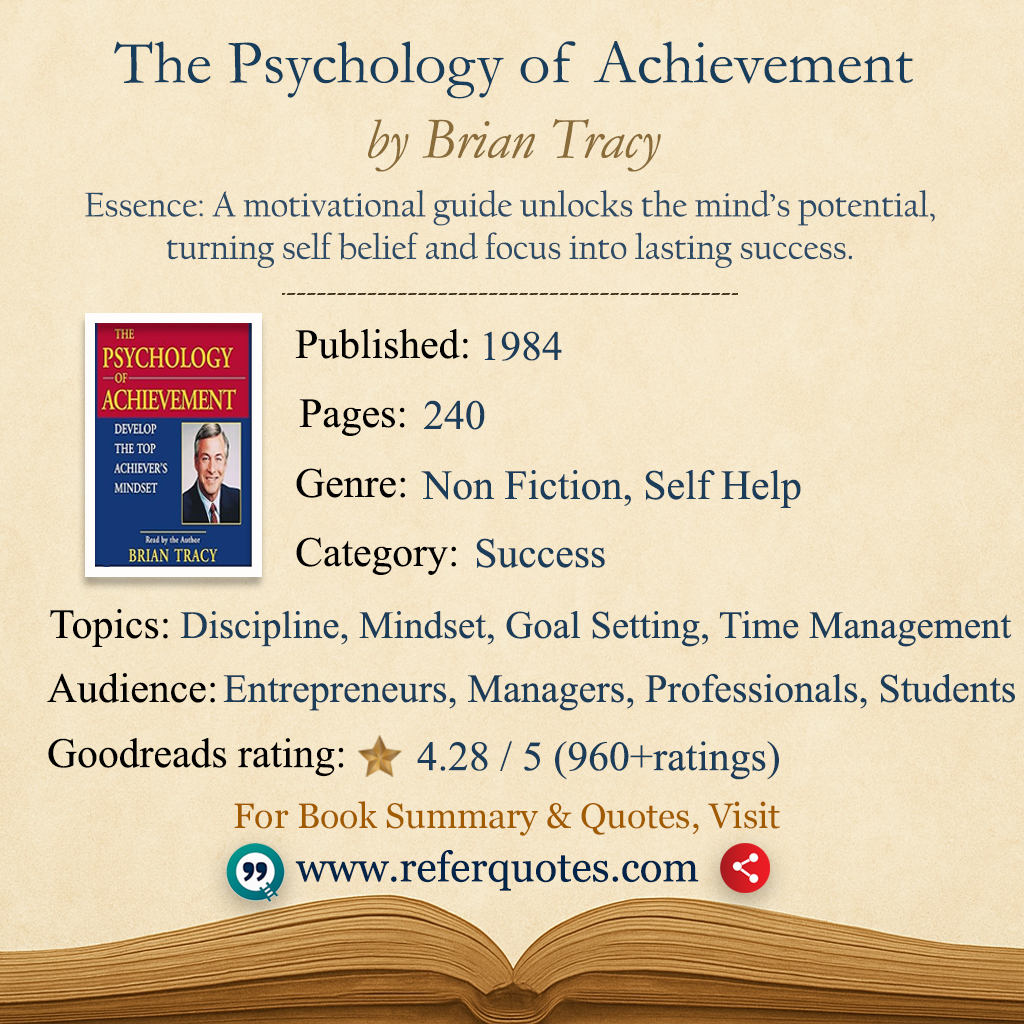
| Language | English (584) |
|---|---|
| Published On | 1984 (2) |
| Timeperiod | Contemporary (222) |
| Genre | nonfiction (88), self-help (89) |
| Category | Success (18) |
| Topics | discipline (30), goal-setting (2), mindset (42), self-esteem (2), time management (10) |
| Audiences | entrepreneurs (202), managers (142), professionals (131), salespeople (21), students (432) |
Table of Contents
- What’s Inside The Psychology of Achievement
- Book Summary
- Chapter Summary
- The Psychology of Achievement Insights
- Usage & Application
- Life Lessons
- FAQ
- Famous Quotes from The Psychology of Achievement
What’s Inside The Psychology of Achievement
Synopsis
A foundational personal-success program that teaches you how to clarify goals, rewire beliefs, build self-discipline, and execute consistently so you achieve more, faster, using proven psychological principles distilled into practical, repeatable habits.
Book Summary
- Clarity of goals plus written plans multiplies execution speed.
- Self-discipline is the “master skill” that unlocks all others.
- Upgrade your self-concept to raise performance ceilings.
- Leverage time with high-value priorities and batching.
- Persistence and continuous learning create compounding gains.
Chapter Summary
Chapter 1 – The Power of Purpose: Clarify what you truly want, purpose fuels motivation and direction.
Chapter 2 – The Master Mind Principle: Surround yourself with positive, goal-oriented people to multiply success.
Chapter 3 – Self-Concept and Confidence: Your achievements rise to the level of how you see yourself—build a winning self-image.
Chapter 4 – The Power of Goal Setting: Turn dreams into measurable, time-bound goals that guide consistent action.
Chapter 5 – The Power of Focus: Concentrate energy on high-value tasks and eliminate distractions that dilute progress.
Chapter 6 – Mastering Time Management: Plan priorities, not activities, time mastery equals life mastery.
Chapter 7 – The Habit of Self-Discipline: Do what must be done, whether you feel like it or not, discipline turns vision into reality.
Chapter 8 – The Power of Persistence: Success belongs to those who keep going when others quit, resilience conquers resistance.
Chapter 9 – Creativity and Problem Solving: Think flexibly; every obstacle hides an opportunity for innovation.
Chapter 10 – The Psychology of Success: Adopt a growth mindset, your thoughts shape your destiny.
The Psychology of Achievement Insights
| Book Title | The Psychology of Achievement |
| Author | Brian Tracy |
| Publisher | Nightingale-Conant |
| Translation | None (originally published in English) |
| Details | Publication Year/Date: 1984; ISBN: 978-1555251713; Last edition: Nightingale-Conant, Revised Audio Program 2002; Number of pages: Approx. 240 (based on transcripts). |
| Goodreads Rating | 4.28 / 5 – 960 ratings – 61 reviews |
About the Author
Brian Tracy is a motivational speaker, author, and business coach, written over 70 books and delivered thousands of seminars on success, leadership, sales, and personal achievement.
Official Website |Facebook | X | Instagram | YouTube |
Usage & Application
How to Use This Book
Here’s how to put this to work fast.
First, career pivot: write 10-year, 3-year, and 12-week goals, then force-rank your weekly tasks by revenue or role impact. Execute the top 20% first, watch your throughput jump 30–50% in 30 days.
Second, sales quota slump: script a daily 45-minute prospecting power hour, remove all distractions, and track dials-to-meetings. Most reps see a 2–3x pipeline bump within two weeks.
Third, founder overload: set a “no” list, batch email twice per day, and move 90-minute deep-work blocks onto your calendar. Expect 1–2 additional mission-critical tasks done per day. Keep score. Tracy’s method works because you change identity via habits, not motivation, then your results catch up.
Video Book Summary
Life Lessons
- Clarity precedes mastery: define precise targets before you optimize tactics.
- Discipline beats motivation: engineer routines that make the right action effortless.
- Your self-concept sets your ceiling: upgrade beliefs to unlock new behaviors.
- Time is a force multiplier: focus on high-value tasks and protect deep work.
- Consistency compounds: small, repeated wins create outsized long-term results.