
- Spiritual awakening often disrupts comfortable narratives.
- Owning your voice may cost acceptance, but wins freedom.
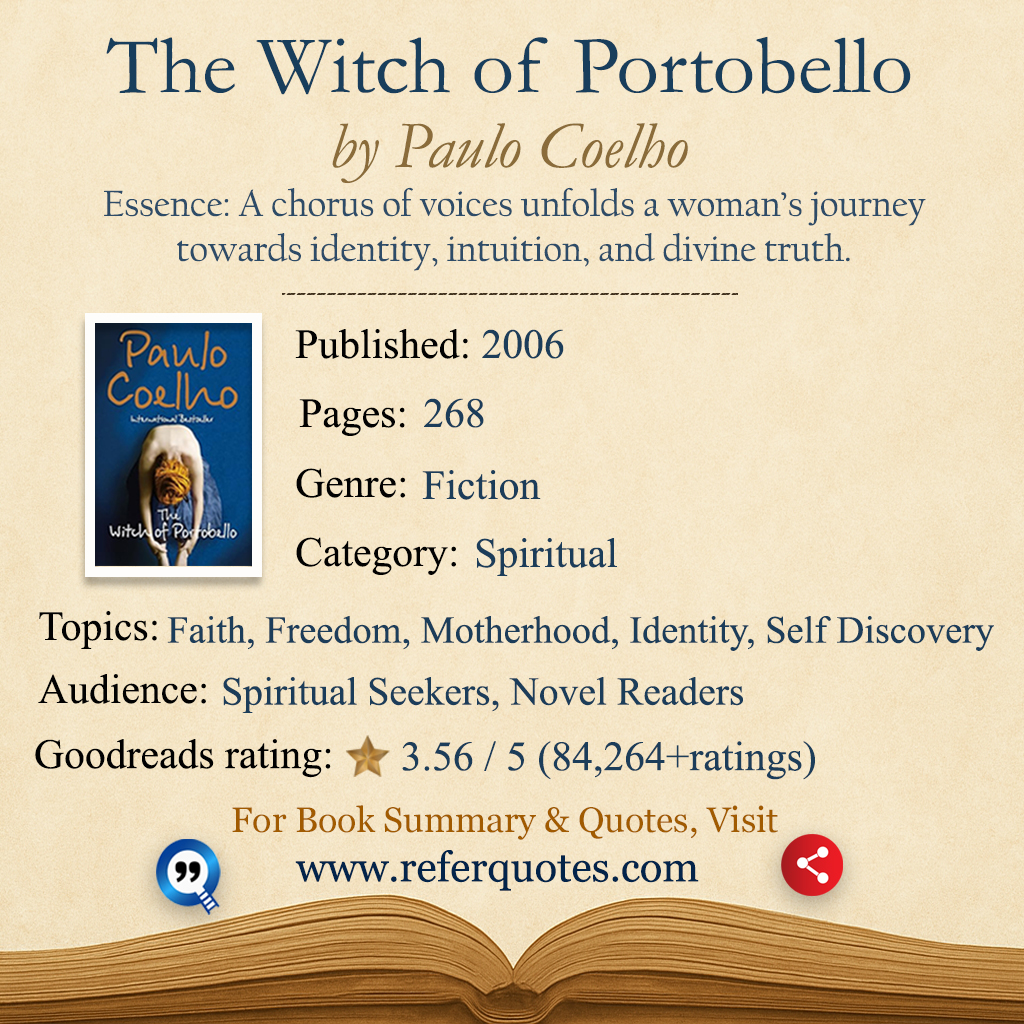
Book Summary
| Language | Portuguese (47) |
|---|---|
| Published On | 2006 (5) |
| Timeperiod | Contemporary (221) |
| Genre | fiction (6), magical realism (1) |
| Category | Spiritual (28) |
| Topics | faith (20), freedom (19), identity (13), motherhood (1), self-discovery (6) |
| Audiences | Book (14), novel readers (2), spiritual seekers (8) |
Table of Contents
- What’s Inside The Witch of Portobello
- Book Summary
- Chapter Summary
- The Witch of Portobello Insights
- Usage & Application
- Life Lessons
- FAQ
- Famous Quotes from The Witch of Portobello
What’s Inside The Witch of Portobello
Synopsis
Through interwoven testimonies, Coelho traces Athena’s journey from adopted child to controversial spiritual leader, exploring identity, the sacred feminine, and the cost of living authentically when society prefers conformity.
Book Summary
The Witch of Portobello book summary: Paulo Coelho’s novel unfolds as a dossier of testimonies about Athena, a woman whose quest for her origins leads to a profound spiritual awakening centered on the divine feminine. This book summary shows how Coelho explores truth, perception, and power by letting witnesses piece together Athena’s life. What does this book talk about? It examines identity, intuition, and the price of authenticity when personal revelation collides with social norms. Why is this book important? It reframes spirituality as embodied practice, dance, voice, presence, inviting you to trust intuition while questioning institutions.
Key takeaways:
- Your calling may be recognized first by others’ reactions, resistance is data.
- Truth-telling requires boundaries; discern when to speak and when to protect.
- Spiritual experience is relational: community can heal or harm.
- The sacred feminine challenges power structures by centering creation and care.
Chapter Summary
- Prologue: A compiler frames the dossier on Athena’s life.
- Testimony 1: Childhood and adoption plant the seeds of identity questions.
- Testimony 2: The search for her biological mother rekindles spiritual hunger.
- Testimony 3: Love, marriage, and motherhood expose restrictive roles.
- Testimony 4: Dance becomes a gateway to intuition and presence.
- Testimony 5: The “Mother” tradition and the sacred feminine teachings emerge.
- Testimony 6: Mentors guide, and sometimes misguide, Athena’s awakening.
- Testimony 7: Institutional pushback from religion and media intensifies.
- Testimony 8: A circle forms around Athena; devotion and jealousy collide.
- Testimony 9: Betrayal tests her message and community resilience.
- Testimony 10: Public controversy peaks on London’s Portobello Road.
- Epilogue: The compiler reveals the missing piece and Athena’s enduring impact.
The Witch of Portobello Insights
| Book Title | The Witch of Portobello |
| Author | Paulo Coelho |
| Publisher | HarperCollins (UK); HarperOne/HarperCollins (US) |
| Translation | Originally published in Portuguese as "A Bruxa de Portobello" (2006); English translation by Margaret Jull Costa (2007). |
| Details | Publication Year: 2006 (Brazil); ISBN: 978-0-06-133880-9; Latest Edition: HarperCollins 2007; 268 pages. |
| Goodreads Rating | 3.56 / 5 – 84,264 ratings – 4660 reviews |
About the Author
Paulo Coelho is a Brazilian novelist known for weaving spirituality and philosophy into stories that feel both magical and real. 165 million copies sold with readers in 80+ languages
Official Website |Facebook | Instagram | YouTube |
Usage & Application
How to Use This Book
If you feel stuck between who you are and who others expect you to be, use this book as a mirror.
Scenario 1: Career pivot, map your “inner signal” (skills + curiosity + energy) and test it with small 30-day projects. Share updates weekly with a trusted peer; track resonance (responses, opportunities) to decide whether to double down.
Scenario 2: Personal boundaries, list three situations where you silence your intuition; script one brave sentence for each and deploy it within 7 days. Measure results (clarity gained, conflicts avoided).
Scenario 3: Creative expression, commit to a daily 20-minute embodied practice (dance, walking, voice notes) to surface ideas; publish one insight each week to build community. The goal isn’t shock value, it’s calibrated authenticity that compounds confidence.
Video Book Summary
Life Lessons
- Authenticity has a cost; pay it consciously, not impulsively.
- Embodied practices (movement, breath, voice) unlock insight faster than overthinking.
- Communities amplify truth, or distort it, so choose your circle carefully.
- Institutions resist change; lead with example, not argument.
- Your origin story matters, but your chosen story defines you.