
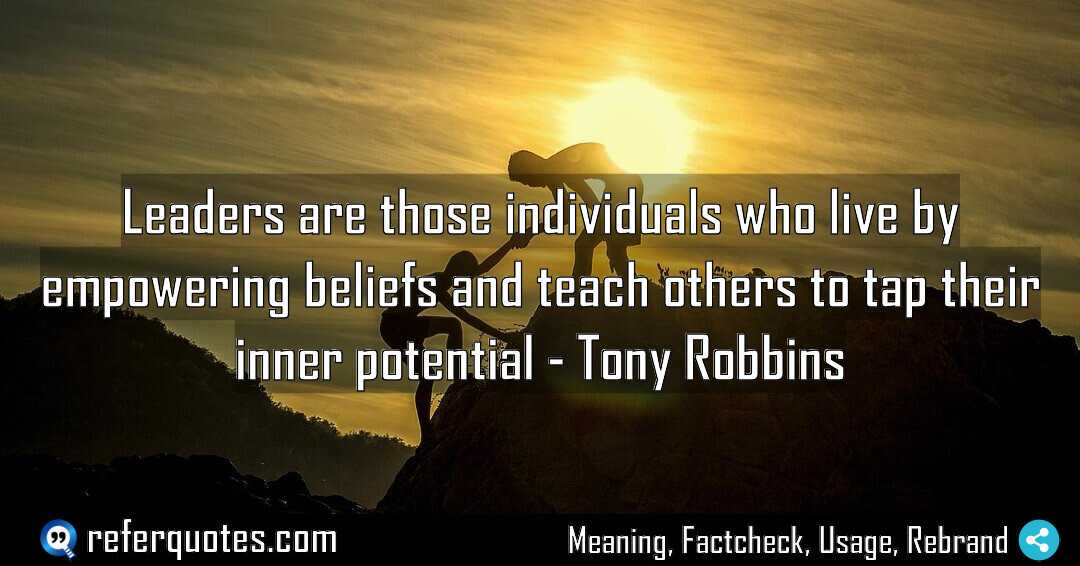
Find audience, FAQ, image, and book of quote-Leaders are those individuals who live by empowering beliefs and teach others to tap their inner potential.
It’s not about titles, it’s about a way of being. You have to embody the change before you can ever hope to inspire it in others.
Share Image Quote:Table of Contents
Meaning
True leadership is an inside job. It starts with your own belief system and radiates outward by activating potential in the people around you.
Explanation
Let me break this down from my own experience. The first part, live by empowering beliefs, is the non-negotiable foundation. You can’t fake this. If a leader is secretly operating from a place of fear or scarcity, it leaks out. It’s in their decisions, their language, their energy. The team feels it. So the real work is doing the internal cleanup, replacing those limiting beliefs with ones that are, as Tony says, empowering.
Then, the second part is the multiplier effect. Once you’re solid there, your role shifts from being the boss to being a catalyst. You’re not handing out potential, you’re teaching people how to tap into what’s already there. You see their capability before they do, and you reflect it back to them. It’s less about command and control, and more about creating an environment where people can surprise themselves with their own abilities.
Summary
| Category | Skill (89) |
|---|---|
| Topics | empowerment (7), leadership (45) |
| Style | motivational (25) |
| Mood | inspiring (47) |
Origin & Factcheck
| Author | Tony Robbins (11) |
|---|---|
| Book | Awaken the Giant Within: How to Take Immediate Control of Your Mental, Emotional, Physical and Financial Destiny! (2) |
About the Author
Tony Robbins started as Jim Rohn’s assistant, then built Robbins Research International. He writes on self-help, business, finance, and health, with several No. 1 bestsellers.
| Official Website | Facebook | X| Instagram | YouTube
Quotation Source:
| Leaders are those individuals who live by empowering beliefs and teach others to tap their inner potential |
| Publication Year: 1991; ISBN: 978-0-671-79154-8; Last edition: Simon & Schuster, 2013; Number of pages: 544. |
| Chapter: The Power of Identity, Approximate page from 2013 edition: 217 |
Context
In the book, this isn’t just a random line about leadership. It’s nestled in a much larger discussion about how we are all running on belief systems that dictate our results. He’s making the point that if you want to change your outer world, your team’s performance, your company’s culture, you have to start by upgrading your inner software. The chapter is literally about taking control of your life, and he positions leadership as a natural outcome of that process.
Usage Examples
First, think about a startup founder. Instead of micromanaging every task, she operates from the belief that this team is capable of brilliant, autonomous work. She then spends her time removing roadblocks and asking powerful questions that help her team tap into their own problem-solving skills. The result? Innovation and ownership.
Or a middle manager in a corporate setting. He’s stuck with a demotivated team. He can’t change the corporate policy, but he can change his own belief from “my hands are tied” to “I can create a pocket of excellence on my team.” He starts by acknowledging small wins and coaching his reports through challenges, which helps them reconnect with their own competence and drive.
This quote is really for anyone in a position to influence others, from CEOs and coaches to teachers and parents. It’s a lens for how you show up.
To whom it appeals?
| Audience | coaches (129), educators (33), leaders (295), managers (142), students (437) |
|---|---|
This quote can be used in following contexts: leadership workshops,motivational keynotes,team-building sessions,empowerment training
FAQ
Question: Isn’t this just positive thinking?
Answer: No. Positive thinking is a surface-level tactic. This is about core beliefs, which are the deep, often unconscious, rules your brain runs on. Changing a belief requires proof and consistent action, not just a happy thought.
Question: What if my team members don’t want to tap into their potential?
Answer: That’s a great question, and I’ve faced it. Often, it’s not that they don’t want to, it’s that they don’t believe they can. Your job as a leader is to create a safe environment for them to try, and maybe even fail, and to consistently see and reflect their strengths back to them until they start to believe it themselves.
Question: Can you really change your core beliefs?
Answer: Yes. It’s not always easy, but it’s possible. It’s the entire premise of cognitive behavioral therapy and much of Robbins’ work. You identify the disempowering belief, challenge its validity, and then consciously install a new, more empowering one through repetition and acting as if it were already true.