
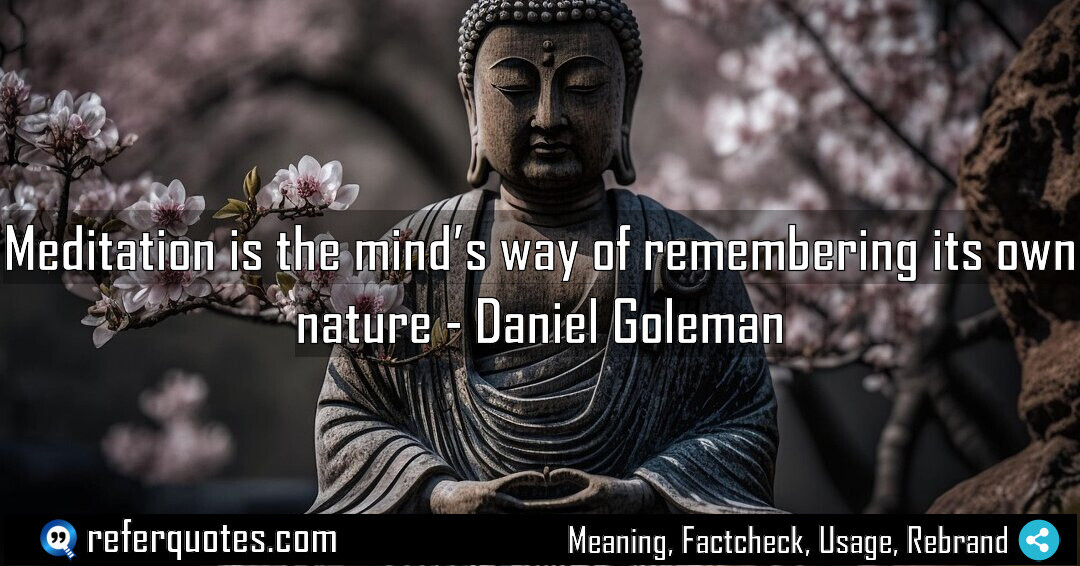
Find explanation, FAQ, author, and usage of quote-Meditation is the mind’s way of remembering its own nature.
It’s a powerful changing that change the goal from emptying your mind to rediscovering its fundamental clarity and peace. This perspective makes the practice feel less like a chore and more like a homecoming.
Share Image Quote:
Table of Contents
Meaning
This quote suggests that meditation isn’t about acquiring something new, but about uncovering what was already there. It’s a process of recollection, not collection.
Explanation
Okay, let me break this down. Think about your mind like a sky. Most of the time, it’s full of clouds, thoughts, worries, to-do lists, that song you can’t get out of your head. We get so identified with the clouds, we forget the sky itself is always there, vast and clear. Meditation, in this beautiful analogy, isn’t about fighting the clouds. It’s the process of sitting back and remembering the sky. You’re not trying to create peace, you’re allowing yourself to return to the innate peace that is your mind’s fundamental nature, which gets obscured by all the mental chatter. It’s a subtle but massive shift in intention.
Summary
| Category | Spiritual (29) |
|---|---|
| Style | poetic (50) |
| Mood | introspective (4), serene (8) |
Origin & Factcheck
Quotation Source:
| Meditation is the mind’s way of remembering its own nature |
| Publication Year/Date: 1977 (originally as The Varieties of Meditative Experience, revised 1988 as The Meditative Mind); ISBN: 9780874778335; Last Edition: Tarcher/Putnam 1988; Number of pages: 320. |
| Approximate page from 1988 edition, Chapter 7: Paths and Goals |
Context
Goleman wrote this after returning from India, where he immersed himself in various contemplative traditions. The book itself is a survey, comparing different meditative paths. This quote, then, is his distillation of the unifying principle behind them all. It’s not advocating one technique over another, but pointing to the common destination, self-recognition.
Usage Examples
- For the frustrated beginner: When someone says, “I can’t meditate, my mind is too busy,” this quote is the perfect response. It reassures them that the goal isn’t to stop thoughts, but to change their relationship to them.
- In a corporate wellness talk: You can frame it as a mental hygiene practice. We remember to shower and brush our teeth for our body; this is just the mind’s equivalent, a way to remember its baseline state of clarity.
- For personal motivation: On days when my practice feels dry, I come back to this. It reminds me I’m not performing a task, I’m engaging in an act of self-remembrance. It takes the pressure off.
To whom it appeals?
| Audience | leaders (295), seekers (47), students (437), teachers (193) |
|---|---|
This quote can be used in following contexts: motivational speeches,daily affirmations,spiritual workshops,self-reflection books
FAQ
Question: What exactly is the mind’s own nature that we’re remembering?
Answer: Great question. It’s often described as a state of innate awareness, clarity, and peace that exists before we add our stories, judgments, and constant commentary. It’s the conscious space in which thoughts appear, not the thoughts themselves.
Question: Isn’t this a very passive way to look at meditation?
Answer: It seems passive, but it’s actually deeply active. The work is in the gentle but consistent effort to dis-identify from the mental noise and rest in that underlying awareness. It’s like building a muscle, the muscle of attention.
Question: How is this different from just zoning out or daydreaming?
Answer: Crucial distinction. Daydreaming is getting lost in thought. This is about waking up from the daydream. It’s a meta-awareness, where you’re aware that you’re aware, even if thoughts are present.
Question: Can someone experience this without formal meditation?
Answer: Absolutely. Have you ever been completely absorbed in a moment, watching a sunset, holding a newborn, lost in a piece of music, and for a second, all internal chatter stopped? That’s a glimpse of it. Meditation is just the dedicated practice to cultivate that state intentionally.