
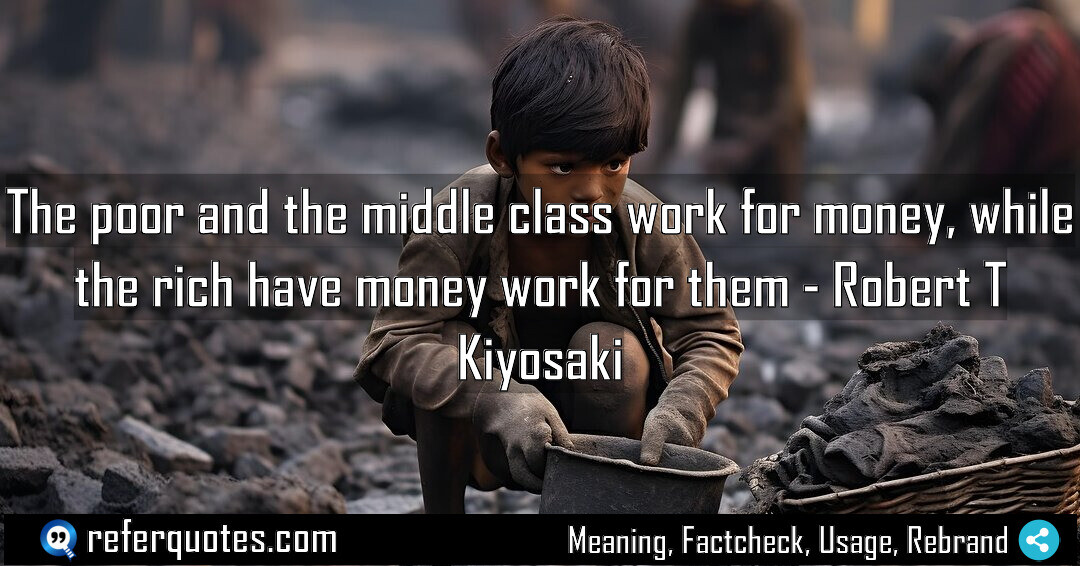
Find origin, book, author, FAQ, and summary of the quote – The poor and the middle class work for money, while the rich have money work for them.
This line may sound simple, but it quietly shifts how you see money and effort. It moves the focus away from how many hours you give and toward what your money is doing on its own. The real difference is not effort alone, but whether your income depends only on your time or continues to grow even when you step away.
Share Image Quote:Table of Contents
Meaning
It’s a fundamental distinction between two ways of thinking. One path relies on exchanging your hours and effort for a fixed paycheck. The other focuses on creating assets and systems that continues to earn for you, even when you are not actively working.
Explanation
Most of us grow up with a familiar path, like study well, find a stable job, work consistently and earn steadily. There is dignity in this path. Yet it ties income closely to time and effort. When the work stops, the income slows or stops too.
There is another way of thinking that unfolds slowly. It begins with a simple question. What can this money do once it comes to me. Instead of spending it fully, a part of it is guided into something that grows on its own. Gradually, these small choices begin to form quiet systems. Income starts to come not just from effort, but from what has already been built.
It is not about avoiding effort or stepping away from work. It is about evolving the role you play in the process. Instead of working time directly for money, you begin to design systems, investments, and decisions that influence how income is created and sustained.
Summary
| Category | Wealth (120) |
|---|---|
| Topics | money (27), work (3) |
| Style | didactic (54) |
| Mood | inspiring (47) |
Origin & Factcheck
This is straight from Robert Kiyosaki’s 2009 book, “The Business of the 21st Century.” It’s a core concept from his entire “Rich Dad” series. You’ll sometimes see it misattributed to other finance gurus, but the phrasing and the philosophy are pure Kiyosaki.
| Author | Robert T Kiyosaki (53) |
|---|---|
| Book | The Business of the 21st Century (26) |
About the Author
Robert T. Kiyosaki is an entrepreneur, investor, and author of the international bestselling personal finance books that has influenced millions, challenging views on money, and financial independence.
| Official Website | Facebook | X| Instagram | YouTube
Quotation Source:
| The poor and the middle class work for money, while the rich have money work for them |
| Publication Year/Date: 2010; ISBN/Unique Identifier: 9781612680796; Last edition: 2011; Number of pages: 160. |
| Chapter 4: The Power of Leverage, Approximate page from 2011 edition |
Context
This perspective is shared in Rich Dad Poor Dad by Robert Kiyosaki. He encourages readers to look beyond job security and begin building financial understanding. The focus shifts from relying on one income source to creating multiple streams that support you long term.
Usage Examples
- For the recent grad obsessed with their starting salary: Your first income is important, but the real difference is how you choose to use it. When you set aside even a small portion and put it to work through saving or investing, you begin building a habit that can shape your entire financial future./li>
- For the side-hustler burning out: Growth doesn’t always come from pushing harder. It comes from creating systems, habits, or assets that continue to produce results even when you step away.
- For anyone feeling stuck in the rat race: There is a path ahead that isn’t built on simply working longer hours. It starts with creating something small, nurturing it with consistency, and letting it expand beyond your direct effort.
To whom it appeals?
| Audience | entrepreneurs (204), investors (99), professionals (131), students (437) |
|---|---|
This quote can be used in following contexts: motivational seminars,personal finance blogs,financial education programs,career guidance workshops,success summits
FAQ
Question: Does this mean I should quit my job?
Answer: Not at all. Your job is often the starting point. It provides the income that helps you begin building something of your own.
Question: But isn’t this just for people who already have money?
Answer: It does not begin with results. It starts with a shift in how you think, repeated quietly each day. Small actions may look insignificant on their own, but when done consistently, they begin to reshape outcomes in a meaningful way
Question: What’s the first step?
Answer: Learn to see the difference between what grows your money and what slowly takes it away. This awareness changes everything. Once you can see the difference, your spending habits will change forever.