
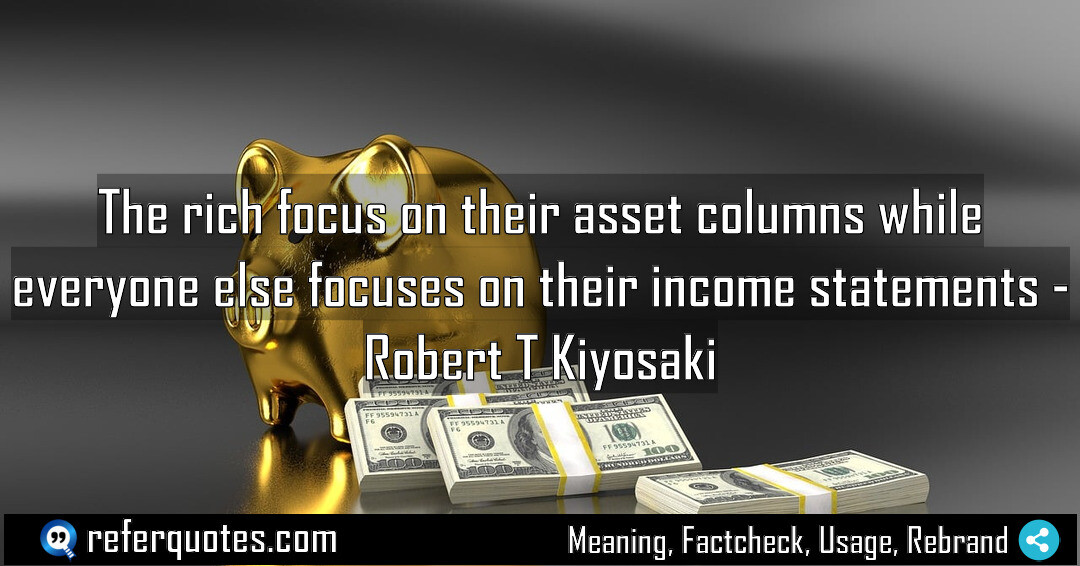
Find image, meaning, explanation, summary, and origin of the quote – The rich focus on their asset columns while everyone else focuses on their income statements.
It is a powerful distinction between how the wealthy and the middle class approach their finances. It’s not just about earning more, and about creating a system that steadily generates wealth on its own.
Share Image Quote:Table of Contents
Meaning
This quote teaches that true wealth grows from what you build, not just what you earn. It shows the difference between living on income and living from assets that continue to provide value in the longer term.
Explanation
Most people, when they get a raise, immediately increase their spending, a bigger house, and a nicer car. Their lifestyle inflates right along with their income statement. Comfort increases, but freedom does not.
The rich do something fundamentally different. They use their income to buy assets, things like cash-flowing real estate, dividend stocks, intellectual property, or a business that doesn’t require their direct presence. Their focus is not on having more to spend today. Their focus is on building something that will support them tomorrow. This is how financial freedom is created. The other becomes lighter with freedom. The difference is not luck. It is focus.
Summary
| Category | Wealth (120) |
|---|---|
| Topics | assets (9) |
| Style | analytical (18), clear (40) |
| Mood | rational (18) |
Origin & Factcheck
This quote comes directly from Robert T. Kiyosaki’s 1997 personal finance classic, Rich Dad Poor Dad. The book, which originated in the United States, is built on the contrasting financial philosophies of his two “dads”—his highly educated but financially struggling real father (Poor Dad) and the entrepreneurial father of his best friend (Rich Dad). It’s important to note that Kiyosaki has stated the “Rich Dad” character is a composite, a storytelling device to illustrate his principles, which has led to some debate about the literal truth of the anecdotes.
| Author | Robert T Kiyosaki (53) |
|---|---|
About the Author
Robert T. Kiyosaki is an entrepreneur, investor, and author of the international bestselling personal finance books that has influenced millions, challenging views on money, and financial independence.
| Official Website | Facebook | X| Instagram | YouTube
Quotation Source:
| The rich focus on their asset columns while everyone else focuses on their income statements |
| Publication Year/Date: 1997; ISBN/Unique Identifier: 978-1612680194; Last edition: 2022 Revised Edition, Number of pages: 336 |
| Chapter 3: Why Teach Financial Literacy, Approximate page from 2022 edition: 70 |
Context
This idea becomes the foundation of everything else. One father figure values salary and job security. The other believes safety comes from ownership. The story gently teaches that long term stability comes not from income alone, but from what you own that can grow without your daily effort.
Usage Examples
- For a young professional: Use part of your bonus or savings to invest instead of spending it all on comfort. Place part of it into investments that grow over time. You are planting seeds for your future.
- For a small business owner: Reinvest profits into systems or products that can generate income without your constant involvement. This turns your work into freedom long term.
- For anyone: When you want to buy something expensive, pause and ask if that same money could build something that gives back to you.
This quote is perfect for anyone feeling stuck in the rat race, for entrepreneurs, and for young people just starting their financial journey.
To whom it appeals?
| Audience | entrepreneurs (204), financial advisors (10), investors (99), students (437) |
|---|---|
This quote can be used in following contexts: business podcasts,investment seminars,financial workshops,money management blogs
FAQ
Question: What exactly counts as an “asset” in this context?
Answer: An asset is anything that puts money into your life. Investments that pay income. Property that creates cash flow. Creative work that earns royalties. A business that runs without your daily presence.
Question: But don’t you need a good income to build assets?
Answer: Income helps, but intention matters more. Even small amounts can build assets if used wisely. The habit is more important than the size.
Question: Is this advice still relevant today?
Answer: It is more relevant than ever. In uncertain times, assets create stability, choice, and resilience that no single income can provide.